Speak in business terms about cyber risk
Budget requests get questioned because security spend feels subjective. Build a financial case that ties vendor decisions to measurable risk reduction.

Black Kite's Cyber Risk Quantification (CRQ) translates technical cyber risk into financial terms, empowering you to justify security investments, communicate exposure to executives, and prioritize risks based on business impact.
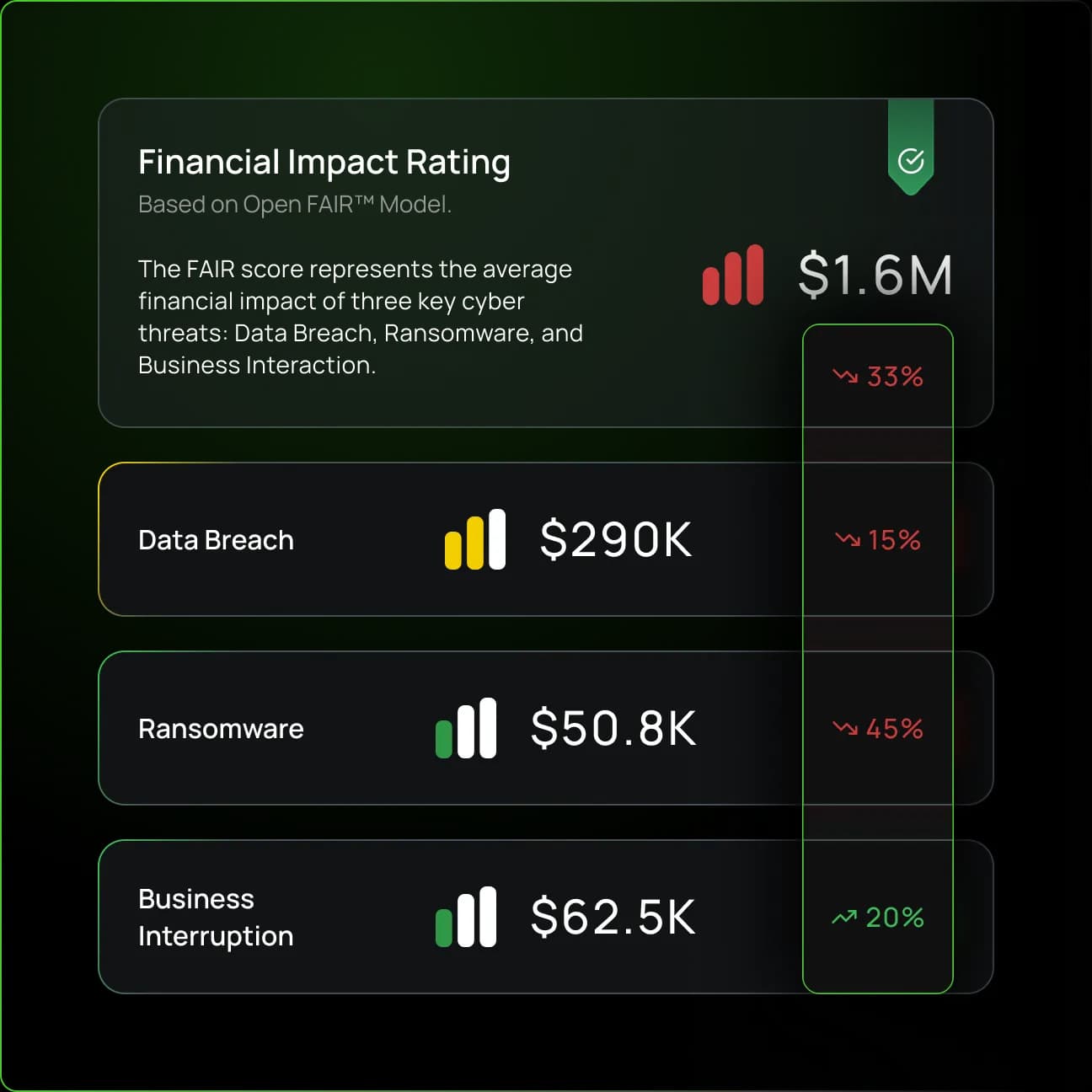
Security conversations stall when risk stays qualitative. Red-yellow-green heat maps don't answer the questions executives ask. "High risk" doesn't tell you whether a vendor relationship represents $100K or $1M in financial exposure. Vague risk labels make it impossible to prioritize vendors, justify budgets, or prove ROI.
Without financial quantification, cyber risk is a compliance exercise. With it, it becomes a business decision.
Cyber Risk Quantification (CRQ) translates the technical reality of your security posture into the financial language executives use to run the business. It's not theoretical. It's operational.
CRQ isn't a nice-to-have. It's what organizations turn to when qualitative risk management stops working. If any of this sounds familiar, you're ready for CRQ.
Leadership asks for ROI, and you can't defend spend without showing measurable risk reduction.
Heat maps and compliance scores don't answer that question.
You can't assess 500 vendors equally. You need to know which pose the most loss exposure.
SEC disclosure rules, audit requirements, and cyber insurance underwriting all demand financial risk data.
Insurers want loss financial exposure modeling, not questionnaires.
Cyber risk must integrate into the same risk register as operational, financial, and strategic risks.
Most cyber risk quantification platforms treat CRQ as an add-on or abstract exercise. Black Kite makes it operational, transparent, and ecosystem-driven.
Black Kite's CRQ models aren't fed by generic industry averages or static data. They're powered by live threat intelligence: what ransomware groups are targeting, which vulnerabilities are actively exploited, and how adversaries move through supply chains.
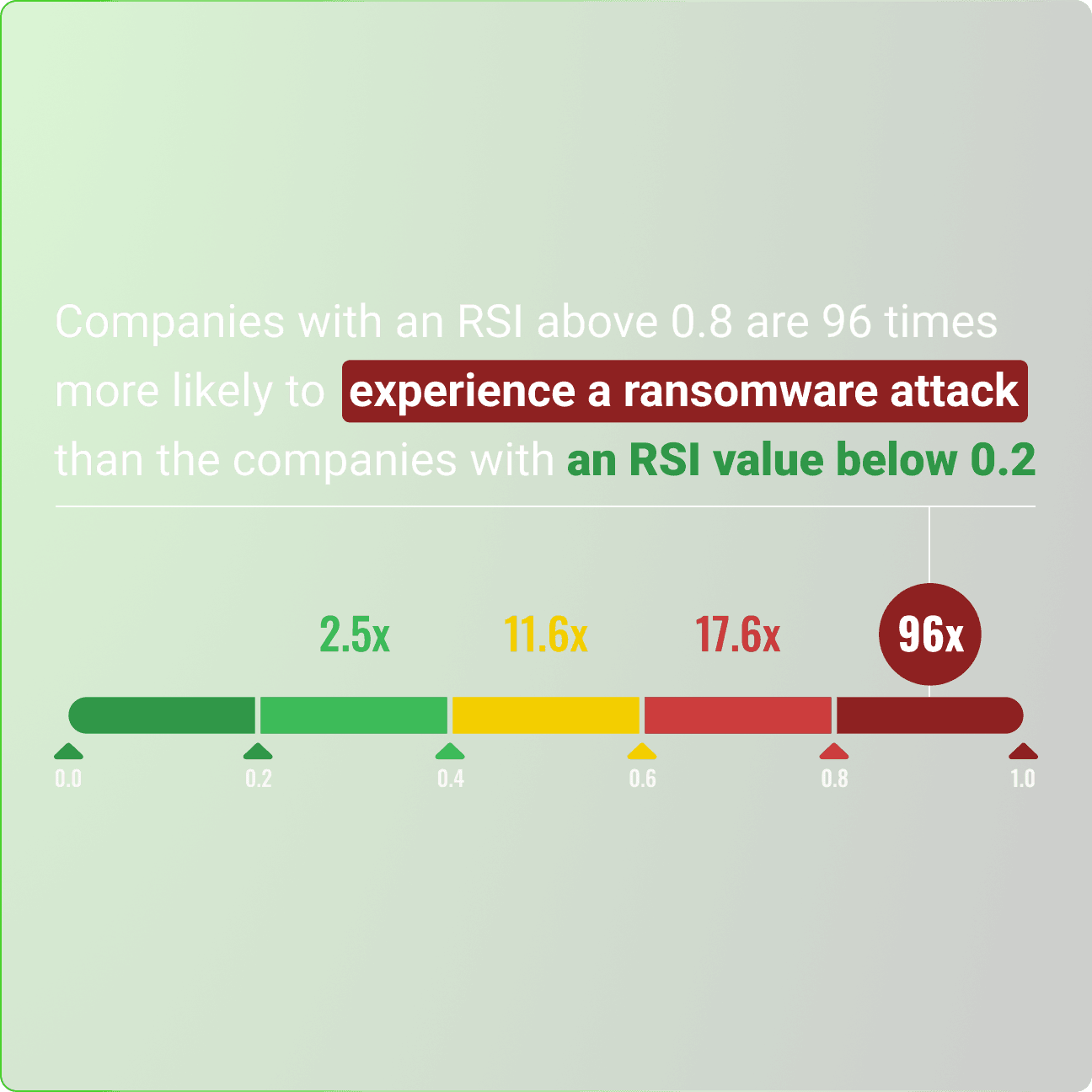
FocusTags® connect global threats to your specific ecosystem. When a new ransomware campaign emerges, you don't get an alert about the campaign. You see exactly which of your vendors are exposed, down to the asset level. The Ransomware Susceptibility Index® (RSI™) predicts vendor breach likelihood by comparing their digital footprint to patterns seen in real-world attacks.
This means your financial risk estimates reflect actual adversary behavior, not theoretical scenarios.
Black Kite quantifies financial risk across your entire third-party cyber ecosystem.
You can model financial exposure of third-party incidents: what happens when a critical vendor gets breached, and that breach flows downstream to your operations? What's the financial impact of concentration risk when five of your top vendors all rely on the same cloud provider?
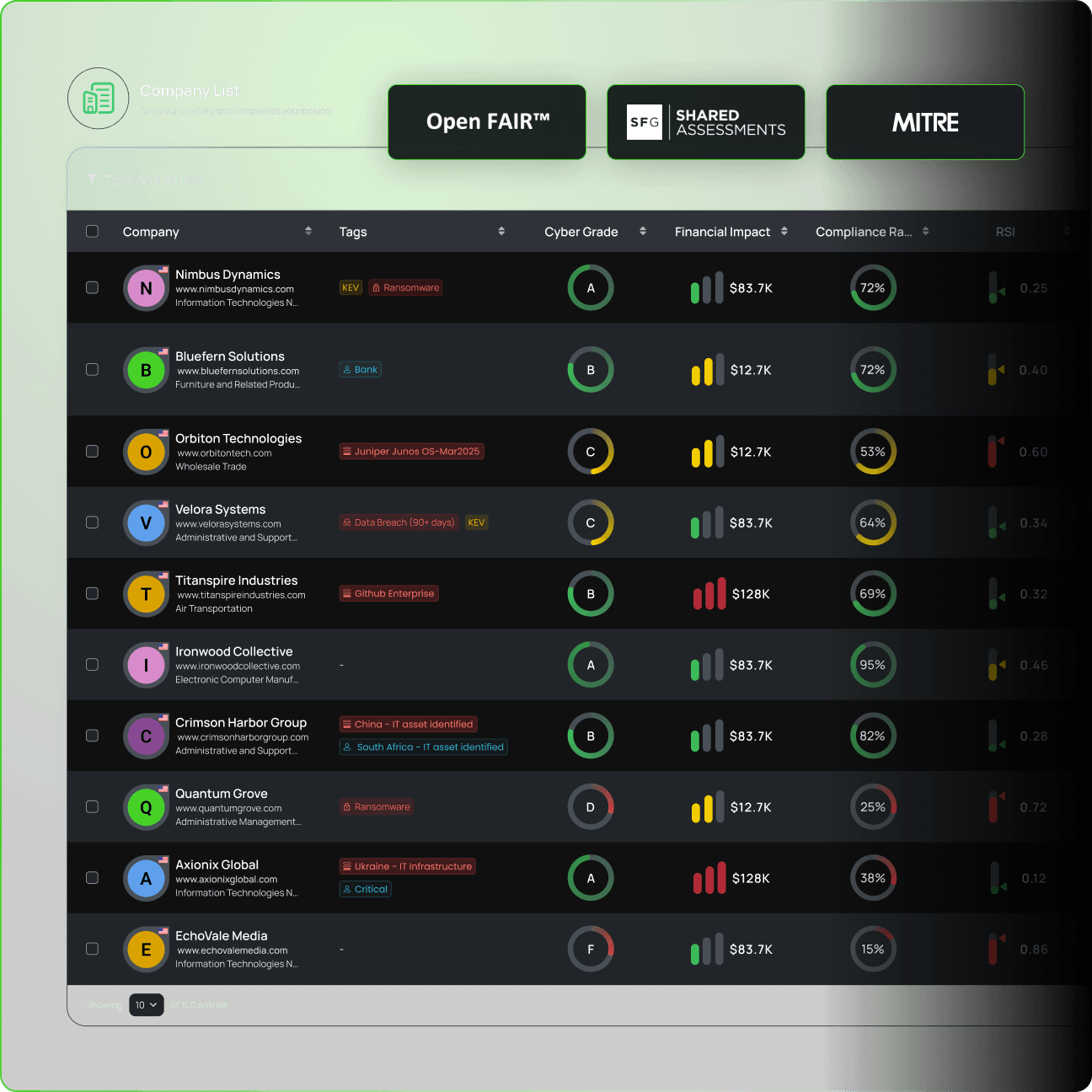
Black Kite’s CRQ is grounded in Open FAIR™. This means risk calculations are explainable. Auditors, regulators, and board members can validate the assumptions and understand how loss estimates are derived.
No proprietary scoring opacity. No "trust the algorithm." Just transparent, repeatable cyber risk measurement that holds up under scrutiny. When you present financial risk to the board or justify it to an insurer, the methodology is defensible. Get your free Open FAIR™ report.
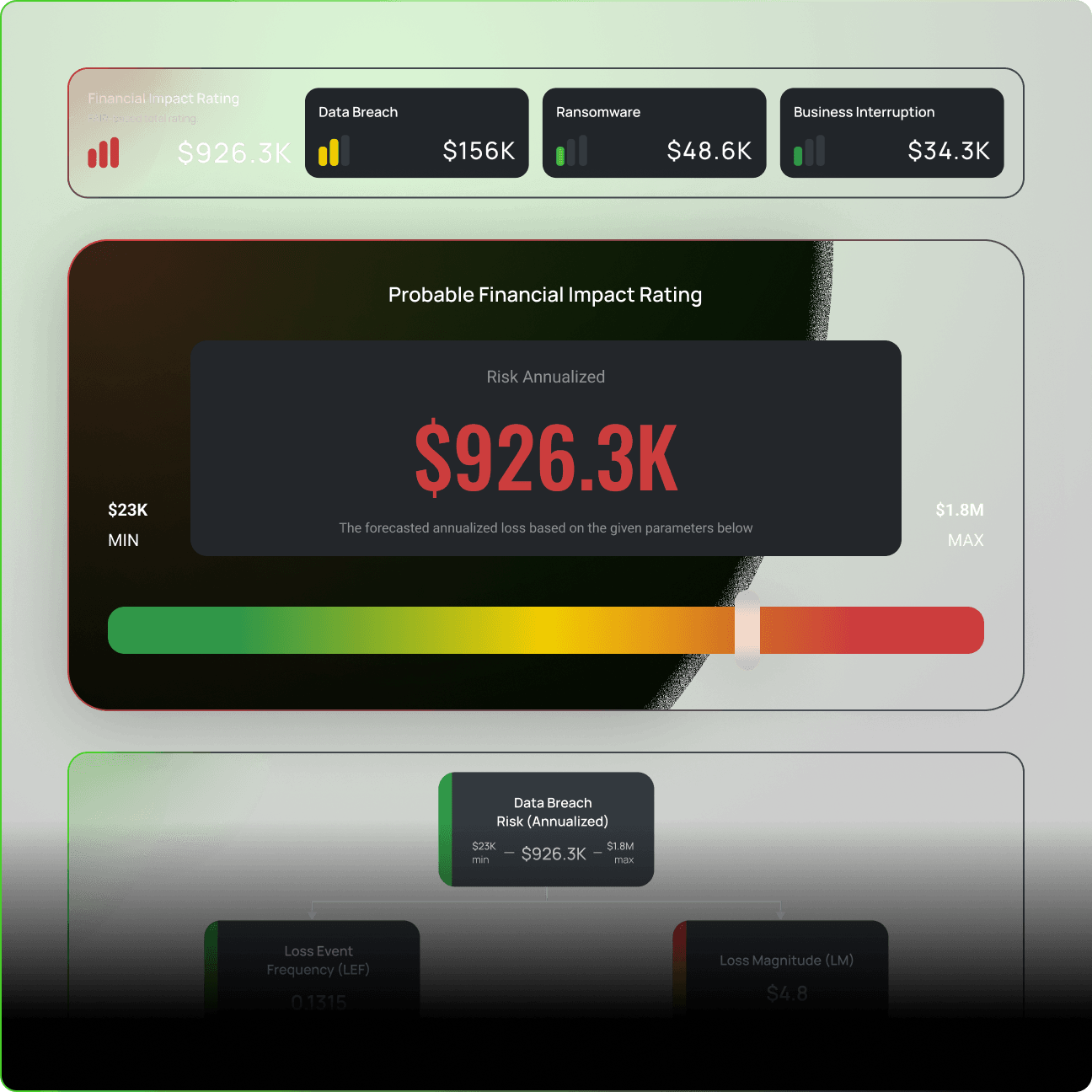
CRQ is about making better decisions faster.
Security ratings give you a snapshot into a vendor’s cybersecurity posture. Cyber risk quantification tells you what it costs if they get breached.
Traditional Security Ratings | Cyber Risk Quantification |
Proprietary scores (A–F, 0–100) | Financial loss estimates (annualized) |
Point-in-time snapshots | Continuous, intelligence-driven models |
Opaque, hard to defend | Standards-based, explainable |
Focuses on posture compliance | Focuses on business impact |
Limited third-party depth |
Black Kite's CRQ doesn't ask you to rip out your existing processes. It enhances them.