FOCUS FRIDAY: TPRM Insights on Critical Vulnerabilities in Citrix NetScaler, VMware vCenter, Zimbra, Oracle WebLogic, and Roundcube
Introduction
This week's Focus Friday covers five FocusTags® spanning remote access and VPN infrastructure, enterprise virtualization management, email and collaboration platforms, Java application servers, and webmail. Two of the five tags carry confirmed active exploitation in the wild — VMware vCenter with 361 documented victims across 47 countries within days of disclosure, and Zimbra with CERT Polska confirmation of active exploitation against unpatched instances.
The most operationally significant event is VMware vCenter's two-CVE attack chain: an authentication bypass in the VMware Directory Service combined with a directory traversal remote code execution vulnerability in the vCenter Syslog server, enabling unauthenticated full vCenter administrator access. Digital forensics evidence confirms attackers are deploying the reverse_ssh framework for persistent C2 communication following exploitation. Citrix NetScaler's pre-authentication RCE via SAML signature canonicalization — with a public proof-of-concept from watchTowr — rounds out the active exploitation picture alongside Zimbra's unauthenticated command injection. Oracle WebLogic's eight-CVE unauthenticated takeover cluster via T3 and IIOP and Roundcube's unassigned RCE and SSRF bypass vulnerabilities complete the week.
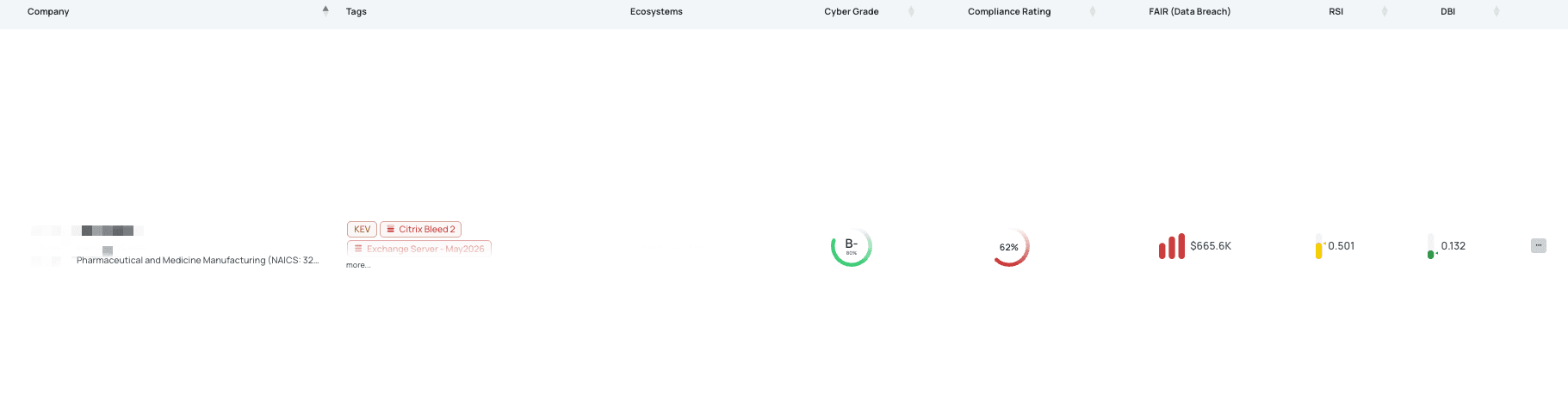
Filtered view of vendors with Citrix NetScaler - Aug2026 FocusTag® on the Black Kite platform.
Citrix NetScaler - Aug2026 (CVE-2026-8452)
What is this vulnerability?
CVE-2026-8452 (CVSS 9.8) is a critical pre-authentication remote code execution vulnerability in Citrix NetScaler ADC and NetScaler Gateway, addressed in Citrix security bulletin CTX696604. The flaw resides in the handling of SAML signature canonicalization: a memory overflow in the SAML processing code allows an unauthenticated remote attacker to trigger arbitrary code execution as root on the affected appliance. The vulnerability is configuration-dependent — it is only exploitable when the appliance is configured as a Gateway (SSL VPN, ICA Proxy, CVPN, or RDP Proxy) or as an AAA virtual server. Cloud Software Group initially rated the impact as denial-of-service only, but security research firm watchTowr published a working pre-authentication RCE proof-of-concept, confirming full code execution as root and significantly lowering the barrier to attack. The watchTowr PoC is publicly available on GitHub. No workarounds exist; patching is the only remediation.
NetScaler ADC and NetScaler Gateway are among the most widely deployed SSL VPN and remote access platforms globally, with tens of thousands of internet-accessible instances. Citrix devices have been high-priority targets for threat actors in recent years — CVE-2023-4966 (Citrix Bleed) and CVE-2023-3519 were both actively exploited and added to CISA's KEV catalog. The Gateway and AAA virtual server configurations affected by CVE-2026-8452 are precisely the internet-facing deployment modes most commonly in production use for enterprise remote access. Organizations should confirm the specific fixed version applicable to their NetScaler release branch via the CTX696604 bulletin and apply it immediately, treating the watchTowr PoC publication as equivalent to confirmed active exploitation risk.
Why should TPRM professionals care?
Citrix NetScaler Gateway and NetScaler ADC serve as the primary SSL VPN and remote access gateway for enterprise workforce connectivity — the internet-facing boundary between the public internet and the internal corporate network. Pre-authentication RCE on this device does not merely compromise the gateway itself: it places an attacker at the network boundary with root-level control over the device that manages VPN sessions, authentication flows, and network traffic routing for all remote users. From root on NetScaler, an attacker can intercept VPN session credentials, inject traffic, pivot to internal networks protected by the device, and potentially extract SSL private keys. The public watchTowr PoC eliminates the technical barrier that would otherwise slow exploitation — TPRM professionals should treat any vendor with an internet-facing NetScaler in the affected Gateway or AAA configuration as an immediate priority engagement regardless of CISA KEV status.
What questions should TPRM professionals ask vendors?
- Have you upgraded all instances of NetScaler ADC and NetScaler Gateway to versions 14.1-72.61, 13.1-63.18, or 13.1-37.272 (FIPS/NDcPP) or later to mitigate the risk of CVE-2026-8452?
- Can you confirm if your NetScaler appliances are configured as a Gateway (SSL VPN, ICA Proxy, CVPN, or RDP Proxy) or an AAA virtual server, which are the configurations exploitable by CVE-2026-8452?
- Have you implemented the recommended post-patch monitoring to review appliance logs and sessions for any signs of prior abuse related to CVE-2026-8452?
- Have you inspected your configuration for vulnerability dependencies, specifically checking whether a Gateway (SSL VPN, ICA Proxy, CVPN, or RDP Proxy) or AAA virtual server is configured, and prioritized patching those appliances?
Remediation recommendations
- Apply the CVE-2026-8452 patch for the installed NetScaler ADC or Gateway release branch immediately. Consult CTX696604 to identify the specific fixed version for each installed release. There are no workarounds — patching is the only complete remediation.
- Treat the watchTowr public PoC publication as equivalent to confirmed active exploitation for risk prioritization purposes. The published PoC demonstrates working pre-auth RCE as root — the practical exploitation barrier is removed. Escalate NetScaler patch deployment to emergency priority.
- Review NetScaler ADC and Gateway logs for anomalous pre-authentication SAML processing requests and unexpected root-level process activity. Citrix ADM can provide centralized log aggregation across NetScaler instances. Look for unusual HTTP/HTTPS requests to SAML authentication endpoints from external IPs.
- Rotate SSL VPN session tokens and user credentials for sessions established through unpatched NetScaler Gateway instances. If root compromise cannot be ruled out, treat private keys stored on the appliance as potentially compromised and initiate certificate rotation.
- Implement continuous NetScaler version monitoring through Citrix ADM or an external network discovery tool. Given the recurring critical vulnerability history of Citrix NetScaler products, automated patch compliance alerting for new CTX security bulletins is essential operational hygiene.
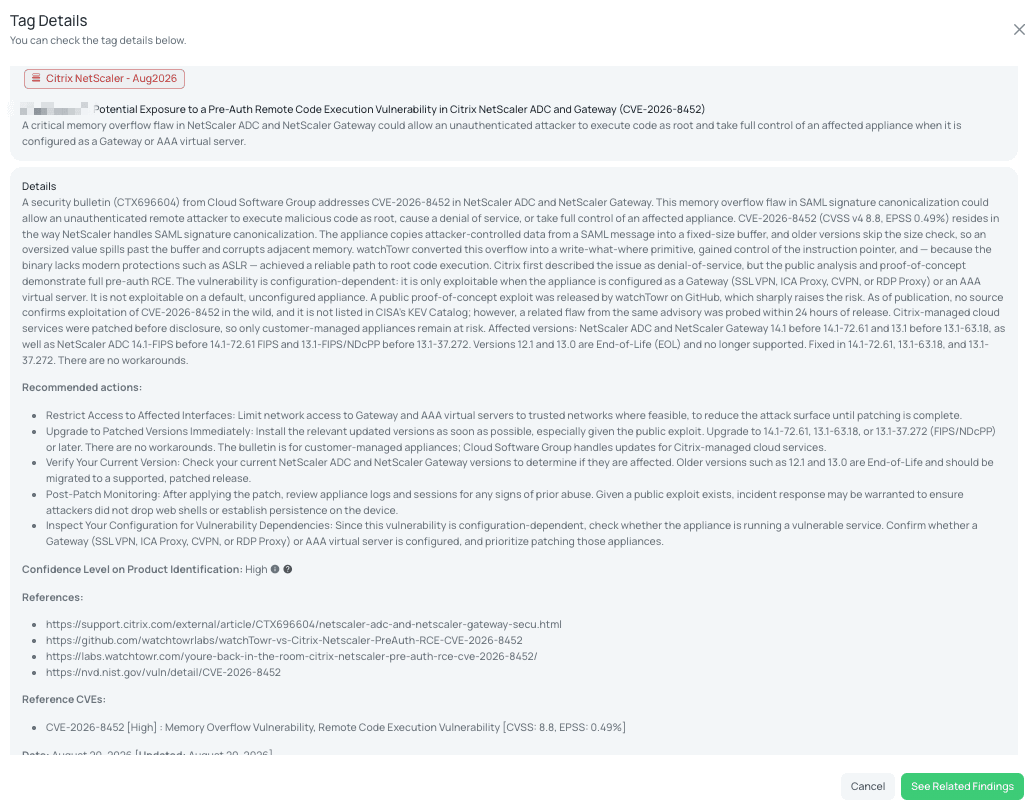
Black Kite's Citrix NetScaler - Aug2026 FocusTag® details critical insights on the event for TPRM professionals.
VMware vCenter - Aug2026 (CVE-2026-59309, CVE-2026-59310)
What is this vulnerability?
Broadcom disclosed two critical vulnerabilities in VMware vCenter Server on July 29, 2026 via security advisory VMSA-2026-0006, both carrying a CVSSv3 score of 9.8. CVE-2026-59309 is an authentication bypass vulnerability in the VMware Directory Service (vmdir): any network-accessible attacker can gain unauthorized access to vCenter without valid credentials, bypassing all authentication controls. CVE-2026-59310 is a directory traversal vulnerability in the vCenter Syslog server that enables unauthenticated arbitrary code execution on the vCenter host. Together these two vulnerabilities form a complete and catastrophic attack chain: CVE-2026-59309 provides unauthenticated entry into vCenter, and CVE-2026-59310 delivers arbitrary code execution — enabling full vCenter administrator takeover without any credentials. No workarounds or mitigations exist for either vulnerability. Fixed releases are available for vCenter 8.0, 9.0, and 9.1, as well as VMware Cloud Foundation, Telco Cloud Platform, and Telco Cloud Infrastructure.
CVE-2026-59310 is confirmed as actively exploited in the wild. Digital forensics firm QUIRSO documented 361 victim IP addresses across 47 countries — Germany, the United States, Turkey, Iran, and France among them — with 151 new victims appearing on August 4 alone, just five days after Broadcom's disclosure. The speed and geographic breadth of exploitation is consistent with automated scanning and exploitation infrastructure, with suspected APT actor involvement. Post-exploitation tradecraft documented by QUIRSO includes deployment of the reverse_ssh open-source framework, which provides an outbound C2 channel specifically designed to bypass firewalls and network security controls, establishing durable persistence within compromised vCenter environments. Security researchers also published analysis documenting the active reverse SSH backdoor deployment pattern.
Why should TPRM professionals care?
VMware vCenter is the centralized management plane governing virtual machines, ESXi servers, configurations, storage, networking, and access permissions across an organization's entire VMware virtual infrastructure. A successful vCenter compromise does not merely expose vCenter itself: an attacker with vCenter administrator access can snapshot and exfiltrate all VMs, modify ESXi host configurations, deploy malicious VMs across the infrastructure, disable security controls, and pivot to every system in the virtualized environment. The 361 confirmed victims within six days of disclosure — across 47 countries — represents one of the most rapid and broadly distributed exploitation events in recent memory. The deployment of reverse_ssh for persistence means compromised vCenter environments may retain attacker access even after patching if the backdoor is not detected and removed. TPRM professionals should treat any vendor with internet-accessible vCenter as an immediate priority for confirmed remediation and compromise assessment.
What questions should TPRM professionals ask vendors?
- Have you updated all instances of VMware vCenter to the fixed versions (9.1.0.0300 for vCenter 9.1.x.x, 9.0.2.0100 for vCenter 9.0.x.x, 8.0 U3k or 8.0 U2f for vCenter 8.0, and KB449886 for Telco Cloud Platform and Telco Cloud Infrastructure deployments) to mitigate the risk of CVE-2026-59309 and CVE-2026-59310?
- Can you confirm if you have deployed the QUIRSO YARA rule for
reverse_sshclient binary detection across all systems that have network connectivity to affected vCenter instances to detect potential exploitation of CVE-2026-59310? - Have you reviewed all vCenter administrator accounts for unauthorized additions or privilege changes, and reset all vCenter administrative credentials post-patching, as recommended in the advisory for CVE-2026-59309?
- Have you restricted network access to the vCenter management interface exclusively to authorized administrative hosts and networks using firewall rules or network segmentation, as an interim measure to reduce the attacker population for CVE-2026-59310 exploitation while patching is completed?
Remediation recommendations
- Apply the VMSA-2026-0006 patches for all vCenter Server versions and VMware Cloud Foundation deployments immediately. No workarounds exist — patching is the only complete remediation for both CVE-2026-59309 and CVE-2026-59310. Consult the Broadcom security advisory for version-specific patch packages.
- Immediately restrict network access to vCenter Server to trusted internal management networks. Remove any direct internet exposure. If vCenter must be accessed remotely, require VPN with strong authentication as the only access path. This is essential even after patching.
- Conduct forensic review of all vCenter instances for evidence of reverse_ssh deployment and compromise: check for reverse_ssh processes on vCenter hosts, review vCenter audit logs for unexpected authentication events or VM configuration changes, and analyze outbound network connections from vCenter management IPs. If compromise indicators are found, treat as an active incident requiring full incident response engagement.
- Rotate all vCenter administrative credentials, SSO administrator accounts, and service account credentials. If compromise cannot be ruled out: rotate VMware NSX, vSAN, and all credentials stored in vCenter credential stores. Review and revoke any API tokens or sessions established during the exposure window.
- Implement continuous monitoring for vCenter audit log anomalies, unexpected outbound connections from vCenter management hosts, and unauthorized VM operations (snapshot creation, export, configuration changes). Given the reverse_ssh post-exploitation pattern, network egress monitoring from vCenter management hosts should be treated as a mandatory ongoing control.
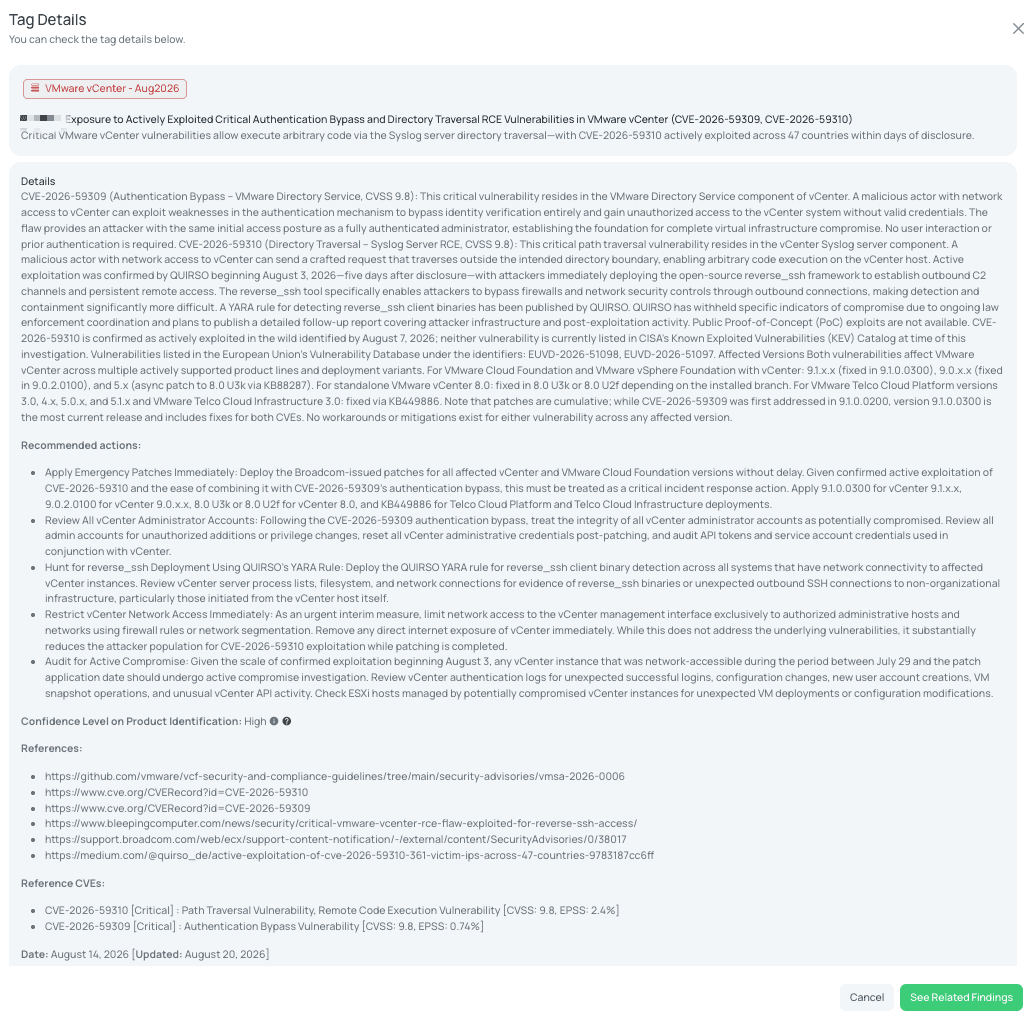
Black Kite's VMware vCenter - Aug2026 FocusTag® details critical insights on the event for TPRM professionals.
Zimbra - Aug2026 (CVE-2026-73570)
What is this vulnerability?
CVE-2026-73570 (CVSS 8.9, CWE-78) is a high-severity command injection vulnerability in Zimbra Collaboration Suite (ZCS) rooted in improper sanitization of untrusted input during SNMP notification processing. An unauthenticated attacker can submit specially crafted requests to a vulnerable Zimbra instance, causing the server to execute arbitrary OS commands with zimbra user privileges. The attack is conditional: it requires the optional zimbra-snmp package to be installed and SNMP notifications to be enabled, with the swatchdog service — enabled by default — playing a key role in the exploitation path. CERT Polska has confirmed active exploitation in the wild. The vulnerability corresponds to the command injection flaw patched in Zimbra 10.1.20, released July 20, 2026; CVE-2026-73570 is the formal CVE identifier now assigned to that fix. All Zimbra Collaboration versions prior to 10.1.20 are affected. No workarounds have been published; upgrade to Zimbra 10.1.20 or later is the only remediation.
Post-exploitation tradecraft documented by CERT Polska includes web shell deployment in Zimbra's Jetty webapps directories and mail data exfiltration, confirming that threat actors are moving rapidly from initial access to persistent, durable compromise of Zimbra mail infrastructure. The zimbra user account holds broad permissions across the Zimbra application stack — including access to all user mailboxes, authentication databases, TLS private keys, and application configuration files. Zimbra has a documented history of targeting by nation-state actors: prior vulnerabilities CVE-2023-37580 (XSS used for credential harvesting by APT groups) and CVE-2024-45519 (pre-auth RCE, actively exploited within two days of PoC release) both received CISA KEV listings following confirmed exploitation campaigns.
Why should TPRM professionals care?
Zimbra Collaboration Suite is enterprise email, calendar, and collaboration infrastructure — a platform that holds all organizational communication, including sensitive business correspondence, credentials shared via email, and internal coordination data. Unauthenticated OS command execution as the zimbra user provides direct access to the full mail store, authentication credentials, and TLS keys on the mail server. The post-exploitation deployment of web shells in Jetty webapps establishes persistent access that survives patching if not detected and removed. Zimbra is particularly common in government, educational, and emerging market enterprise deployments — sectors that frequently maintain older, unpatched instances. TPRM professionals should confirm that vendors with Zimbra deployments have both patched to 10.1.20 and conducted IoC review for pre-patch compromise, given CERT Polska's confirmed active exploitation data.
What questions should TPRM professionals ask vendors?
- Have you upgraded all instances of Zimbra Collaboration Suite to version 10.1.20 or later to mitigate the risk of CVE-2026-73570?
- Can you confirm if the optional
zimbra-snmppackage is installed and SNMP notifications are enabled in your Zimbra configuration, which could potentially activate the exploitation path of CVE-2026-73570? - Have you reviewed
/var/log/zimbra.logfor anomalous service status change entries and inspected files created by thezimbrauser in the past 30 days under Jetty webapps directories and/tmp, as recommended by CERT Polska for this vulnerability? - Have you rotated all Zimbra administrative credentials, mail account passwords, API tokens, and TLS private keys accessible to the
zimbrauser context, as a precautionary measure against potential exploitation of CVE-2026-73570?
Remediation recommendations
- Upgrade Zimbra Collaboration Suite to version 10.1.20 or later immediately. This is the only remediation for CVE-2026-73570. No workarounds have been published. CERT Polska's active exploitation confirmation makes this an emergency patching priority.
- If immediate upgrade is not possible: as a temporary partial mitigation, disable SNMP notifications and remove the zimbra-snmp package to eliminate the specific exploitation pathway for CVE-2026-73570. This is not a substitute for patching but reduces the attack surface while the upgrade is scheduled.
- Conduct forensic review of Zimbra Jetty webapps directories for unauthorized web shell files. Review zimbra user process history, mail server logs for anomalous mailbox access or bulk data exports, and outbound network connections from the Zimbra server for unexpected external communications. Any web shell discovery requires full incident response engagement.
- Rotate all Zimbra administrative credentials, TLS private keys, DKIM signing keys, and any secrets stored in Zimbra configuration for any instance running a vulnerable version with SNMP enabled. The zimbra user's access scope makes this rotation essential for preventing persistent attacker access using exfiltrated credentials.
- Implement monitoring for Zimbra Jetty webapps directory file integrity and zimbra user process activity. The documented post-exploitation tradecraft — web shell deployment in Jetty directories — provides a specific detection target for ongoing compromise monitoring. File integrity monitoring on Zimbra webapps paths should be treated as a mandatory ongoing control given the platform's sustained APT targeting history.
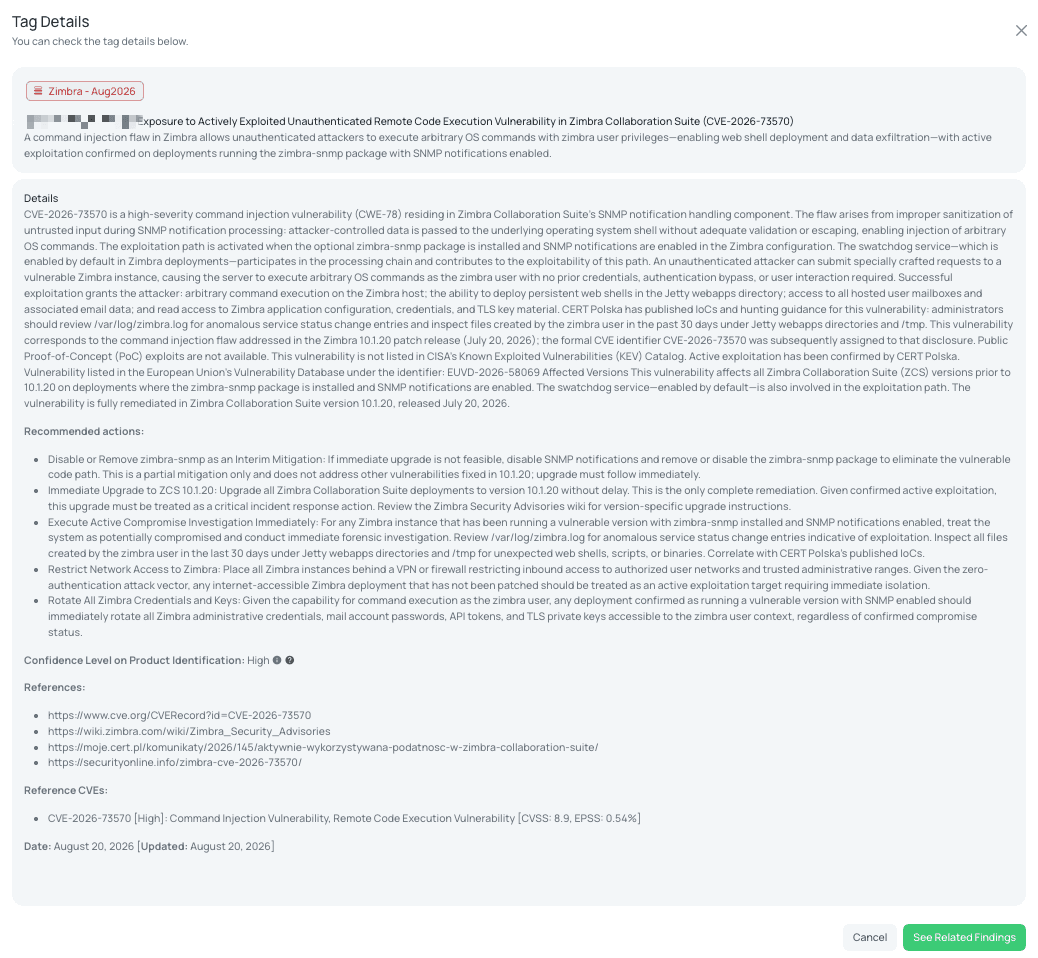
Black Kite's Zimbra - Aug2026 FocusTag® details critical insights on the event for TPRM professionals.
Oracle WebLogic - Aug2026 (CVE-2026-60702, CVE-2026-60698, CVE-2026-60977, CVE-2026-60672, CVE-2026-60696, CVE-2026-60699, CVE-2026-60680, CVE-2026-60415)
What is this vulnerability?
Oracle disclosed 8 vulnerabilities in Oracle WebLogic Server as part of its August 2026 Critical Patch Update (CPU), affecting the Core component of WebLogic Server in Oracle Fusion Middleware. Supported versions affected are 12.2.1.4.0, 14.1.1.0.0, 14.1.2.0.0, and 15.1.1.0.0. All 8 CVEs describe easily exploitable vulnerabilities that allow an unauthenticated attacker with network access via the T3 or IIOP protocols to fully compromise Oracle WebLogic Server. The highest-rated vulnerability is CVE-2026-60702 with a CVSSv3 Base Score of 9.9, which includes a scope change (Changed Scope) and confirms full confidentiality, integrity, and availability impact — meaning successful exploitation enables access to sensitive data, code execution, and potential lateral impact beyond the WebLogic server itself. The full cluster of 8 CVEs collectively enables server takeover through the T3 and IIOP protocol interfaces.
Oracle WebLogic Server's T3 and IIOP protocol interfaces are the historical attack vector for WebLogic deserialization exploits — a vulnerability class that has generated multiple CISA KEV entries over the past several years, including CVE-2020-14882, CVE-2021-2109, CVE-2023-21839, and CVE-2024-20931. WebLogic's T3 protocol is often internet-accessible in enterprise Java application server deployments by default on port 7001, and IIOP exposure is similarly common. Oracle's CPU advisory provides severity ratings and patching guidance; organizations should apply the July 2026 CPU or later to address all 8 CVEs. No public PoC or confirmed active exploitation was reported at time of disclosure.
Why should TPRM professionals care?
Oracle WebLogic Server is enterprise Java application infrastructure — a platform commonly deployed as the runtime for business-critical Java EE applications, including ERP backends, financial systems, and enterprise middleware. Its T3 and IIOP interfaces, historically used for Java object serialization and remote method invocation, have generated more CVE entries than any other single attack surface in Oracle's Fusion Middleware stack. Eight simultaneous unauthenticated takeover vulnerabilities in a single CPU cycle — with the highest CVSS score at 9.9 including a scope change — represents one of the most severe WebLogic patch events in recent years. The scope change in CVE-2026-60702 indicates that impact reaches beyond the WebLogic server process itself to connected systems and data. TPRM professionals should confirm Oracle CPU patch application, validate T3/IIOP exposure status, and identify any internet-accessible WebLogic instances.
What questions should TPRM professionals ask vendors?
- Have you applied the August 2026 Critical Patch Update for Oracle WebLogic Server to address CVE-2026-60702, CVE-2026-60698, CVE-2026-60977, CVE-2026-60672, and CVE-2026-60696?
- Have you disabled the T3 and IIOP protocols or restricted them to trusted IP addresses using a connection filter (
weblogic.security.net.ConnectionFilterImpl) to mitigate the risk of these vulnerabilities? - Can you confirm that strong access controls, including multi-factor authentication (MFA) for administrative functions, have been enforced to reduce the risk associated with CVE-2026-60702?
- Have you ensured that the WebLogic process user operates with minimal filesystem and network privileges to limit the impact of a potential compromise?
Remediation recommendations
- Apply the Oracle August 2026 Critical Patch Update to all affected WebLogic Server versions (12.2.1.4.0, 14.1.1.0.0, 14.1.2.0.0, 15.1.1.0.0) immediately. Download the CPU patch from My Oracle Support and follow Oracle's patching documentation for the installed version. Verify successful patch application via the Oracle WebLogic patch verification utility.
- Restrict T3 and IIOP protocol access to trusted internal networks immediately as a compensating control pending CPU patch application. Block port 7001 (T3/IIOP) from untrusted networks at the firewall or network layer. This eliminates the network-accessible exploitation path for all 8 CVEs without affecting application functionality for authorized internal users.
- Audit all WebLogic instances for internet-accessible T3/IIOP or admin console interfaces. Any internet-facing WebLogic management port should be treated as an immediate remediation priority given the historical active exploitation of WebLogic deserialization vulnerabilities via T3.
- Establish or validate a quarterly Oracle CPU patch cadence for all WebLogic Server deployments. Oracle CPUs are released quarterly and WebLogic's T3/IIOP deserialization surface generates critical vulnerabilities in the majority of CPU cycles — a reactive patch approach creates prolonged exposure windows.
- Review WebLogic server logs for anomalous T3 or IIOP connection activity from untrusted IP addresses during the pre-patch exposure window. Prior WebLogic T3 exploitation patterns involve establishing a T3 connection followed by sending a crafted serialized Java object — review for unexpected T3 session establishment from external or unfamiliar IP ranges.
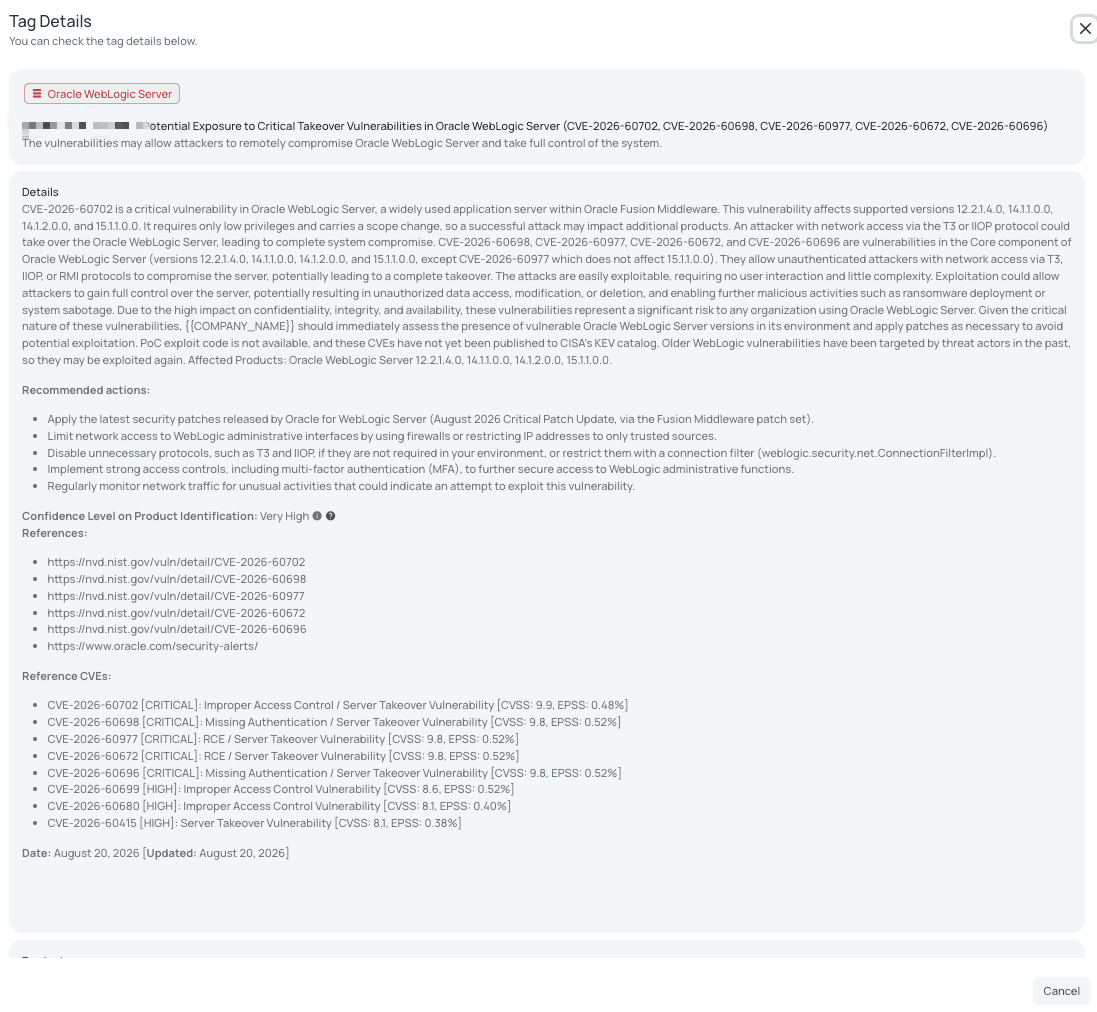
Black Kite's Oracle WebLogic - Aug2026 FocusTag® details critical insights on the event for TPRM professionals.
Roundcube - Aug2026
What is this vulnerability?
The Roundcube development team released security updates 1.6.18 and 1.7.3 on August 9, 2026, addressing eleven separate security bugs including three primary high-severity vulnerabilities. No CVE identifiers have been assigned at time of disclosure. The most severe is a remote code execution vulnerability (estimated CVSS 8.8) in the cmd_learn driver of the markasjunk spam-training plugin. Roundcube's markasjunk plugin supports multiple spam-training backends, including the cmd_learn driver which passes user-controlled input to system commands as part of its spam classification workflow. Insufficient input validation in this driver enables an attacker to trigger arbitrary code execution on the Roundcube mail server. Two additional Server-Side Request Forgery bypass vulnerabilities (estimated CVSS 7.5 each) bypass Roundcube's is_local_url() protection function through reserved address ranges (100.64.0.0/10 and the IPv6 link-local range fe80::/10) and through DNS rebinding hostnames (nip.io and sslip.io), enabling requests to reach internal network services shielded from external access.
The eleven bugs addressed in these releases also include LDAP filter injection, Sieve script injection, IMAP command injection, and stored XSS in the address book. No active exploitation or public proof-of-concept has been confirmed at time of disclosure. The affected versions are Roundcube Webmail 1.6.x prior to 1.6.18 and 1.7.x prior to 1.7.3. Roundcube is one of the most widely deployed open-source webmail platforms globally, used extensively by hosting providers, government agencies, educational institutions, and enterprises. Its internet-accessible deployment model — serving as a browser-based webmail interface — means the attack surface is broadly reachable from external networks.
Why should TPRM professionals care?
Roundcube mail servers occupy a privileged network position as the webmail interface for organizational email — holding direct access to all user mailboxes, IMAP server credentials, and sensitive business communications. An attacker achieving RCE on the Roundcube server gains the same operational foothold as a compromised mail server: access to email archives, credential harvesting from stored sessions, lateral movement into internal mail infrastructure, and the ability to read, modify, or exfiltrate any organizational email. The markasjunk plugin's command execution driver represents a direct and reliable code execution path — spam-training plugins routinely invoke system utilities as part of their classification workflow, making command injection in these drivers particularly impactful. Roundcube has a prior CISA KEV history: CVE-2023-43770 (link injection leading to XSS) was exploited by an advanced threat actor to target government organizations. The SSRF bypass vulnerabilities further enable internal network reconnaissance — accessing cloud metadata APIs, internal admin interfaces, and database services not intended to be externally reachable.
What questions should TPRM professionals ask vendors?
- Have you updated all instances of Roundcube Webmail to versions 1.6.18 or 1.7.3 to mitigate the risk of the RCE vulnerability in the
markasjunkplugin and the SSRF vulnerabilities involving reserved IP ranges and DNS rebinding hostnames? - Can you confirm whether the
markasjunkplugin has been disabled in the Roundcube configuration to eliminate the RCE attack surface if immediate patching was not feasible? - Have you implemented network-level egress controls on the Roundcube server to block unexpected outbound HTTP connections to internal IP ranges, including RFC 1918 addresses,
100.64.0.0/10, and link-local ranges, as a defense-in-depth measure against the SSRF vulnerabilities? - Have you reviewed Roundcube access logs and mail server logs for anomalous requests to
markasjunkplugin endpoints, unexpected outbound HTTP connections to internal network addresses, unusual LDAP query patterns, or suspicious Sieve script modifications that may indicate exploitation of the vulnerabilities addressed in this release?
Remediation recommendations
- Upgrade Roundcube Webmail to 1.6.18 or 1.7.3 immediately. These releases address the RCE vulnerability, both SSRF bypass flaws, and eight additional security bugs. Download from the official Roundcube GitHub releases page and follow the Roundcube upgrade guide for the installed version.
- If the markasjunk plugin is installed with the cmd_learn driver: disable or reconfigure the driver as an immediate compensating control pending the upgrade. Switching markasjunk to a non-command-executing spam-training backend (such as IMAP-based learning) eliminates the RCE attack vector while patching is scheduled.
- Implement WAF rules or reverse proxy filters to detect and block SSRF attempts targeting reserved address ranges (100.64.0.0/10, fe80::/10) and DNS rebinding hostnames (nip.io, sslip.io patterns). These SSRF bypass techniques are systematically applicable and can be filtered at the perimeter regardless of patch status.
- Review Roundcube server logs for anomalous outbound HTTP connections, unexpected process activity, and markasjunk plugin invocations. Correlate with web access logs for unusual requests to Roundcube mail-training endpoints. While no active exploitation is confirmed, the plugin-based RCE path may be exploitable without leaving obvious server-level artifacts before code execution occurs.
- Apply Roundcube security updates as a standard practice for future releases. Roundcube security updates are released as point versions (1.6.x, 1.7.x) on a periodic basis — establish a patching cadence that ensures new releases are evaluated and applied within 72 hours of release given Roundcube's prior exploitation history and government/enterprise targeting profile.
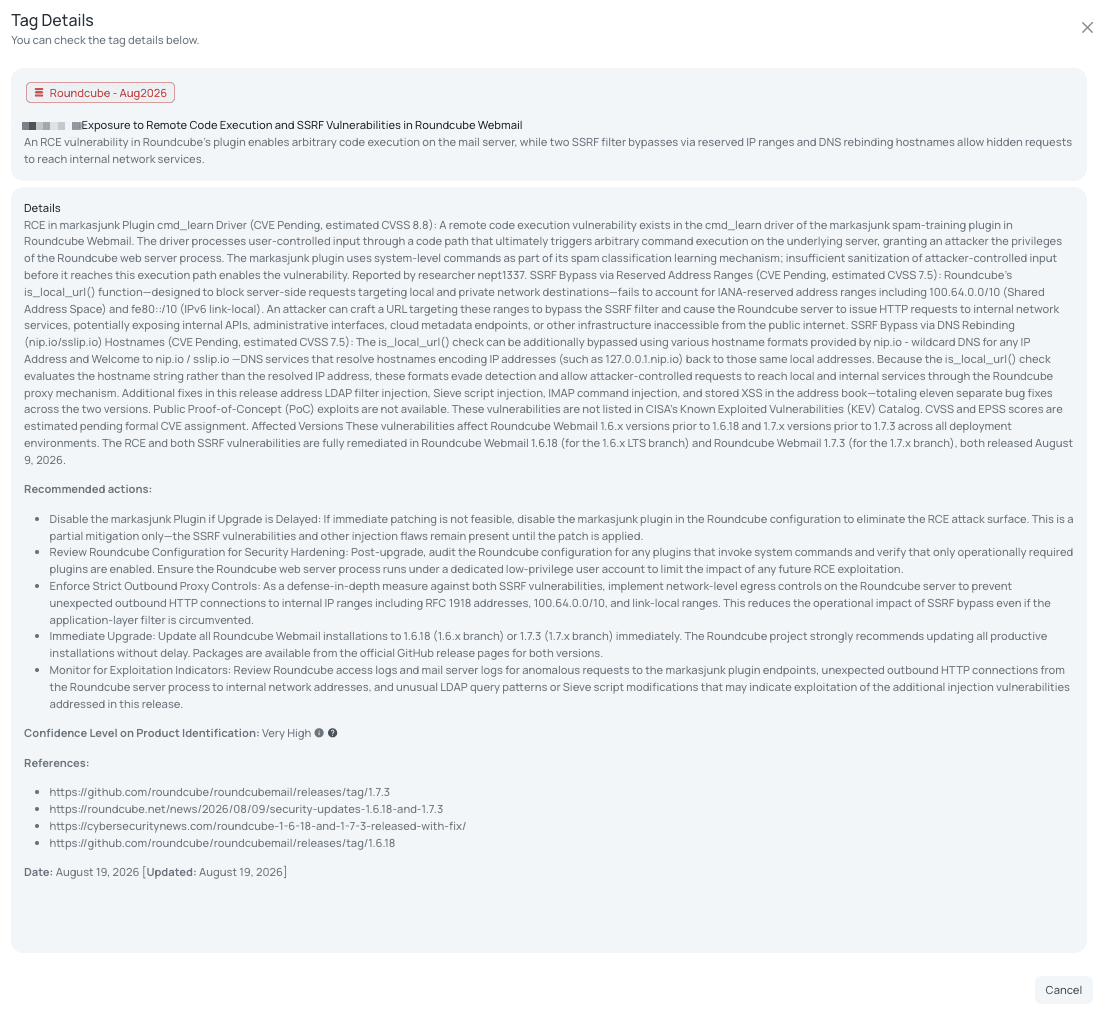
Black Kite's Roundcube - Aug2026 FocusTag® details critical insights on the event for TPRM professionals.
How TPRM Professionals Can Leverage Black Kite for These Vulnerabilities
This week's five FocusTags® span remote access infrastructure, virtualization management, email platforms, application servers, and webmail — five different technology categories, each representing a distinct third-party risk exposure class. Two of the five carry confirmed active exploitation with documented victim counts, one carries a public proof-of-concept that removes all technical exploitation barriers, and two represent high-severity vulnerabilities requiring version-specific patch confirmation. The week illustrates a consistent theme: the highest-value targets for threat actors are the platforms that manage other systems — vCenter managing all VMs, NetScaler managing all VPN sessions, Zimbra managing all organizational email.
The VMware vCenter exploitation event demonstrates why TPRM programs must extend beyond CVE tracking to infrastructure-layer risk assessment. With 361 confirmed victims across 47 countries within six days — and attackers deploying persistent reverse_ssh backdoors — the difference between a vendor that patched within 24 hours of VMSA-2026-0006 and one that patched within 10 days is the difference between no compromise and confirmed breach. FocusTags® identify vendors with internet-accessible vCenter instances and trigger immediate engagement before that window closes.
• Continuous External Attack Surface Monitoring: FocusTags® correlate active campaigns and PoC publications with vendor technology profiles derived from external signals — identifying internet-facing Citrix NetScaler, VMware vCenter, Zimbra, and Oracle WebLogic instances before exploitation attempts can succeed.
• Active Exploitation Velocity Tracking: CVE-2026-59310 generated 361 confirmed victims in six days. FocusTags® surface this exploitation velocity as an immediate engagement trigger — ensuring TPRM teams can act within the critical early window, not after the wave has passed.
• Configuration-Dependent Exposure Assessment: CVE-2026-8452 in NetScaler is only exploitable in Gateway or AAA configurations. CVE-2026-73570 in Zimbra requires SNMP package installation. FocusTags® vendor questions embed these configuration-dependency checks, enabling accurate exposure assessment rather than binary patch-or-not tracking.
• Continuous Risk Score Integration: FocusTag® exposure updates vendor risk ratings in real time, ensuring that confirmed exploitation events — 361 vCenter victims, active Zimbra exploitation per CERT Polska — immediately elevate vendor risk scores without waiting for scheduled assessment cycles.
Strengthening TPRM Outcomes with Black Kite’s FocusTags®
Black Kite's FocusTag® technology gives TPRM teams the operational intelligence needed to keep pace with an accelerating threat landscape — from confirmed active exploitation of VMware vCenter with 361 victims across 47 countries, to pre-auth RCE proof-of-concepts in Citrix NetScaler and nation-state-targeted Zimbra command injection, to Oracle WebLogic's recurring T3/IIOP unauthenticated takeover cluster.
• Automated Vendor Scoring: Each FocusTag® automatically affects the risk scores of vendors detected running the affected technology, enabling portfolio-wide risk visibility without manual assessment effort across all five of this week's tags simultaneously.
• Targeted Vendor Engagement: FocusTags® generate specific, structured vendor questions for each vulnerability — including configuration-dependency checks (NetScaler Gateway mode, Zimbra SNMP, markasjunk plugin), version-specific patch verification, and post-compromise forensic IoC review questions.
• TPRM-Contextualized Analysis: Every FocusTag® is evaluated through a TPRM lens — assessing the implications for third-party breach scenarios, supply chain risk, and vendor assessment prioritization, not just technical severity scores.
About Focus Friday
Every week, we delve into the realms of critical vulnerabilities and their implications from a Third-Party Risk Management (TPRM) perspective. This series is dedicated to shedding light on pressing cybersecurity threats, offering in-depth analyses, and providing actionable insights.
FocusTags® in the Last 30 Days
- Citrix NetScaler - Aug2026: CVE-2026-8452, Pre-Authentication Memory Overflow in SAML Signature Canonicalization enabling Remote Code Execution as Root in NetScaler ADC and NetScaler Gateway.
- VMware vCenter - Aug2026: CVE-2026-59309, CVE-2026-59310, Authentication Bypass in VMware Directory Service and Directory Traversal RCE in vCenter Syslog Server enabling Unauthenticated Full vCenter Takeover.
- Zimbra - Aug2026: CVE-2026-73570, Unauthenticated SNMP Command Injection enabling Arbitrary OS Command Execution as zimbra User in Zimbra Collaboration Suite.
- Oracle WebLogic - Aug2026: CVE-2026-60702, and 7 additional CVEs (CVSS up to 9.9), Multiple Unauthenticated Remote Code Execution and Takeover Vulnerabilities via T3 and IIOP in Oracle WebLogic Server.
- Roundcube - Aug2026: No CVE, Remote Code Execution via markasjunk Plugin cmd_learn Driver and Server-Side Request Forgery Bypass Vulnerabilities in Roundcube Webmail.
- Water Sector Campaign: CVE-2017-16740, Active Cyber Campaign Targeting Internet-Facing Rockwell MicroLogix PLCs Causing Operational Disruptions at U.S. Water and Wastewater Utilities.
- Metabase: CVE-2026-72898, Unauthenticated SQL Injection via /api/session/reset_password enabling Full Administrator Takeover in Metabase Business Intelligence Platform.
- Cisco ASA & FTD - Aug2026: CVE-2026-20349, Unauthenticated Denial of Service via Crafted HTTP Request to Remote Access SSL VPN Service in Cisco Secure Firewall ASA and FTD.
- Cisco IMC - Aug2026: CVE-2026-20200, CVE-2026-20288, Argument Injection via SSH Public Key Retrieval Feature enabling Low-Privilege to Root Escalation in Cisco Integrated Management Controller.
- Cisco IOS XE - Aug2026: CVE-2026-20272, CVE-2026-20267, and 5 additional CVEs, Multiple Critical and High-Severity Vulnerabilities including Command Injection and Authentication Bypass in Cisco IOS XE Software.
- Adobe ColdFusion - Aug2026: CVE-2026-48362, and 14 additional CVEs (CVSS up to 10.0), Multiple Critical Remote Code Execution and Deserialization Vulnerabilities in Adobe ColdFusion.
- SharePoint - Aug2026: CVE-2026-63520, CVE-2026-66808, and 13 additional CVEs, Multiple Deserialization and Unauthenticated Remote Code Execution Vulnerabilities in Microsoft SharePoint Server.
- Exchange Server - Aug2026: CVE-2026-62912, CVE-2026-65813, and 5 additional CVEs, Multiple Remote Code Execution and Privilege Escalation Vulnerabilities in Microsoft Exchange Server.
- ClamAV - Aug2026: CVE-2026-20337, CVE-2026-20338, and 5 additional CVEs, Multiple ZIP Parser and File Processing Denial of Service Vulnerabilities in ClamAV Antivirus Engine.
- pgAdmin - Aug2026: CVE-2026-17566, CVE-2026-17349, CVE-2026-17351, CVE-2025-13780, CVE-2026-12045, Remote Code Execution via Unsafe Deserialization and Multiple Critical Vulnerabilities in pgAdmin 4.
- Django - Aug2026: CVE-2026-15307, CVE-2026-15920, CVE-2026-15337, CVE-2026-15830, Remote Code Execution and Multiple High-Severity Vulnerabilities in Django Web Framework.
- Jenkins - Aug2026: CVE-2026-70426, JEP-200 Deserialization Filter Bypass enabling Remote Code Execution in Jenkins Automation Server.
- TeamCity - Jul2026: CVE-2026-63077, Unauthenticated Authentication Bypass via Agent Polling Protocol leading to Remote Code Execution in JetBrains TeamCity On-Premises.
- Cisco FMC - Jul2026: CVE-2026-20316, CVE-2026-20079, Static Credential Authentication Bypass and Critical Authentication Bypass (CVSS 10.0) leading to Root Execution in Cisco Secure Firewall Management Center.
- SolarWinds WHD - Aug2026: CVE-2026-28323, CVE-2026-28299, SAML Authentication Bypass and Denial of Service Vulnerability in SolarWinds Web Help Desk.
- N-central - Aug2026: CVE-2026-18577, CVE-2026-18556, Authentication Bypass via Alternate Path leading to Full Account Takeover and RMM-Level Access in N-able N-central.
- Langflow - Aug2026: CVE-2026-9198, Unauthenticated Superuser Token Minting via /api/v1/auto_login enabling Remote Code Execution in Langflow.
- Apache Tomcat - Aug2026: CVE-2026-34486, CVE-2026-29146, EncryptInterceptor Bypass enabling Unauthenticated Remote Code Execution via Java Deserialization in Apache Tomcat Clustering.
- Gitea - Aug2026: CVE-2026-59774, Org-mode #+INCLUDE Path Traversal enabling Arbitrary File Read and Remote Code Execution in Gitea.
- WordPress - wp2shell : CVE-2026-63030, CVE-2026-60137, REST API Batch-Route Confusion Vulnerability and SQL Injection Vulnerability Leading to Unauthenticated Remote Code Execution in WordPress Core.
- NGINX - Jul2026 : CVE-2026-42533, CVE-2026-60005, CVE-2026-56434, Heap-Based Buffer Overflow Vulnerability, Uninitialized Memory Access Vulnerability, and Use-After-Free Vulnerability in NGINX.
- SolarWinds Serv-U - Jul2026 : CVE-2026-28302, CVE-2026-28304, CVE-2026-28305, CVE-2026-28306, CVE-2026-28307, CVE-2026-28308, CVE-2026-28309, CVE-2026-28310, CVE-2026-28311, CVE-2026-28312, CVE-2026-28313, CVE-2026-28314, CVE-2026-28315, CVE-2026-28316, CVE-2026-28317, CVE-2026-28321, Insecure Direct Object Reference, Privilege Escalation, Remote Code Execution, Broken Access Control, and Stored Cross-Site Scripting Vulnerabilities in SolarWinds Serv-U.
- Oracle WebLogic - Jul2026 : CVE-2026-60206, CVE-2026-60205, CVE-2026-60204, CVE-2026-60202, CVE-2026-60198, CVE-2026-60294, CVE-2026-60200, CVE-2026-60291, CVE-2026-60292, CVE-2026-60199, CVE-2026-60208, Unauthenticated Remote Code Execution and Unauthorized Data Access Vulnerabilities in Oracle WebLogic Server.
- Zimbra - Jul2026 (Latest) : No CVE, Command Injection Vulnerability in SNMP Monitoring Component and Cross-Site Scripting Vulnerabilities in Zimbra Collaboration Suite Classic Web Client.
- Exim Mail - Jul2026 : GCVE-25-2026-07-45-1, Local Directory Traversal Vulnerability Leading to Privilege Escalation in Exim Mail Transfer Agent.
- RabbitMQ : CVE-2026-57219, CVE-2026-57221, TLS Client Authentication Bypass Vulnerability, OAuth2 JWKS Verification Bypass Vulnerability, OAuth Client Secret Exposure Vulnerability, and Cross-Tenant Authorization Bypass Vulnerability in RabbitMQ Server.
- Langflow - Jul2026 (Latest) : CVE-2026-0770, CVE-2026-5027, Unsafe Code Execution Vulnerability Leading to Unauthenticated Remote Code Execution in Langflow.
- Gitea : CVE-2026-58443, Incorrect Authorization Vulnerability Allowing Public-Only API Tokens to Trigger Writes to Private Repository Branches in Gitea.
- Progress ShareFile SZC : CVE Pending, Authenticated Path Traversal Vulnerability Allowing Arbitrary File Read, Arbitrary File Write, and Directory Enumeration in Progress ShareFile Storage Zone Controller.
- SonicWall SMA1000 - Jul2026 : CVE-2026-15409, CVE-2026-15410, Unauthenticated Server-Side Request Forgery Vulnerability and Post-Authentication Code Injection Vulnerability in SonicWall SMA1000.
See Black Kite's full CVE Database and the critical TPRM vulnerabilities that have an applied FocusTags® at https://blackkite.com/cve-database.
References
https://nvd.nist.gov/vuln/detail/CVE-2026-8452
https://support.citrix.com/external/article/CTX696604/netscaler-adc-and-netscaler-gateway-secu.html
https://labs.watchtowr.com/youre-back-in-the-room-citrix-netscaler-pre-auth-rce-cve-2026-8452/
https://github.com/watchtowrlabs/watchTowr-vs-Citrix-Netscaler-PreAuth-RCE-CVE-2026-8452
https://www.cve.org/CVERecord?id=CVE-2026-59309
https://www.cve.org/CVERecord?id=CVE-2026-59310
https://support.broadcom.com/web/ecx/support-content-notification/-/external/content/SecurityAdvisories/0/38017
https://github.com/vmware/vcf-security-and-compliance-guidelines/tree/main/security-advisories/vmsa-2026-0006
https://medium.com/@quirso_de/active-exploitation-of-cve-2026-59310-361-victim-ips-across-47-countries-9783187cc6ff
https://www.bleepingcomputer.com/news/security/critical-vmware-vcenter-rce-flaw-exploited-for-reverse-ssh-access/
https://www.cve.org/CVERecord?id=CVE-2026-73570
https://wiki.zimbra.com/wiki/Zimbra_Security_Advisories
https://moje.cert.pl/komunikaty/2026/145/aktywnie-wykorzystywana-podatnosc-w-zimbra-collaboration-suite/
https://securityonline.info/zimbra-cve-2026-73570/
https://nvd.nist.gov/vuln/detail/CVE-2026-60702
https://nvd.nist.gov/vuln/detail/CVE-2026-60698
https://nvd.nist.gov/vuln/detail/CVE-2026-60977
https://nvd.nist.gov/vuln/detail/CVE-2026-60672
https://nvd.nist.gov/vuln/detail/CVE-2026-60696
https://www.oracle.com/security-alerts/
https://roundcube.net/news/2026/08/09/security-updates-1.6.18-and-1.7.3
https://github.com/roundcube/roundcubemail/releases/tag/1.6.18
https://github.com/roundcube/roundcubemail/releases/tag/1.7.3
https://cybersecuritynews.com/roundcube-1-6-18-and-1-7-3-released-with-fix/