FOCUS FRIDAY: TPRM Insights on Critical Vulnerabilities in ATG Systems, LiteLLM, Ivanti EPMM, Exchange Server, SharePoint, MariaDB, and SolarWinds Serv-U
Introduction
This week's Focus Friday covers seven FocusTags® that cut across a diverse and consequential cross-section of enterprise infrastructure: industrial control systems (Automatic Tank Gauge systems), AI proxy platforms (LiteLLM), mobile device management (Ivanti EPMM), enterprise email infrastructure (Microsoft Exchange Server), enterprise collaboration platforms (Microsoft SharePoint), open-source database management (MariaDB), and managed file transfer services (SolarWinds Serv-U). Two of the week's most prominent tags arrive via Microsoft's June 2026 Patch Tuesday release, bringing a combined twelve CVEs across Exchange Server and SharePoint. Three tags carry active exploitation confirmed by CISA's Known Exploited Vulnerabilities catalog — ATG systems, LiteLLM, and SolarWinds Serv-U — making this a particularly urgent week for TPRM programs.
The breadth of affected platforms this week reinforces a consistent theme in third-party risk: critical exposure does not concentrate in any single technology stack. The ATG tag addresses a class of operational technology risk that receives limited attention in conventional TPRM frameworks — internet-exposed industrial control systems with no authentication and confirmed active exploitation. The MariaDB tag presents a CVSS 10.0 maximum-severity database flaw affecting hundreds of thousands of deployments across all four major supported release branches simultaneously, with no vendor workaround available and version upgrade as the only remediation path. Meanwhile, LiteLLM's CISA KEV addition highlights the rapidly expanding attack surface within AI infrastructure, where proxy services aggregating access to multiple language models carry enterprise-grade security responsibilities that many organizations have not yet calibrated.
For TPRM professionals, this week's portfolio of tags represents a high-priority engagement window. Three tags with confirmed active exploitation, one with a maximum possible CVSS score, two from a single Patch Tuesday release, and one targeting ICS/OT environments together form a threat landscape that demands targeted vendor outreach rather than passive monitoring. Black Kite's FocusTags® translate this complex environment into actionable vendor risk intelligence — enabling teams to identify exposure across their third-party ecosystem and ask the specific, technically grounded questions that differentiate genuine remediation from unverified patch assurances.
%2520Systems.png&w=3840&q=85)
Filtered view of vendors with Automatic Tank Gauge (ATG) Systems FocusTag® on the Black Kite platform.
Automatic Tank Gauge (ATG) Systems
What is this vulnerability?
Federal agencies including CISA and the FBI have issued a joint advisory confirming active malicious cyber activity targeting internet-exposed Automatic Tank Gauge (ATG) systems. ATG systems are industrial control devices used to monitor and manage liquid storage tanks across critical infrastructure sectors including Energy, Chemical, Food and Agriculture, and Transportation. These systems measure fuel levels, temperature, pressure, and leak detection alerts in storage tanks at gas stations, fuel depots, aviation facilities, and industrial chemical storage sites.
The vulnerability is not a software flaw with a CVE identifier — it is a systemic configuration exposure: ATG systems from manufacturers including Veeder-Root, OPW, and approximately 55 other vendors are being deployed with direct public internet connectivity on TCP port 10001, with no authentication or access control protecting the command interface. An unauthenticated remote attacker can connect directly to this port and issue commands that modify critical tank parameters — altering fuel level readings, tampering with temperature and pressure sensor data, disabling or triggering false leak detection alerts, and potentially causing pump shutdowns or dangerous overfill conditions. Approximately 1,977 ATG devices are currently identifiable on Shodan via the query 'port:10001 tag:ics "I20100"'. No specific CVE has been assigned to this campaign, but the exposure is listed in CISA's Known Exploited Vulnerabilities catalog and carries a critical risk profile equivalent to CVSS 9.8.
Why should TPRM professionals care?
ATG exposure sits at the intersection of cybersecurity and physical safety risk — a combination that makes this tag particularly significant for TPRM programs assessing vendors in the energy, logistics, chemical, and transportation sectors. Vendors who operate fuel storage infrastructure, manage fuel supply chains, or provide services to facilities using ATG systems may have internet-exposed devices that an adversary can manipulate without credentials. The operational consequences extend beyond data exposure: a successful attack can trigger physical outcomes including environmental spills from falsified sensor readings, pump failures, supply disruption, and potential safety incidents at fuel handling facilities. For third-party risk professionals, this means standard cyber risk questionnaires are insufficient — operational technology systems at vendor facilities require specific inquiry into whether industrial monitoring devices are internet-exposed and whether authentication controls are enforced. CISA's confirmation of active exploitation means this is not a theoretical concern: adversaries are already engaging with exposed ATG systems in the wild.
What questions should TPRM professionals ask vendors?
- Are any Automatic Tank Gauge systems in your operational environment directly accessible from the public internet? If so, have you conducted an audit using tools such as Shodan to identify all internet-facing ATG interfaces?
- Is TCP port 10001 or any other ATG command port restricted to authorized internal network ranges via firewall rules or network segmentation, or is it exposed to untrusted networks?
- Have strong, unique passwords been implemented on all ATG administrative interfaces and command ports? Is default or no-password access configuration still present on any devices?
- Have all ATG system configurations been reviewed following the CISA and FBI joint advisory to confirm no unauthorized parameter modifications — including fuel level thresholds, leak detection settings, or alarm configurations — have been made?
- What monitoring exists on ATG network interfaces to detect and alert on unauthorized command connections or unexpected parameter modifications?
- Has a secure remote access solution (VPN or equivalent) been implemented for all legitimate ATG management access, eliminating any direct internet-facing exposure?
Remediation recommendations
- Disconnect all ATG systems from the public internet immediately. No ATG command interface should be directly reachable from untrusted networks — this is the single most critical remediation action.
- Enforce strong, unique passwords on all ATG administrative interfaces and command ports; eliminate any default or empty credential configurations across all ATG devices.
- Deploy network segmentation placing all ATG systems on isolated OT/ICS network segments with strict firewall rules blocking inbound access from untrusted networks.
- Implement a secure VPN or equivalent encrypted remote access solution for all legitimate ATG management activity, eliminating any need for direct internet exposure.
- Audit all ATG parameter configurations for unauthorized modifications following the CISA advisory; verify that fuel level thresholds, alarm settings, and leak detection configurations match authorized baseline values.
- Deploy monitoring and alerting on ATG network interfaces for anomalous connection attempts, unexpected command sequences, or unauthorized parameter change events.
%2520Systems.png&w=3840&q=85)
Black Kite's Automatic Tank Gauge (ATG) Systems FocusTag® details critical insights on the event for TPRM professionals.
LiteLLM (CVE-2026-4227)
What is this vulnerability?
CVE-2026-42271 (CVSS 8.8, EPSS 4.12%) is an authenticated command execution vulnerability in BerriAI LiteLLM, a widely deployed open-source AI proxy server that acts as a unified gateway to multiple large language model APIs from providers including OpenAI, Anthropic, Google, Azure, and dozens of others. LiteLLM is used in enterprise environments as a centralized AI access layer, managing API key routing, cost controls, rate limiting, and model selection across an organization's AI tooling stack.
The vulnerability resides in two Model Context Protocol (MCP) stdio test endpoints: POST /mcp-rest/test/connection and POST /mcp-rest/test/tools/list. These endpoints were designed to allow users to preview and test MCP server configurations before saving them. The request body accepts a full server configuration — including command, args, and env fields — that the stdio transport uses to spawn a subprocess on the proxy host. Because the endpoints performed only API key validation without any role-based access checks, any authenticated user holding a low-privilege internal-user proxy API key could submit an arbitrary command configuration and trigger its execution on the LiteLLM proxy host with the privileges of the proxy process. This grants full OS-level command execution to any user with a valid API key, regardless of their role or permission level. The vulnerability was added to CISA's Known Exploited Vulnerabilities catalog on June 8, 2026. It affects LiteLLM versions 1.74.2 through 1.83.6 and is fully remediated in version 1.83.7, which restricts the MCP stdio test endpoints to administrator-level users only.
Why should TPRM professionals care?
LiteLLM's role as an AI API gateway makes it a critical chokepoint in the enterprise AI architecture: a compromised LiteLLM proxy server has access to API keys for every language model the organization uses, can read and modify all AI requests and responses in transit, and typically sits adjacent to internal data sources and AI pipelines processing sensitive information. CVE-2026-42271 allows any user with a valid proxy API key — including external contractors, low-privilege service accounts, or developers — to execute arbitrary commands on the proxy host. The CISA KEV addition confirms active exploitation, meaning this vulnerability is being actively weaponized against deployed LiteLLM instances. For TPRM professionals, vendors running LiteLLM as part of their AI infrastructure represent a significant exposure point: a successful exploit could enable an attacker to exfiltrate all AI API credentials managed by the proxy, intercept prompts and responses containing potentially sensitive business data, and achieve persistent access to the vendor's AI infrastructure environment.
What questions should TPRM professionals ask vendors?
- Have all LiteLLM proxy instances been upgraded to version 1.83.7 or later? If running versions 1.74.2 through 1.83.6, what is the remediation timeline and what interim access controls have been applied to the MCP stdio test endpoints?
- Have all proxy API keys been audited and revoked following the CISA KEV confirmation of active exploitation? Have new keys been reissued with the minimum necessary permissions?
- What role-based access controls govern who can create and hold LiteLLM proxy API keys? Are low-privilege or service account keys scoped to specific permitted operations?
- Are LiteLLM proxy hosts isolated from sensitive internal data sources and network segments? What egress filtering exists to limit outbound command execution from the proxy process?
- What logging and monitoring exists for API requests to the LiteLLM proxy, specifically for POST requests to /mcp-rest/test/connection and /mcp-rest/test/tools/list endpoints?
Remediation recommendations
- Upgrade all LiteLLM instances to version 1.83.7 or later immediately — this is the only complete remediation for CVE-2026-42271.
- Disable or firewall-restrict the /mcp-rest/test/connection and /mcp-rest/test/tools/list endpoints as an interim measure if immediate patching is not operationally feasible.
- Rotate all proxy API keys as a precautionary measure given CISA's confirmation of active exploitation; treat existing keys as potentially compromised.
- Audit LiteLLM access logs for POST requests to the MCP stdio test endpoints from non-administrator accounts in the period prior to patching; treat any such activity as a potential indicator of exploitation.
- Enforce network segmentation isolating the LiteLLM proxy host from sensitive internal systems, and implement egress filtering on the proxy host's process-level outbound connections.
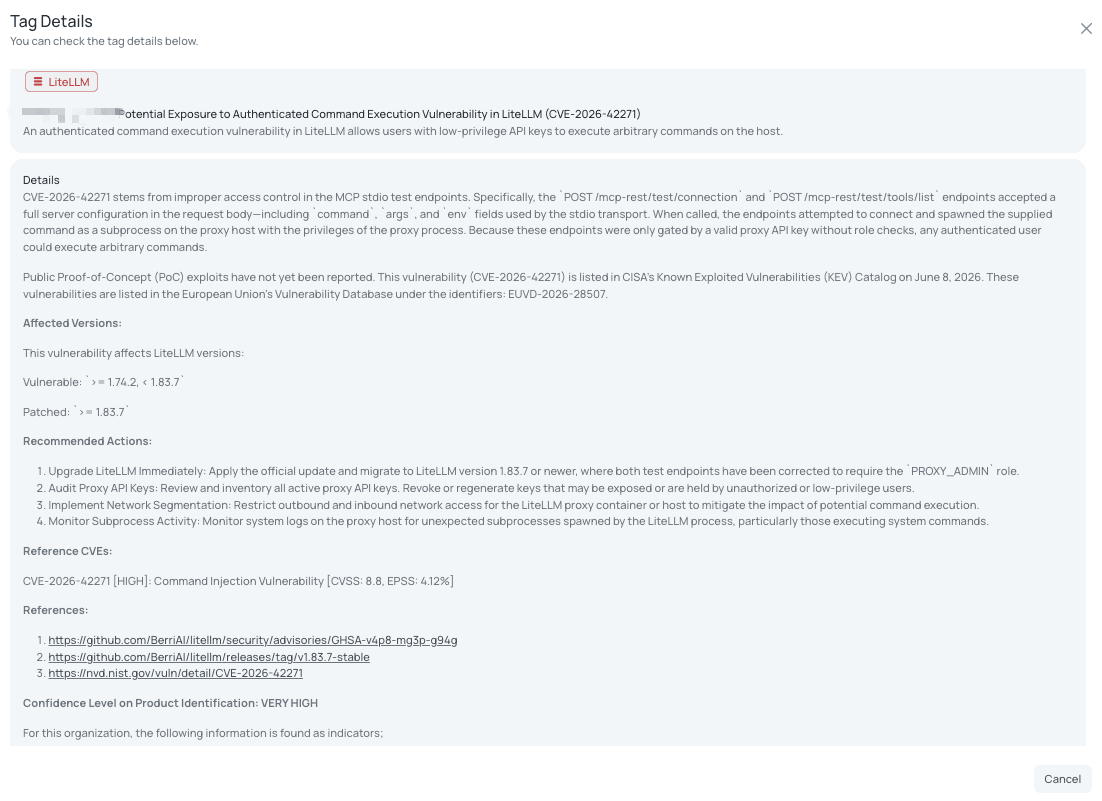
Black Kite's LiteLLM FocusTag® details critical insights on the event for TPRM professionals.
Ivanti EPMM - Jun2026 (CVE-2026-10727)
What is this vulnerability?
CVE-2026-10727 is a high-severity OS command injection vulnerability in Ivanti Endpoint Manager Mobile (EPMM), the enterprise mobile device management platform used to manage and secure mobile device fleets across large organizations. The vulnerability allows authenticated attackers with administrative access to submit specially crafted input that is passed to the underlying operating system command shell without proper sanitization. Successful exploitation can enable arbitrary OS command execution as the root user on the affected EPMM server.
This makes CVE-2026-10727 particularly impactful because exploitation occurs on a system that typically has privileged control over mobile device enrollment, device policies, managed application deployment, VPN profiles, email configurations, and other enterprise mobility controls. While exploitation requires authenticated administrative access, compromise of an EPMM administrator account could allow an attacker to move from application-level access to full root-level control of the EPMM backend.
No public Proof-of-Concept exploit has been reported, and Ivanti has not observed active exploitation in the wild at the time of disclosure. CVE-2026-10727 is not listed in the CISA KEV catalog. The vulnerability is fully remediated in Ivanti EPMM versions 12.9.0.1, 12.8.0.3, and 12.7.0.2. Deployments running earlier releases across the 12.x branch, including 12.6.x, 12.5.x, 12.4.x, 12.3.x, 12.2.x, 12.1.x, 12.0.x, and older, remain unpatched.
Why should TPRM professionals care?
- Ivanti EPMM is a high-value third-party risk concern because it controls the mobile device management lifecycle for enrolled corporate devices. A compromised EPMM server may give an attacker administrative visibility and control over managed device configurations, application deployment policies, VPN profiles, email account settings, and mobile access controls.
- For TPRM professionals, vendors operating Ivanti EPMM may use the platform to manage mobile access to sensitive corporate resources, including email, internal applications, and VPN connectivity. If CVE-2026-10727 is exploited after an attacker obtains administrative access, the attacker could execute root-level commands on the EPMM server, potentially altering MDM configurations, accessing sensitive management data, modifying device policies, or creating a foothold for broader infrastructure compromise.
- Although this vulnerability is not currently known to be exploited in the wild, Ivanti products have been repeatedly targeted in previous attack campaigns. Vendors running unpatched EPMM deployments should therefore be treated as a priority verification item, especially where EPMM administrative interfaces are exposed to untrusted networks or administrative access controls are weak.
What questions should TPRM professionals ask vendors?
- Have all Ivanti EPMM deployments been upgraded to version 12.9.0.1, 12.8.0.3, or 12.7.0.2 to address CVE-2026-10727? What is the current deployed version and patch timeline if not yet updated?
- Is EPMM administrative access restricted to trusted internal network ranges only, or is the administration interface accessible from the public internet or untrusted external networks?
- What multi-factor authentication controls are enforced for EPMM administrative accounts? Are administrative credentials protected by hardware tokens or equivalent strong authentication?
- Have EPMM access logs and configuration logs been audited for anomalous administrative authentication, suspicious configuration changes, or unexpected OS-level command execution since the vulnerability disclosure date?
- Given prior Ivanti vulnerability campaigns, what enhanced monitoring controls have been deployed on the EPMM server for indicators of compromise, privilege misuse, or lateral movement activity?
Remediation recommendations
- Upgrade Ivanti EPMM to version 12.9.0.1, 12.8.0.3, or 12.7.0.2 immediately. These versions provide the official remediation for CVE-2026-10727.
- Restrict the EPMM administration interface to trusted internal IP ranges only; eliminate any direct public internet accessibility of the administrative endpoint using firewall rules or reverse proxy controls.
- Enforce multi-factor authentication on all EPMM administrative accounts; review and minimize the number of accounts with administrative access.
- Review EPMM configuration logs, application logs, and system logs for anomalous OS-level command execution that may indicate exploitation prior to patching.
- Conduct a post-patch integrity review of all managed device profiles, VPN configurations, app deployment policies, and administrative accounts to verify that no unauthorized changes were introduced.
Microsoft Exchange Server - Jun2026 (CVE-2026-45504, CVE-2026-45503, CVE-2026-47631, CVE-2026-45583, CVE-2026-45501, CVE-2026-45500, CVE-2026-45502)
What is the Microsoft Exchange Server - Jun2026 vulnerability?
Microsoft's June 2026 Patch Tuesday release addresses seven vulnerabilities in Microsoft Exchange Server spanning four distinct vulnerability classes: Elevation of Privilege, Information Disclosure, Spoofing, and Remote Code Execution. CVE-2026-45504 (CVSS 8.8) is the most critical: an Elevation of Privilege and Server-Side Request Forgery flaw that allows a network attacker to abuse Exchange's internal request routing to escalate privileges and redirect server-side HTTP requests to unauthorized targets. CVE-2026-45503 (CVSS 8.1) is a related SSRF enabling information disclosure — authenticated attackers can exploit the server-side request forgery to enumerate and exfiltrate sensitive data through the Exchange request pipeline.
CVE-2026-47631 (CVSS 8.1) is a Spoofing vulnerability via Cross-Site Scripting, enabling attackers to execute arbitrary scripts in authenticated Outlook Web Access sessions through crafted email payloads. CVE-2026-45583 (CVSS 7.5) is a Remote Code Execution vulnerability via code injection in the Exchange processing pipeline. CVE-2026-45501, CVE-2026-45500 (CVSS 6.5 and 6.1) are additional Spoofing/XSS vulnerabilities enabling session manipulation, and CVE-2026-45502 (CVSS 5.0) is an Information Disclosure/SSRF enabling limited data exfiltration. Approximately 55,062 Exchange Server instances are identifiable on Shodan running pre-patch builds. Patched builds: Exchange 2016 CU23 build 15.01.2507.069 or later; Exchange 2019 CU14 build 15.02.1544.041 or later; Exchange 2019 CU15 build 15.02.1748.046 or later; Exchange SE build 15.02.2562.043 or later. No public PoC; not in CISA KEV.
Why should TPRM professionals care?
Microsoft Exchange Server remains the backbone of enterprise email infrastructure for tens of thousands of on-premises organizations globally, processing the full volume of internal and external communications across the organization. The combination of SSRF (CVE-2026-45504 and CVE-2026-45503) with a network privilege escalation path means an attacker with authenticated access — including access to a compromised mailbox or low-privilege Exchange account — can exploit Exchange's trust relationships to escalate privileges and exfiltrate data without direct code execution. The CVE-2026-47631 XSS vector creates a direct email-borne delivery mechanism: a crafted email to an Exchange user triggers script execution in their Outlook Web Access session upon opening, bypassing perimeter defenses entirely. For TPRM professionals, vendors still operating on-premises Exchange infrastructure represent a significant risk surface: the volume of exposed builds on Shodan (~55,062) confirms that a substantial portion of the ecosystem has not yet patched, and the multi-vector nature of this release means there is no single mitigation that substitutes for the cumulative update.
What questions should TPRM professionals ask vendors?
- Have all Exchange Server instances been updated to the June 2026 cumulative update builds — 15.01.2507.069+ for Exchange 2016 CU23, 15.02.1544.041+ for Exchange 2019 CU14, 15.02.1748.046+ for Exchange 2019 CU15, or 15.02.2562.043+ for Exchange SE?
- Are Exchange Web Services and Outlook Web Access endpoints restricted from direct public internet exposure, or is the Exchange HTTPS interface accessible externally without layered perimeter controls such as a reverse proxy or WAF?
- What controls are in place to detect SSRF attempts against Exchange's internal request routing — specifically outbound server-side HTTP requests to internal network ranges or cloud metadata endpoints initiated by the Exchange process?
- Has the Exchange environment been reviewed for indicators of prior exploitation — specifically anomalous privilege escalation events, unexpected email rules, or unauthorized OWA session activity — since the start of the June 2026 Patch Tuesday advisory window?
- What is the organization's policy for Exchange cumulative update deployment velocity? Is there a maximum dwell time between a Patch Tuesday release and full Exchange fleet update completion?
Remediation recommendations
- Apply the June 2026 cumulative updates immediately to all Exchange Server deployments: 15.01.2507.069 or later for Exchange 2016 CU23; 15.02.1544.041 or later for Exchange 2019 CU14; 15.02.1748.046 or later for Exchange 2019 CU15; 15.02.2562.043 or later for Exchange SE.
- Deploy a WAF or reverse proxy in front of Exchange OWA to provide an additional XSS and injection filtering layer independent of the Exchange application itself.
- Implement network-level egress controls on Exchange servers to block unexpected outbound HTTP/HTTPS connections initiated by the Exchange process, limiting SSRF exploitation reach.
- Audit Exchange audit logs for anomalous EWS API calls, unexpected privilege assignments, and unusual OWA session activity coinciding with the vulnerability disclosure window.
- Enforce multi-factor authentication on all Exchange OWA and EWS endpoints to raise the authentication barrier for exploiting the authenticated vulnerability vectors.
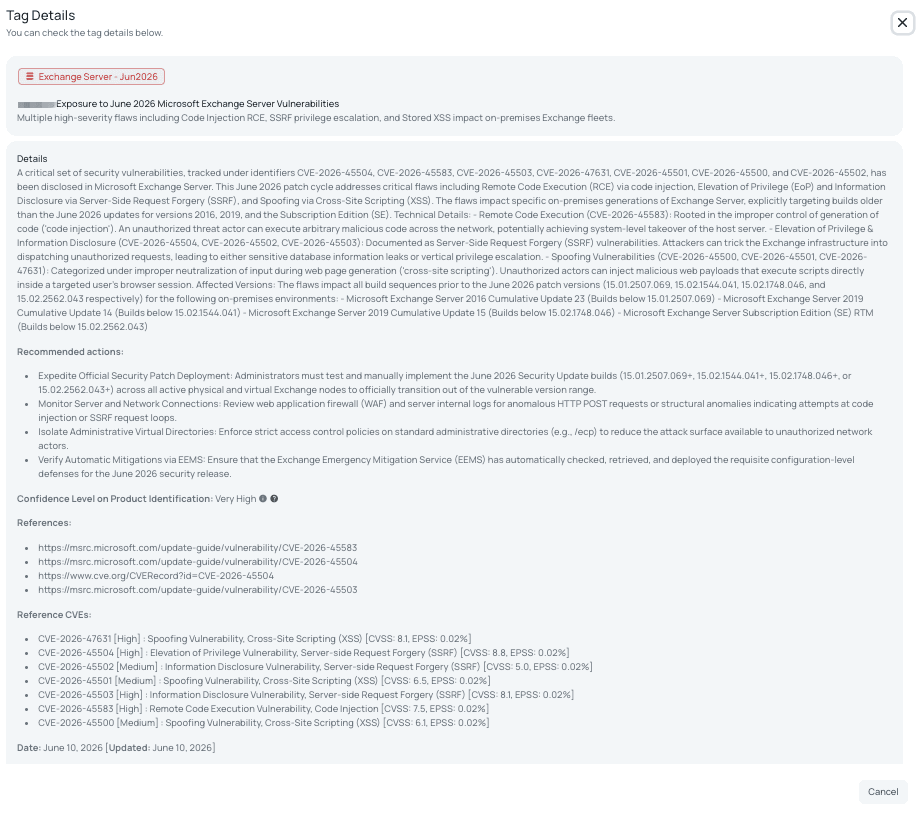
Black Kite's Exchange Server - Jun2026 FocusTag® details critical insights on the event for TPRM professionals.
Microsoft SharePoint - Jun2026 (CVE-2026-45484, CVE-2026-47298, CVE-2026-47634, CVE-2026-45481, CVE-2026-45454)
What is this vulnerability?
Five vulnerabilities in Microsoft SharePoint Server were disclosed as part of the June 9, 2026 Patch Tuesday release. CVE-2026-45484 (CVSS 8.8, EPSS 0.02%) is the most severe: a deserialization of untrusted data vulnerability (CWE-502) that allows any authenticated domain user to escalate privileges directly to SharePoint Administrator. By submitting a crafted serialized payload, an attacker achieves unrestricted administrative control over all SharePoint sites, document libraries, and stored data — without requiring any existing elevated permissions. CVE-2026-47298 (CVSS 8.0, EPSS 0.02%) enables Remote Code Execution via improper authorization through a client-side attack vector: an attacker who convinces an authenticated user to connect to a malicious server achieves code execution on the client system.
CVE-2026-47634 and CVE-2026-45481 (CVSS 7.3 each, EPSS 0.02%) are Cross-Site Scripting spoofing vulnerabilities rated by Microsoft as 'Exploitation More Likely' — the designation Microsoft applies when exploitation is credible in the near term. Both require only a malicious link to be clicked by an authenticated SharePoint user, enabling session hijacking, credential theft, or unauthorized actions within the SharePoint context. CVE-2026-45454 (CVSS 6.5, EPSS 0.02%) is a path traversal vulnerability (CWE-22) enabling server-side code execution with high confidentiality impact, exploitable by any authenticated user without administrative privileges. Together these five flaws create a multi-vector attack surface spanning privilege escalation, client-side code execution, session hijacking, and path traversal. Approximately 8,979 SharePoint instances are detectable on Shodan running affected configurations. Fixed via June 2026 cumulative security updates for SharePoint SE, SharePoint 2019, and SharePoint Enterprise 2016. No public PoC reported; not in CISA KEV.
Why should TPRM professionals care?
SharePoint is the central document management and intranet platform for the majority of enterprise Microsoft environments — storing contracts, personnel records, project documentation, financial data, and sensitive business communications. CVE-2026-45484's deserialization privilege escalation means that any authenticated user in a vendor's domain can convert a standard SharePoint account into full SharePoint administrative access. This is particularly alarming for vendor environments where employees, contractors, or service providers have standard SharePoint access: a single compromised or malicious low-privilege account can escalate to unrestricted administrative control over the entire SharePoint environment and all data stored within it. The two CVEs marked 'Exploitation More Likely' by Microsoft signal that weaponization of the XSS spoofing vectors is anticipated in the near term. For TPRM professionals, any vendor that shares SharePoint sites or document libraries with your organization represents a direct inbound attack surface via these XSS vectors, where a crafted link delivered through the shared collaboration context could compromise your own users' SharePoint sessions.
What questions should TPRM professionals ask vendors?
- Have the June 2026 cumulative security updates been applied to all SharePoint Server Subscription Edition, 2019, and Enterprise 2016 instances?
- Have SharePoint access logs been audited for anomalous deserialization activity or unexpected privilege escalation events — specifically newly elevated SharePoint Administrator accounts — following the June 2026 advisory?
- What controls prevent authenticated users from accessing SharePoint administrative interfaces? Is privilege escalation monitoring in place to detect unexpected role assignments in the SharePoint environment?
- For any externally shared SharePoint sites — including sites shared with your organization — what controls prevent cross-tenant XSS exploitation via malicious link delivery through shared document libraries or collaboration channels?
- Is SharePoint administrative access protected by multi-factor authentication and privileged access workstations, given CVE-2026-45484's authenticated privilege escalation to SharePoint Administrator?
Remediation recommendations
- Apply the June 2026 cumulative security updates to all SharePoint Server instances (SE, 2019, Enterprise 2016) immediately.
- Audit SharePoint permissions and role assignments for any unexpected elevation to SharePoint Administrator since the June 2026 advisory window; treat unauthorized administrative accounts as indicators of compromise.
- Implement Content Security Policy headers on SharePoint to reduce XSS exploitability as a defense-in-depth control supplementing the patch.
- Restrict SharePoint administrative access to privileged access workstations with MFA enforced, limiting the impact of any successful privilege escalation via CVE-2026-45484.
- For externally shared SharePoint sites, enforce strict user invitation and link-sharing policies to reduce the attack surface for CVE-2026-47634 and CVE-2026-45481 spoofing via cross-tenant contexts.
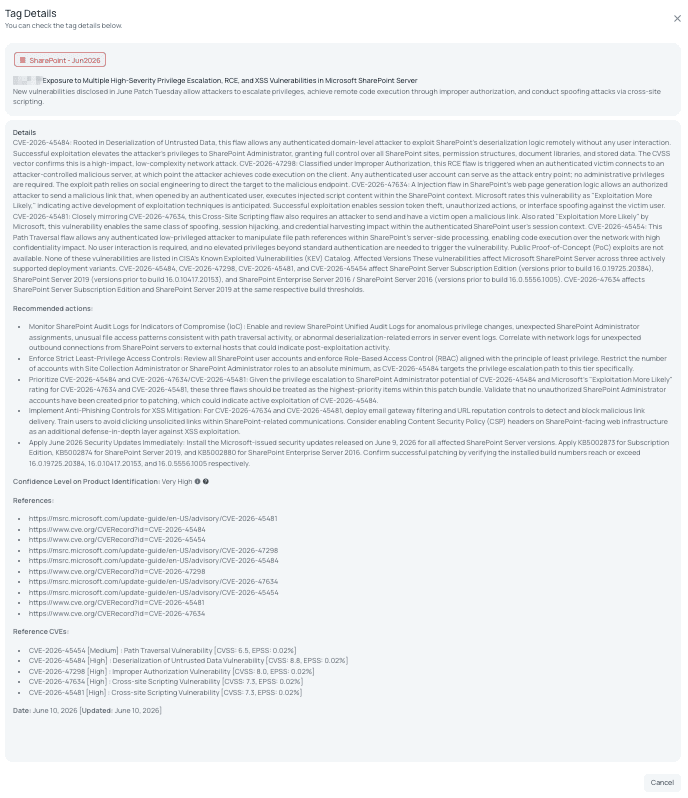
Black Kite's SharePoint - Jun2026 FocusTag® details critical insights on the event for TPRM professionals.
MariaDB - Jun2026 (CVE-2026-49261, CVE-2026-48165, CVE-2026-48163)
What is the MariaDB — Jun2026 vulnerability?
Three significant vulnerabilities have been identified in MariaDB Community Server, one of the most widely deployed open-source relational database management systems in enterprise, cloud, and critical infrastructure environments. CVE-2026-49261 carries a CVSSv3 score of 10.0 — the maximum possible severity rating. While the precise technical mechanics of this flaw remain reserved by the assigning authority at time of publication, a maximum severity score on a remotely accessible database service is universally interpreted as a potential unauthenticated remote code execution or complete authentication bypass path. The scale of MariaDB's global deployment — with approximately 757,632 instances identifiable on Shodan — translates this single flaw into an extraordinarily broad attack surface spanning web applications, ERP systems, financial platforms, and SaaS products that use MariaDB as their backend data store.
CVE-2026-48165 and CVE-2026-48163 each carry CVSSv3 scores of 8.0 with EPSS of 0.02%. Both target structural security boundaries within the MariaDB Community Server architecture across multiple release branches simultaneously, enabling remote actors to bypass security controls or compromise the integrity of stored data. The breadth of affected versions is particularly significant: all four actively maintained release branches are affected — all versions prior to 11.8.8 in the 11.8.x branch, prior to 11.4.12 in the 11.4.x LTS branch, prior to 10.11.18 in the 10.11.x LTS branch, and prior to 10.6.27 in the 10.6.x LTS branch. No vendor workaround exists for any of the three vulnerabilities — version upgrade to the respective patched release is the only viable remediation. No public PoC; not in CISA KEV.
Why should TPRM professionals care?
MariaDB is a foundational database layer across the global enterprise software ecosystem. It serves as the backend data store for web applications, e-commerce platforms, SaaS products, content management systems, ERP deployments, and financial platforms — many of which are operated by third-party vendors processing your organization's data. A CVSS 10.0 flaw in a database system of this scale and prevalence represents one of the highest-priority risk events a TPRM program can encounter. If CVE-2026-49261 follows the pattern of prior maximum-severity database vulnerabilities, it likely enables unauthenticated remote code execution or authentication bypass — meaning an attacker with network reach to a vendor's MariaDB instance could access, exfiltrate, or manipulate all data stored in that database without any prior credential requirement. The absence of any vendor workaround means that every unpatched deployment in your vendor ecosystem remains fully exposed until the version upgrade is applied, with no compensating configuration change available as an interim control.
What questions should TPRM professionals ask vendors?
- Have all MariaDB Community Server instances been upgraded to the patched release corresponding to the deployed branch — 11.8.8, 11.4.12, 10.11.18, or 10.6.27? What is the current deployed version and remediation timeline for any unpatched instances?
- Are any MariaDB instances accessible from the public internet or from untrusted network segments? Have firewall rules been verified to restrict MariaDB port access (default TCP 3306) exclusively to authorized application server IP addresses?
- Has a prioritized remediation approach been applied for CVE-2026-49261 given its maximum CVSS 10.0 score? Was patching treated as a critical incident response action rather than a standard maintenance cycle?
- Have MariaDB general query logs and error logs been reviewed for anomalous authentication attempts, unexpected administrative operations, or unusual query patterns that may indicate exploitation attempts prior to patching?
- Are all database user accounts operating under the principle of least privilege, with application accounts restricted from administrative-level permissions?
Remediation recommendations
- Upgrade all MariaDB Community Server instances immediately to the patched release for the deployed branch: 11.8.8 for 11.8.x, 11.4.12 for 11.4.x LTS, 10.11.18 for 10.11.x LTS, or 10.6.27 for 10.6.x LTS. No workaround exists — version upgrade is the only remediation.
- Enforce network-level firewall rules restricting MariaDB port access (TCP 3306) exclusively to authorized application server IP addresses; eliminate any direct public internet exposure of the database service.
- Audit MariaDB query logs and error logs for anomalous authentication patterns, unexpected administrative operations, or unfamiliar source addresses that may indicate exploitation attempts against CVE-2026-49261.
- Apply the principle of least privilege to all MariaDB database accounts — revoke unnecessary privileges, and ensure application accounts do not hold administrative-level permissions.
- Enable the MariaDB audit plugin if not already active to capture comprehensive access logging for ongoing monitoring and forensic capability.
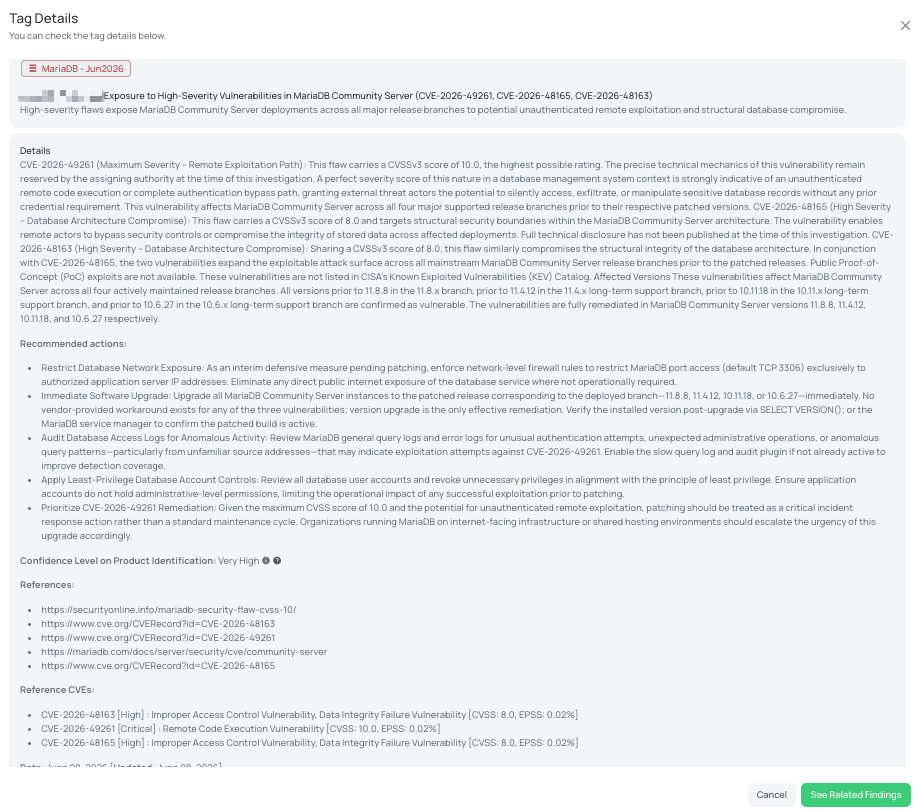
Black Kite's MariaDB - Jun2026 FocusTag® details critical insights on the event for TPRM professionals.
SolarWinds Serv-U - Jun2026 (CVE-2026-28318)
What is this vulnerability?
CVE-2026-28318 (CVSS 7.5, EPSS 6.68%) is an uncontrolled resource consumption vulnerability in SolarWinds Serv-U, a widely deployed managed file transfer and FTP server platform used across enterprise environments for secure file exchange, SFTP hosting, and managed file transfer workflows. The vulnerability allows unauthenticated remote attackers to crash the Serv-U service by transmitting specially crafted POST requests containing the Content-Encoding: deflate header. The malformed compressed request triggers uncontrolled resource consumption within the Serv-U process, causing a service crash and effective Denial of Service against the file transfer platform.
The vulnerability was added to CISA's Known Exploited Vulnerabilities catalog on June 5, 2026, confirming active exploitation by threat actors in the wild. Public Proof-of-Concept exploits have been reported. The vulnerability is also listed in the European Union's Vulnerability Database under identifier EUVD-2026-34268. Federal agencies subject to CISA's BOD 22-01 are required to remediate by June 19, 2026. All SolarWinds Serv-U versions prior to 15.5.4 Hotfix 1 are affected across the full version history. The vulnerability is fully remediated in Serv-U version 15.5.4 Hotfix 1. Approximately 228,000 Serv-U instances are detectable on Shodan across multiple version lines.
Why should TPRM professionals care?
SolarWinds Serv-U is a critical component in vendor file transfer infrastructure — it is frequently the platform vendors use to exchange sensitive documents, financial data, regulated records, and confidential files with business partners and clients. A Denial of Service attack that crashes the Serv-U service disrupts these file transfer workflows, with potential cascading effects on time-sensitive regulatory submissions, financial transactions, and operational processes that depend on managed file transfer availability. The CISA KEV addition and public PoC availability together confirm that this is a low-barrier, actively weaponized attack: any threat actor with network access to a vendor's Serv-U instance can trigger a service crash without credentials using a straightforward crafted POST request. For TPRM professionals, the SolarWinds brand carries additional historical context — the 2020 SolarWinds supply chain compromise established Serv-U and related SolarWinds products as high-priority targets for sophisticated adversaries. The combination of active exploitation, a public PoC, and SolarWinds' prominence as a software supply chain component makes this a high-urgency tag for TPRM programs.
What questions should TPRM professionals ask vendors?
- Have all SolarWinds Serv-U instances been upgraded to version 15.5.4 Hotfix 1? What is the current deployed version and remediation timeline for any unpatched instances?
- Are Serv-U file transfer interfaces accessible from the public internet? What network controls are in place to restrict access to authorized transfer partners only?
- Has network traffic to Serv-U instances been monitored for unusual POST requests — specifically those containing Content-Encoding: deflate headers — that may indicate active exploitation attempts?
- If immediate patching is not possible, what interim mitigations have been applied from the SolarWinds Trust Center advisory for CVE-2026-28318?
- What business continuity measures exist for file transfer operations if the Serv-U service is crashed by exploitation? Has a failover or alternative transfer mechanism been tested?
Remediation recommendations
- Upgrade all SolarWinds Serv-U instances to version 15.5.4 Hotfix 1 immediately. This is the official and complete remediation for CVE-2026-28318.
- Apply the vendor's interim mitigations from the SolarWinds Trust Center advisory for CVE-2026-28318 if immediate upgrade is not operationally feasible.
- Implement network monitoring and alerting for POST requests to Serv-U instances containing Content-Encoding: deflate headers or other anomalous compression encoding to detect active exploitation attempts.
- Restrict Serv-U interface accessibility to authorized transfer partners via firewall rules or allowlisted IP ranges, reducing the pool of potential attackers who can reach the service.
- Federal agencies subject to BOD 22-01 must remediate CVE-2026-28318 by the CISA-mandated June 19, 2026 deadline.
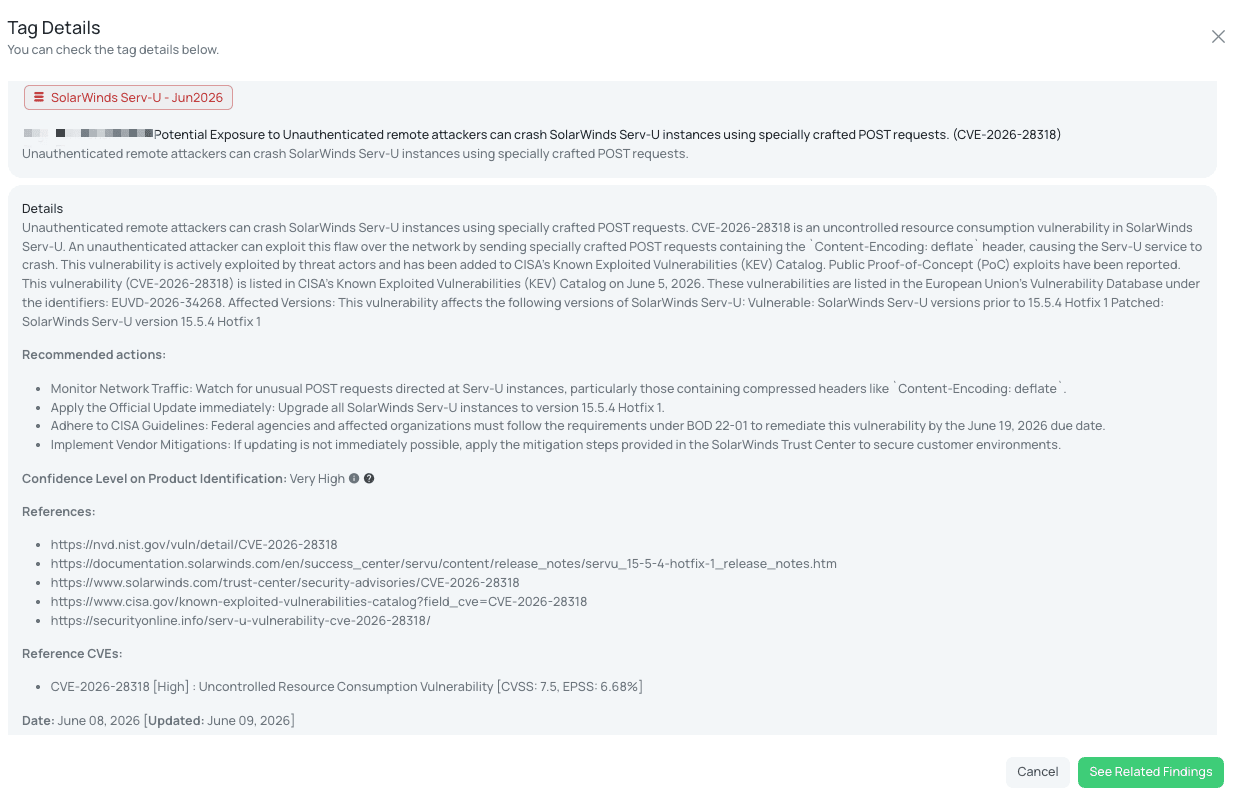
Black Kite's SolarWinds Serv-U - Jun2026 FocusTag® details critical insights on the event for TPRM professionals.
How TPRM Professionals Can Leverage Black Kite for These Vulnerabilities
This week's seven FocusTags® span a threat landscape defined by three distinct urgency signals that TPRM professionals must recognize and act on simultaneously. Three tags — ATG-Exposure-2026, LiteLLM, and SolarWinds Serv-U — carry CISA KEV listings confirming active exploitation in the wild, meaning adversaries are actively compromising these systems in vendor environments right now. One tag — MariaDB — carries a maximum CVSS 10.0 score with no vendor workaround available, making unpatched deployments unconditionally exposed until a version upgrade is completed. Two tags — Exchange Server and SharePoint — arrived in a single Patch Tuesday release carrying twelve CVEs across two of the most widely deployed enterprise collaboration platforms in the world. The breadth and concurrent timing of these disclosures would overwhelm any TPRM program attempting manual tracking and vendor-by-vendor outreach without an intelligence layer to prioritize the response.
Black Kite's FocusTags® translate this complex, multi-vector threat environment into vendor-specific, actionable intelligence. Rather than requiring TPRM teams to parse seven separate advisory streams, map each CVE to relevant technology profiles across their vendor portfolio, and manually draft outreach for each affected vendor, FocusTags® automatically surface the vendors in your ecosystem whose technology footprint matches the affected products. The operational technology dimension of this week's ATG tag illustrates the depth of this capability: internet-exposed ICS devices at vendor facilities will not appear in standard security questionnaire responses or CVE-to-technology-inventory mappings — they require the kind of external attack surface discovery that Black Kite's tagging infrastructure performs continuously.
For organizations managing large vendor ecosystems, the compounding effect of FocusTag® intelligence across weeks is particularly valuable. The SharePoint and Exchange tags this week overlap with vendors already engaged from prior weeks' ICS and AI infrastructure tags — enabling TPRM teams to build a consolidated, vendor-specific risk picture rather than managing parallel single-vulnerability conversations. As the attack surface continues to expand across OT environments, AI infrastructure, enterprise collaboration platforms, and foundational database systems, FocusTags® provide the consistent, structured intelligence layer that enables TPRM programs to operate at the pace of the evolving threat landscape rather than lagging behind it.
Strengthening TPRM Outcomes with Black Kite’s FocusTags®
Black Kite's FocusTag® technology provides TPRM teams with the intelligence infrastructure needed to keep pace with an accelerating threat landscape. By automatically correlating newly disclosed vulnerabilities with the technology profiles of vendors in your ecosystem, Black Kite transforms reactive patch tracking into proactive vendor risk management.
- Instant Vendor Exposure Mapping: FocusTags® automatically identify which vendors in your portfolio are running affected products, eliminating the manual effort of mapping CVEs to vendor technology inventories across large, complex third-party ecosystems.
- Precision-Targeted Remediation Requests: Each FocusTag® includes specific, technically grounded vendor questions — moving beyond generic patch status inquiries to version-specific, control-specific questions that surface genuine remediation versus compliance theater.
- Continuous Risk Score Integration: FocusTag® exposure feeds directly into Black Kite's vendor risk scores, ensuring that critical vulnerability exposure is immediately reflected in your third-party risk ratings without waiting for the next scheduled assessment cycle.
- Operational Efficiency at Scale: By consolidating multi-product vulnerability intelligence into a single prioritized view, FocusTags® enable TPRM teams to manage concurrent threat events across diverse technology categories without scaling headcount — ensuring risk teams operate at the speed of the threat landscape.
About Focus Friday
Every week, we delve into the realms of critical vulnerabilities and their implications from a Third-Party Risk Management (TPRM) perspective. This series is dedicated to shedding light on pressing cybersecurity threats, offering in-depth analyses, and providing actionable insights.
FocusTags® in the Last 30 Days
- Automatic Tank Gauge (ATG) Systems : Critical Internet-Exposed Automatic Tank Gauge Systems Enabling Unauthenticated Remote Command Execution.
- LiteLLM : CVE-2026-42271, High-Severity Authenticated Command Execution Vulnerability in LiteLLM AI Proxy Server.
- Ivanti EPMM - Jun2026 : CVE-2026-6973, CVE-2026-10727, High-Severity Remote Code Execution and OS Command Injection Vulnerabilities in Ivanti Endpoint Manager Mobile.
- Exchange Server - Jun2026 : CVE-2026-45504, CVE-2026-45503, CVE-2026-47631, CVE-2026-45583, CVE-2026-45501, CVE-2026-45500, CVE-2026-45502, High-Severity Privilege Escalation, SSRF, Spoofing, Remote Code Execution, and Information Disclosure Vulnerabilities in Microsoft Exchange Server.
- SharePoint - Jun2026 : CVE-2026-45484, CVE-2026-47298, CVE-2026-47634, CVE-2026-45481, CVE-2026-45454, High-Severity Privilege Escalation, Remote Code Execution, Spoofing, and Path Traversal Vulnerabilities in Microsoft SharePoint.
- MariaDB - Jun2026 : CVE-2026-49261, CVE-2026-48165, CVE-2026-48163, Critical and High-Severity Remote Code Execution, Authentication Bypass, and Server-Side Vulnerabilities in MariaDB Community Server.
- SolarWinds Serv-U - Jun2026 : CVE-2026-28318, High-Severity Uncontrolled Resource Consumption Vulnerability in SolarWinds Serv-U.
- Samba - Jun2026 : CVE-2026-4480, CVE-2026-4408, CVE-2026-1933, CVE-2026-3012, CVE-2026-3238, CVE-2026-2340, Critical and High-Severity Vulnerabilities including Remote Code Execution and Access Control Bypass in Samba.
- Roundcube - Jun2026 : CVE-2026-48842, CVE-2026-48844, CVE-2026-48848, CVE-2026-48845, CVE-2026-48846, Five High-Severity Vulnerabilities including SQL Injection, Server-Side Code Injection (RCE), and XSS in Roundcube Webmail. Langflow - Jun2026 : CVE-2026-7524, CVE-2026-48519, Two Critical-Severity Vulnerabilities including Path Traversal and Remote Code Execution in Langflow OSS.
- Axios - Jun2026 : CVE-2026-44492, CVE-2026-44494, Two High-Severity Vulnerabilities including SSRF via NO_PROXY Bypass and Prototype Pollution in Axios.
- ActiveMQ - Jun2026 : CVE-2026-45505, CVE-2026-42588, CVE-2026-49157, CVE-2026-42253, High-Severity Vulnerabilities including Remote Code Execution, Incorrect Permissions, and XSS in Apache ActiveMQ.
- Apache Solr - Jun2026 : CVE-2026-44825, Critical Hardcoded and Default Credentials Vulnerability in Apache Solr.
- Apache Airflow - Jun2026 : CVE-2026-45360, High-Severity Arbitrary Class Import Vulnerability in Apache Airflow.
- Plesk - Jun2026 : CVE-2026-44962, Near-Maximum-Severity Chained XPath and OS Command Injection Vulnerability in Plesk.
- Synology DSM Chat Server - Jun2026 : CVE-2026-40541, CVE-2026-32998, CVE-2026-32997, CVE-2026-32996, CVE-2026-9548, CVE-2026-9491, Critical and High-Severity Vulnerabilities including Remote Code Execution and Arbitrary File Access in Synology Chat Server.
- Langflow - May2026 : CVE-2025-34291, Critical CORS/CSRF and Remote Code Execution Vulnerabilities in Langflow.
- FreeBSD - May2026 : CVE-2026-45255, CVE-2026-45250, CVE-2026-45251, CVE-2026-45252, CVE-2026-39461, CVE-2026-45254, CVE-2026-45253, Critical and High-Severity Remote Code Execution, Kernel Privilege Escalation, Sandboxing Breaches, and Network Denial of Service Vulnerabilities in FreeBSD core OS.
- Memcached - May2026 : CVE-2026-47783, CVE-2026-47784, High-Severity SASL Authentication Timing Side-Channel Vulnerabilities in Memcached.
- Exchange Server - May2026 : CVE-2026-42897, High-Severity Cross-Site Scripting (XSS) Vulnerability in Outlook Web Access (OWA).
- NGINX - May2026 : Critical Memory Corruption and Remote Code Execution Vulnerability in Nginx.
- OpenClaw - May2026 : CVE-2026-44112, CVE-2026-44113, CVE-2026-44115, CVE-2026-44118, Critical Sandbox Escape, Sensitive Data Exfiltration, Privilege Escalation, and Persistent Backdoor Installation Vulnerabilities in OpenClaw.
- Flowise - May2026 : CVE-2026-46442, Critical Sandbox Escape and Remote Code Execution Vulnerability in Flowise.
- PostgreSQL - May2026 : CVE-2026-6637, CVE-2026-6477, CVE-2026-6473, CVE-2026-6475, CVE-2026-6479, High-Severity Stack Buffer Overflow, Memory Corruption, Integer Wraparound, Filesystem Hijacking, and Denial of Service Vulnerabilities in PostgreSQL.
- MongoDB - May2026 : CVE-2026-8053, Critical Time-Series Arbitrary Code Execution Vulnerability in MongoDB Server.
- pgAdmin - May2026 : CVE-2026-7813, CVE-2026-7816, CVE-2026-7815, CVE-2026-7820, CVE-2026-7818, CVE-2026-7817, CVE-2026-7819, Critical and High-Severity OS Command Injection, Improper Authorization, Unsafe Deserialization, SSRF, and Authentication Bypass Vulnerabilities in pgAdmin 4.
- FreePBX - May2026: CVE-2026-46376, Critical Hard-Coded Credentials Vulnerability in FreePBX User Control Panel (UCP).
- n8n - May2026 : CVE-2026-44790, CVE-2026-44791, CVE-2026-44789, Critical Arbitrary File Read, Prototype Pollution, and Remote Code Execution Vulnerabilities in n8n.
- Dead.Letter : CVE-2026-45185, Critical Remote Code Execution, Use-After-Free, Memory Corruption, and Improper Input Validation Vulnerabilities in Exim Mail Server.
See Black Kite's full CVE Database and the critical TPRM vulnerabilities that have an applied FocusTags® at https://blackkite.com/cve-database.
References
https://nvd.nist.gov/vuln/detail/CVE-2026-42271
https://github.com/BerriAI/litellm/security/advisories/GHSA-v4p8-mg3p-g94g
https://github.com/BerriAI/litellm/releases/tag/v1.83.7-stable
https://nvd.nist.gov/vuln/detail/CVE-2026-10727
https://securityonline.info/ivanti-epmm-security-updates/
https://msrc.microsoft.com/update-guide/vulnerability/CVE-2026-45504
https://msrc.microsoft.com/update-guide/vulnerability/CVE-2026-45583
https://msrc.microsoft.com/update-guide/vulnerability/CVE-2026-45503
https://www.cve.org/CVERecord?id=CVE-2026-45504
https://www.cve.org/CVERecord?id=CVE-2026-45484
https://www.cve.org/CVERecord?id=CVE-2026-47298
https://www.cve.org/CVERecord?id=CVE-2026-47634
https://www.cve.org/CVERecord?id=CVE-2026-45481
https://www.cve.org/CVERecord?id=CVE-2026-45454
https://msrc.microsoft.com/update-guide/en-US/advisory/CVE-2026-45454
https://msrc.microsoft.com/update-guide/en-US/advisory/CVE-2026-45481
https://msrc.microsoft.com/update-guide/en-US/advisory/CVE-2026-47634
https://msrc.microsoft.com/update-guide/en-US/advisory/CVE-2026-47298
https://msrc.microsoft.com/update-guide/en-US/advisory/CVE-2026-45484
https://www.cve.org/CVERecord?id=CVE-2026-49261
https://www.cve.org/CVERecord?id=CVE-2026-48165
https://www.cve.org/CVERecord?id=CVE-2026-48163
https://mariadb.com/docs/server/security/cve/community-server
https://securityonline.info/mariadb-security-flaw-cvss-10/
https://nvd.nist.gov/vuln/detail/CVE-2026-28318
https://securityonline.info/serv-u-vulnerability-cve-2026-28318/
https://www.solarwinds.com/trust-center/security-advisories/CVE-2026-28318
https://www.cisa.gov/known-exploited-vulnerabilities-catalog?field_cve=CVE-2026-28318