CVE-2026-109618
Product
PHP Group PHP
Issue
Memory Corruption
CVSS
9.8
EPSS
99.9%
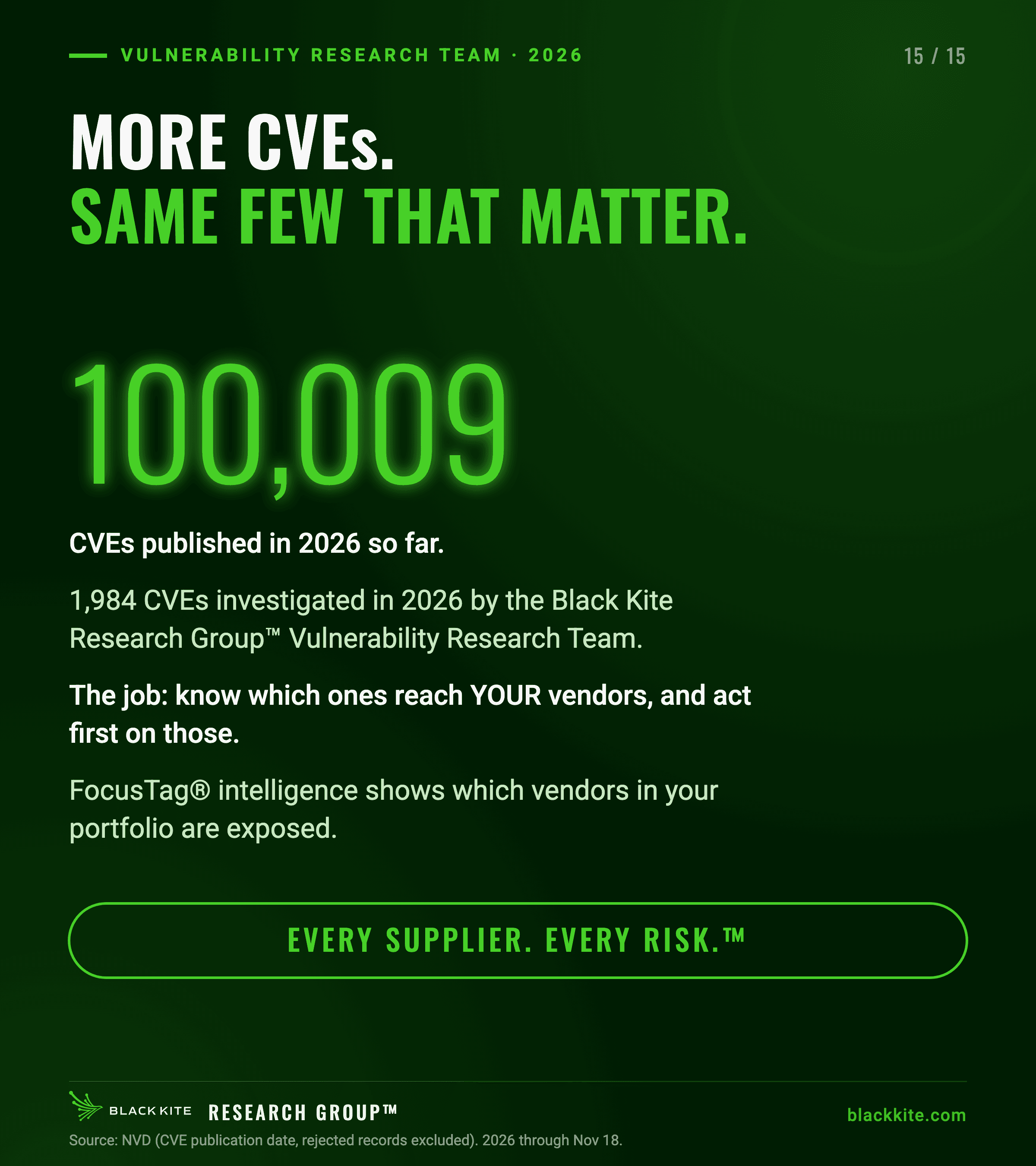
As of Nov 18, 100,009 CVEs have been published in 2026. That is 2.1x all of 2025, and the year is not over: 43 days still to go.
The Black Kite Research Group™ Vulnerability Research Team tracked the surge, what drove it, and which of these CVEs attackers actually used. The sections below follow the report slide by slide. Or download the report PDF.
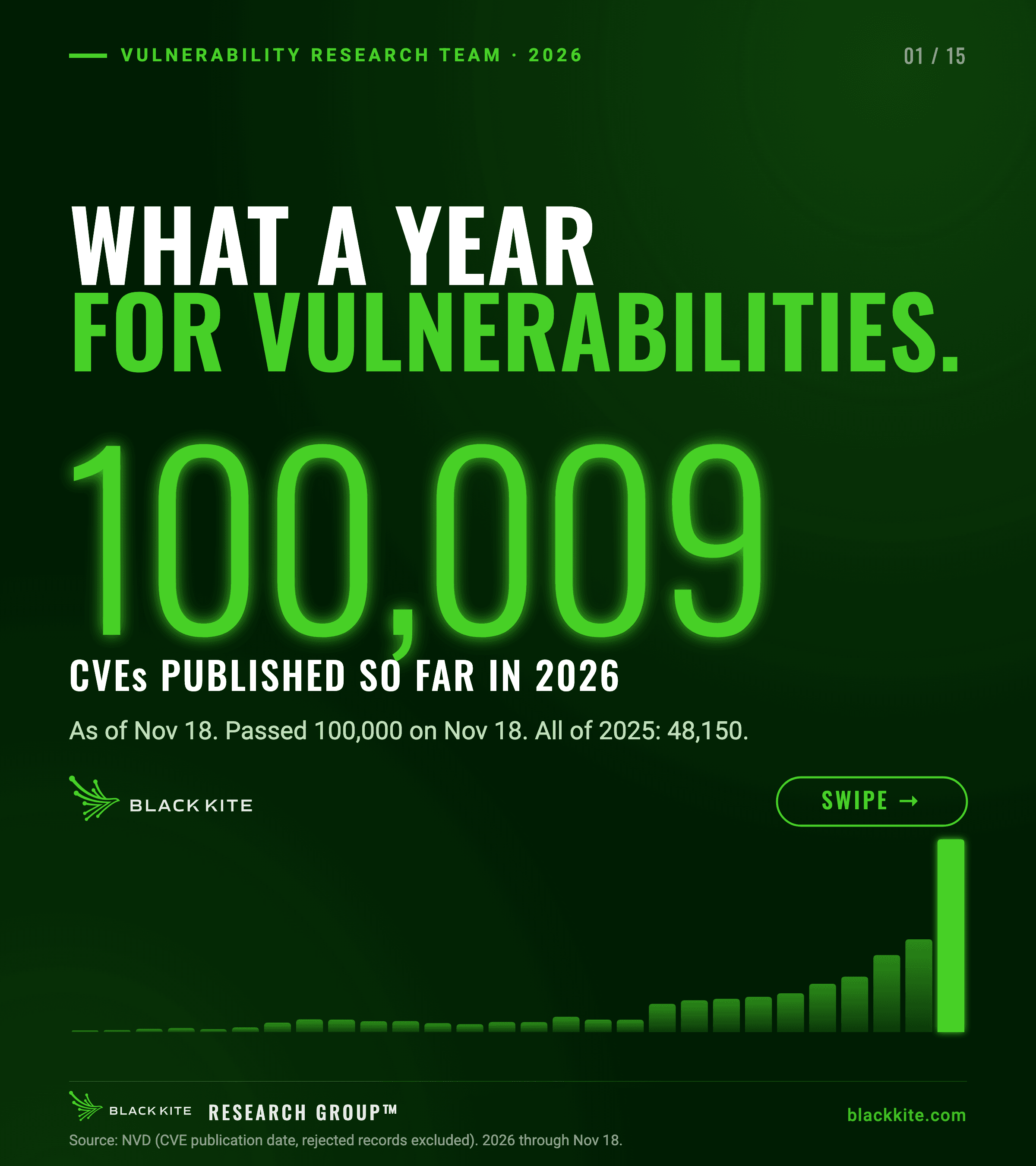
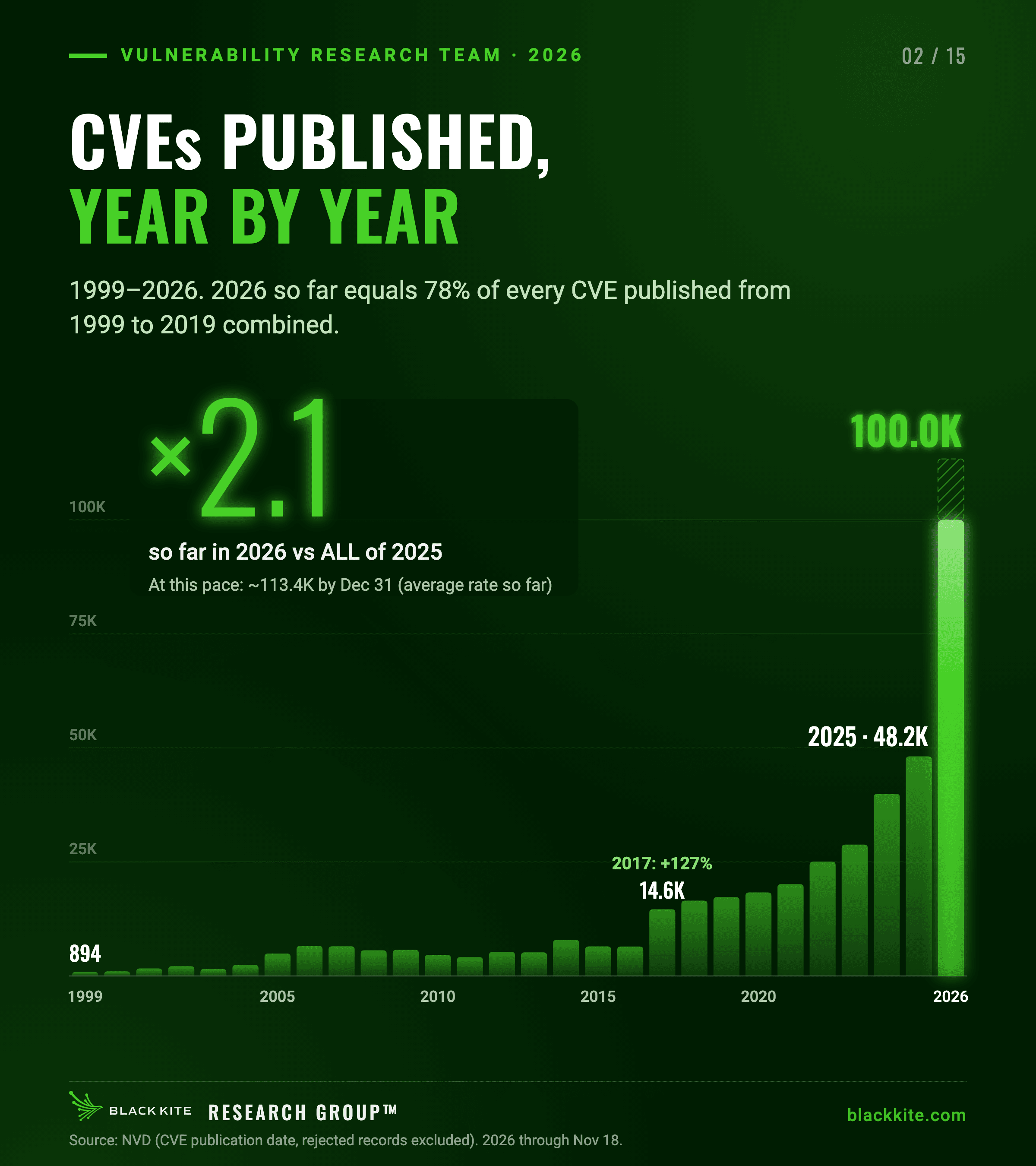
CVE publication has climbed for two decades, from 894 in 1999 to 48,150 in 2025. In 2017, annual volume jumped 127%.
2026 is already at 100.0K, which equals 78% of every CVE published from 1999 to 2019 combined. At the average pace so far, the year lands near 113.4K by Dec 31.
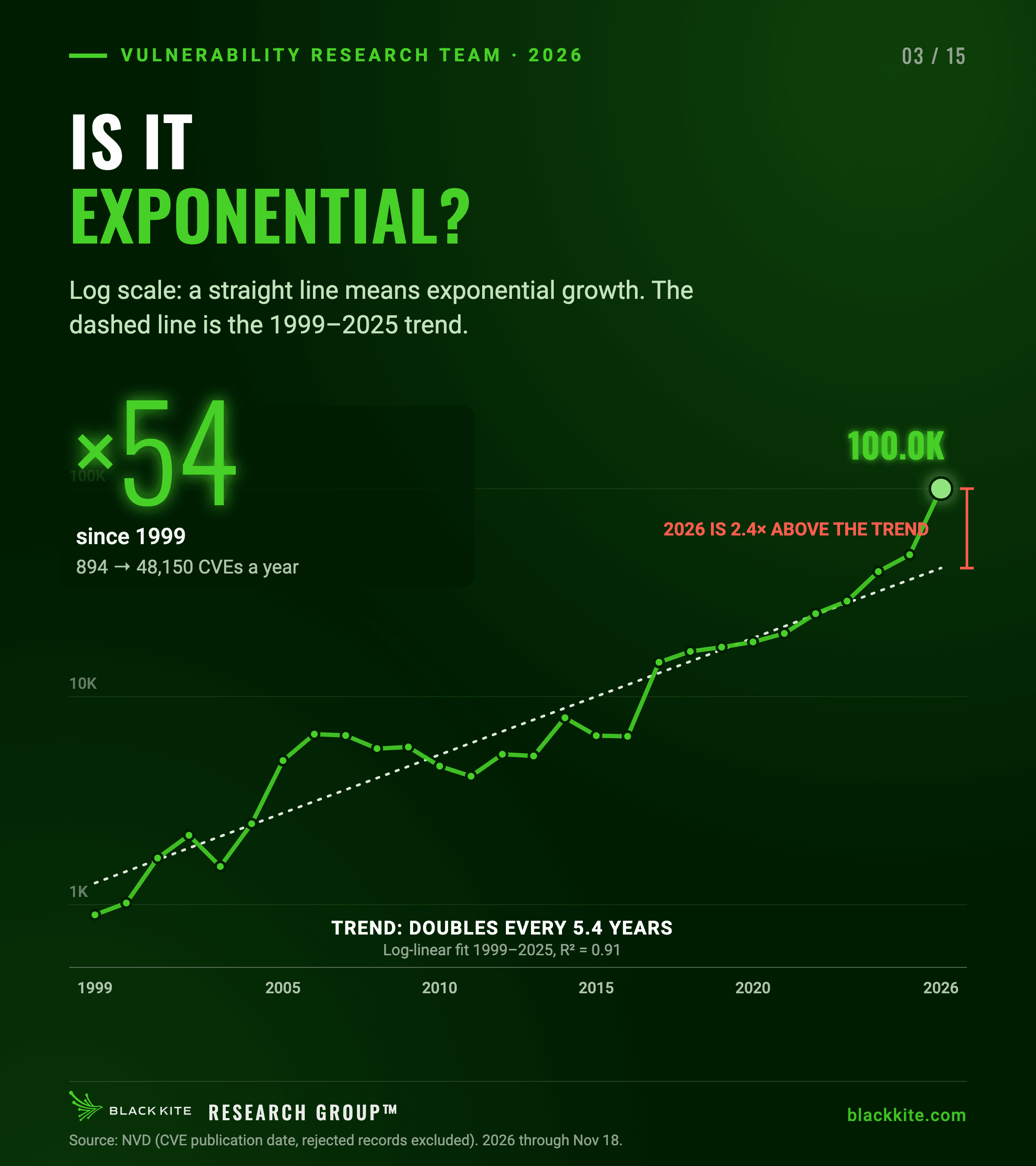
CVE growth was already close to exponential. Annual volume rose 54x since 1999, from 894 to 48,150 CVEs a year. On a log scale, a straight line means exponential growth, and the 1999–2025 trend (a log-linear fit, R² = 0.91) doubles every 5.4 years.
2026 did not follow that curve. At 100.0K, it sits 2.4x above the trend line.
Each 25,000 CVEs arrived faster than the last. The first 25,000 took 139 days (May 19). The next took 86 (Aug 13), then 54 (Oct 6), then 43 (Nov 18). All of 2025 was passed on Aug 10.
Monthly volume rose 4.0x from January to October, from 4,302 to 17,051 CVEs a month. That is growth of about 17% a month.
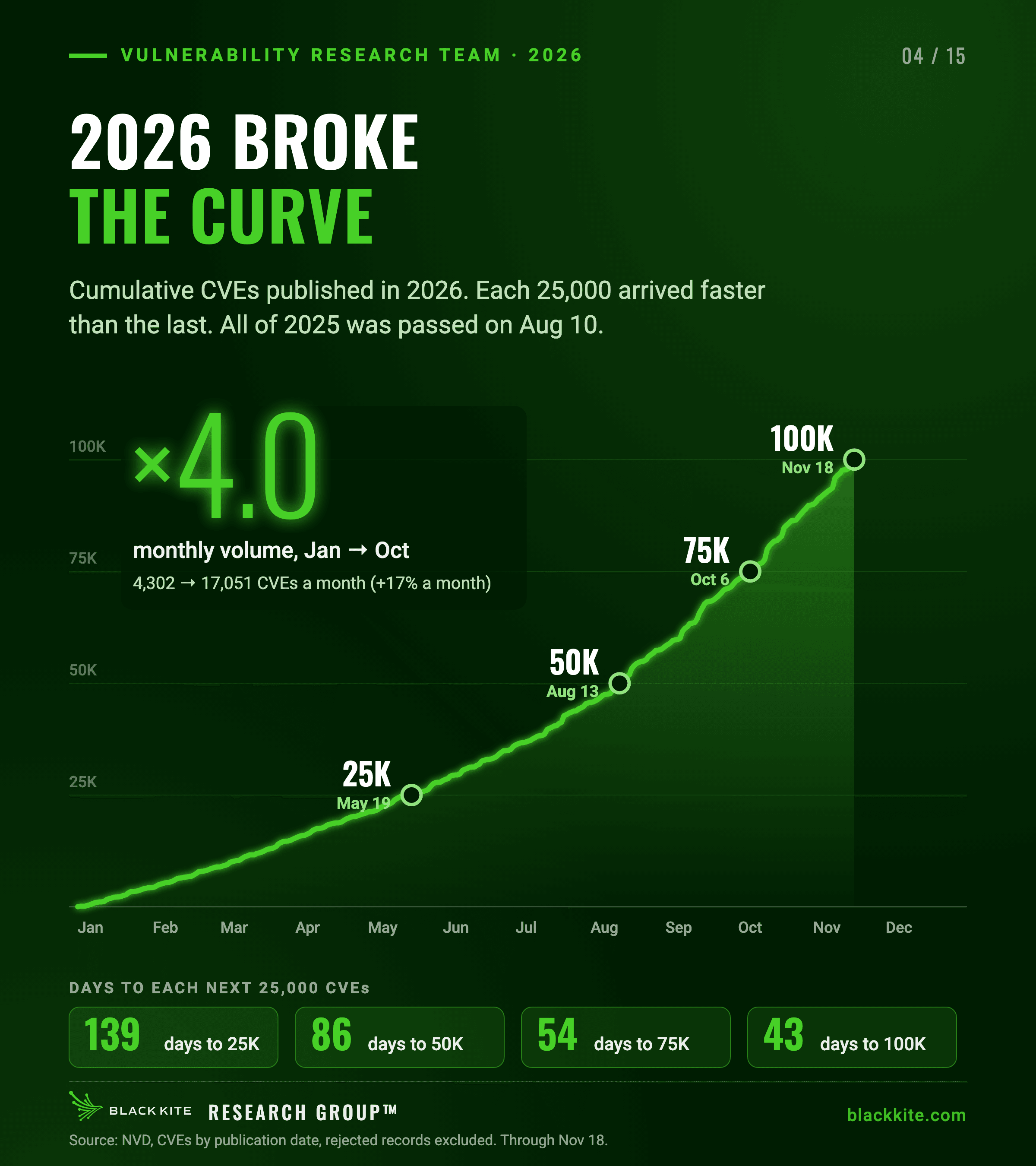
No single cause explains the number. Discovery, reporting and cataloguing all sped up in the same year. These are contributing factors, not a ranking of causes.
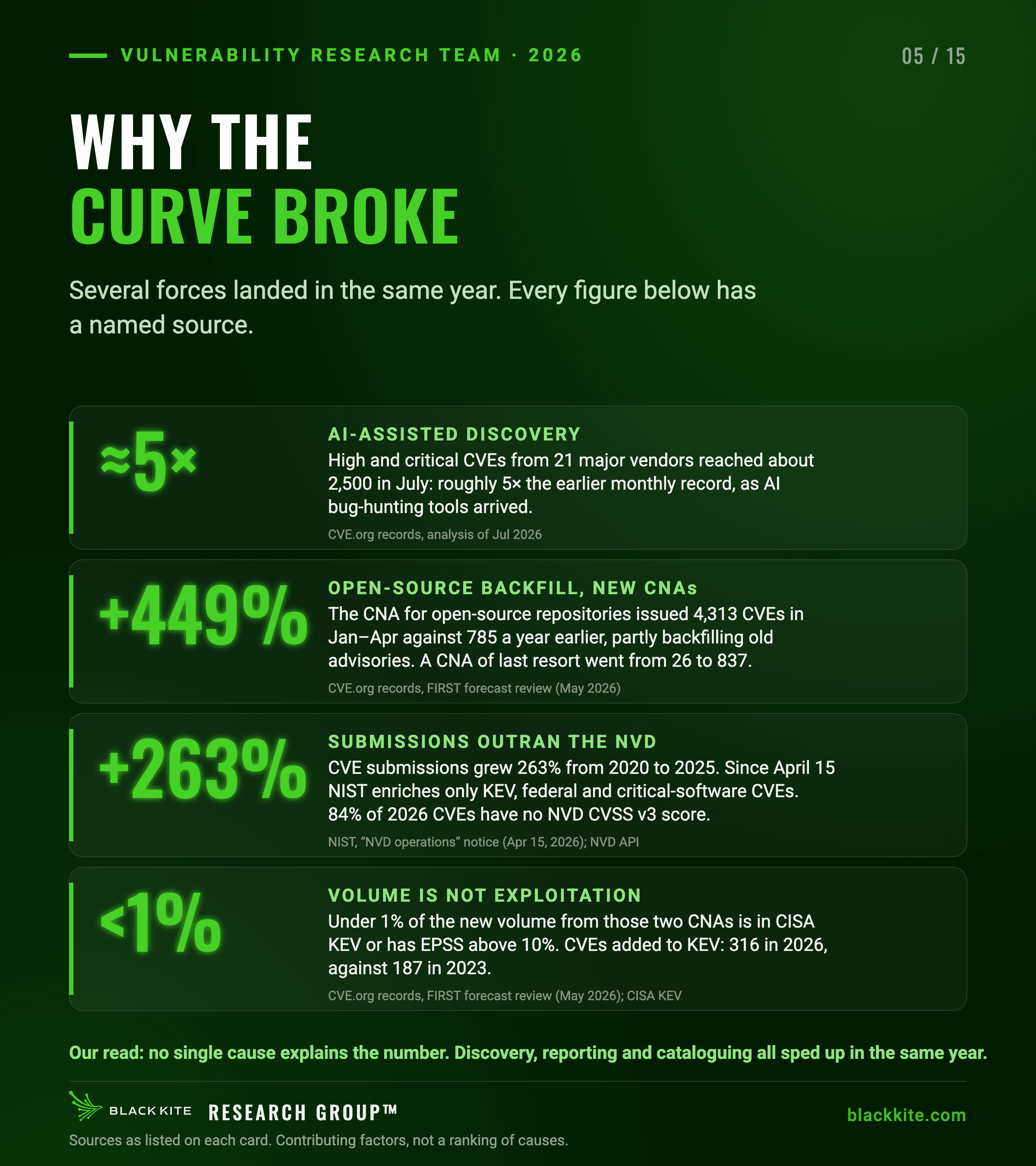
In 2016, it took 82 minutes to get a new CVE. In 2026, it takes 4.6. Average publishing rate by year:
2026 through Nov 18. Leap years are divided by 366.
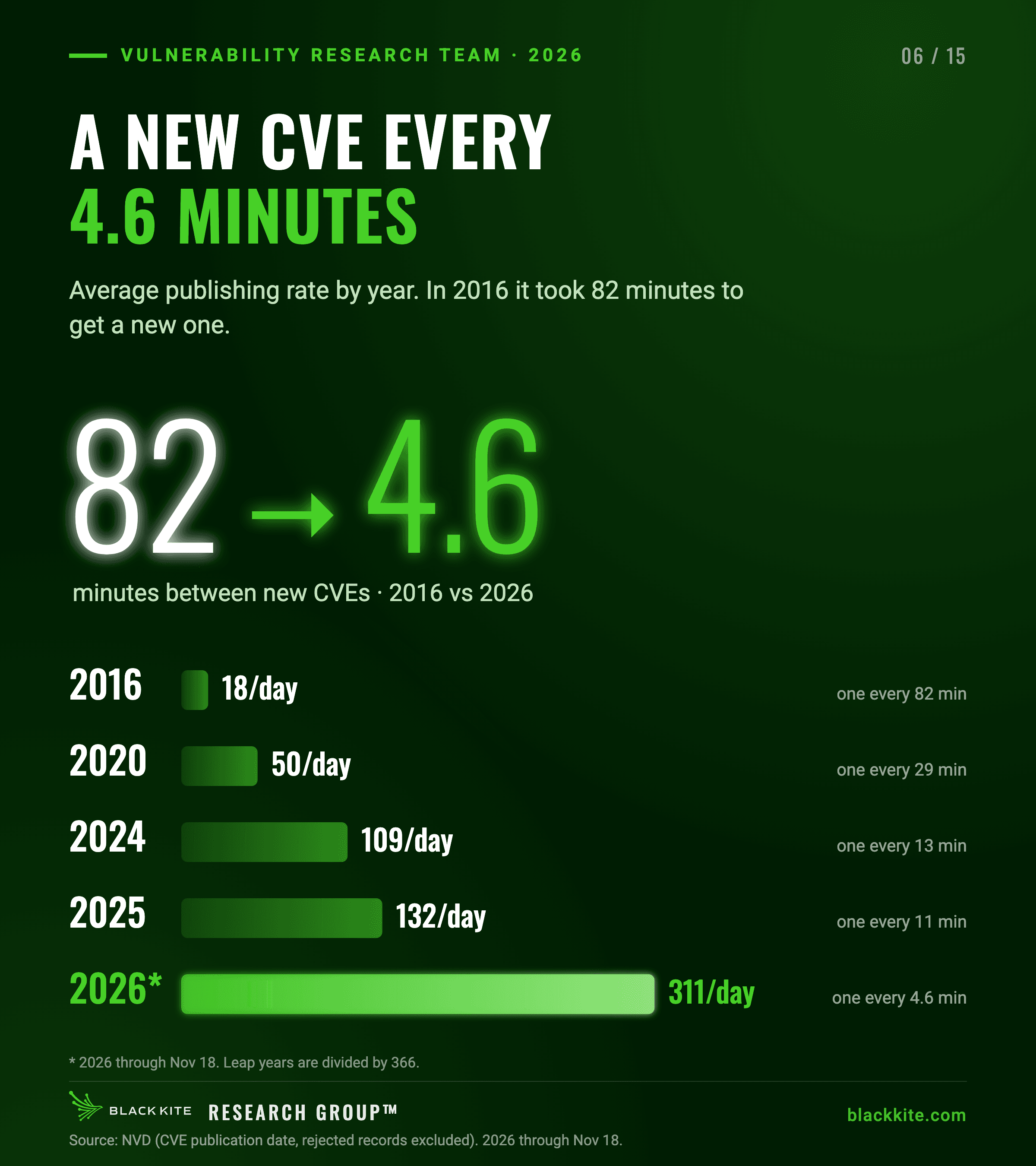
2026 left both earlier years behind by spring. October 2026 brought 17,051 CVEs, 4.0x October 2025 (4,273). November is on pace for about 16.9K, with 10,165 published from Nov 1 through Nov 18.
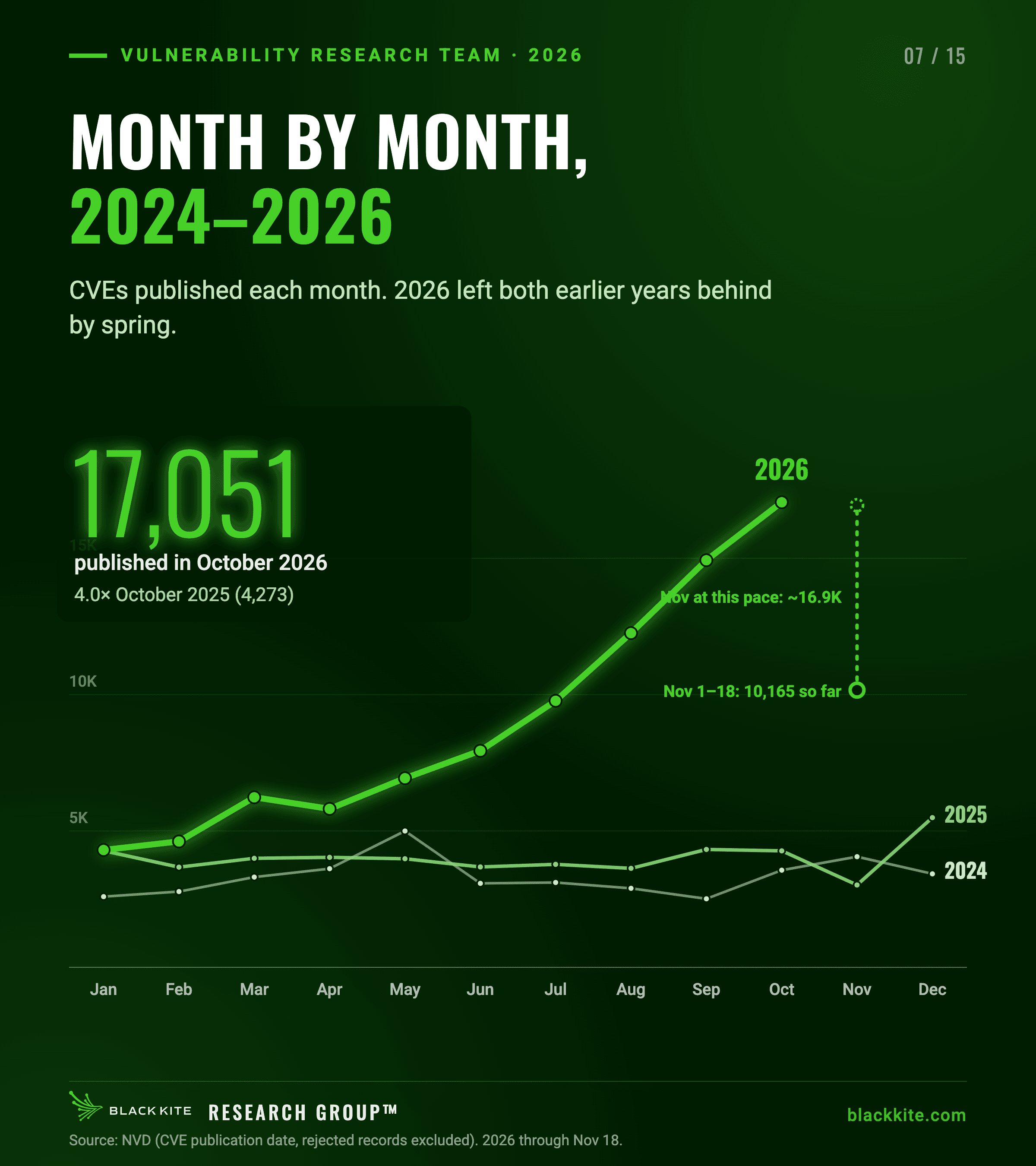
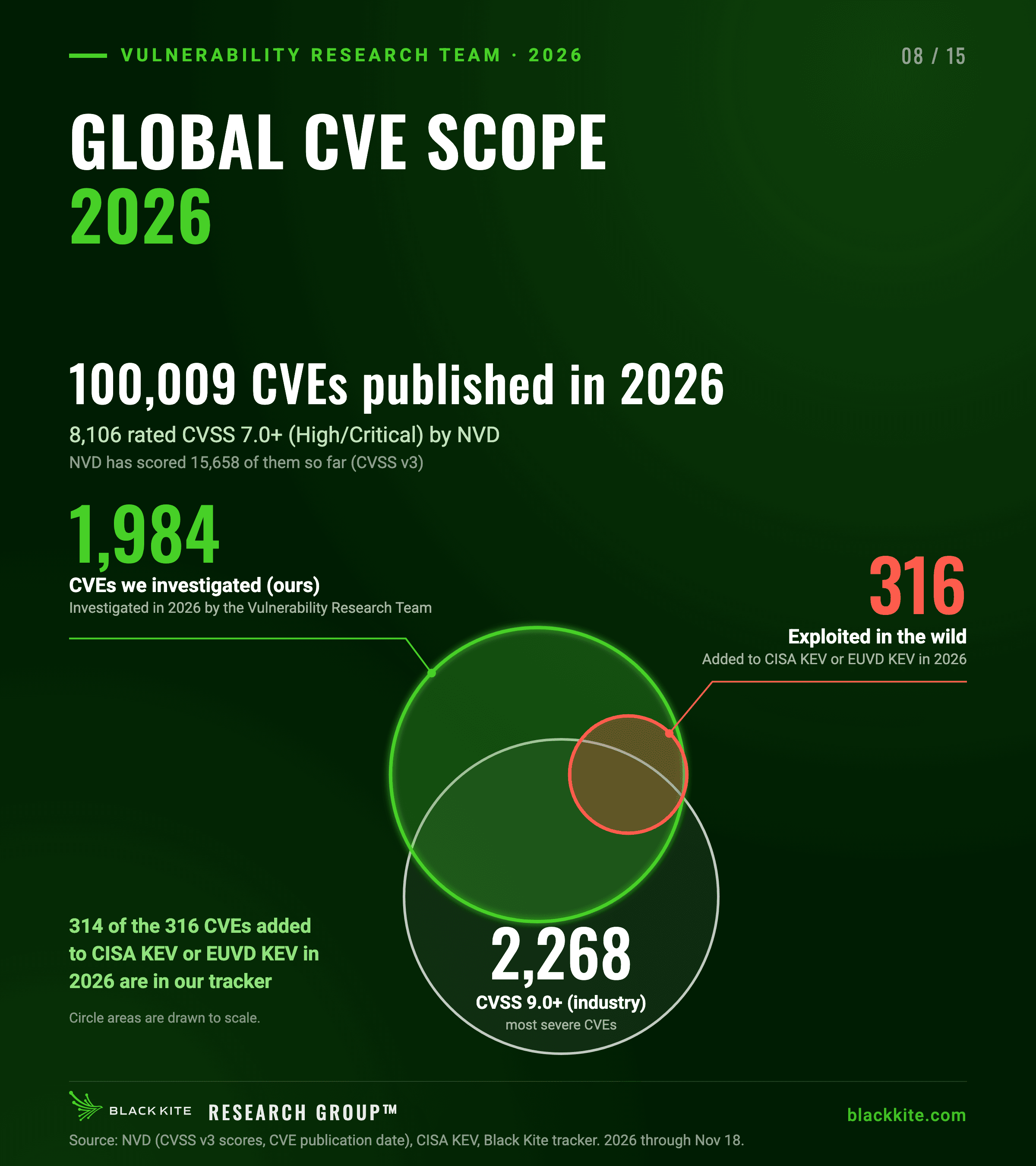
Of the 100,009 CVEs published in 2026, NVD has scored 15,658 so far (CVSS v3), and 8,106 are rated CVSS 7.0 or higher (High or Critical) by NVD. Another 2,268 carry a CVSS 9.0+ rating by industry scoring, the most severe tier.
The Vulnerability Research Team investigated 1,984 CVEs in 2026. 316 CVEs were added to CISA KEV or EUVD KEV this year (EUVD is the European Union Vulnerability Database), and 314 of them are in our tracker.
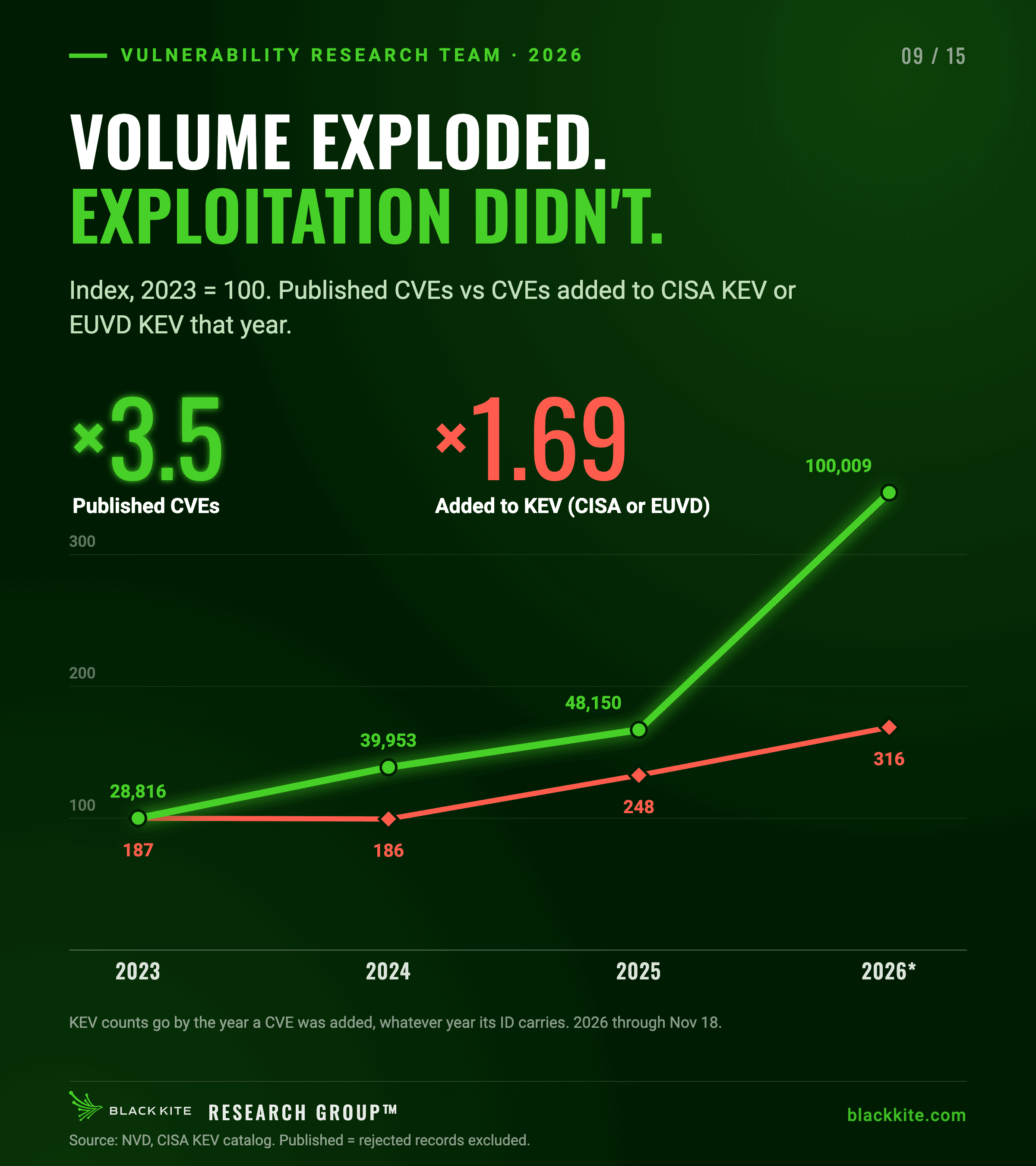
Since 2023, published CVEs grew 3.5x, from 28,816 to 100,009. CVEs added to CISA KEV or EUVD KEV grew 1.69x, from 187 to 316.
KEV counts go by the year a CVE was added, whatever year its ID carries. 2026 through Nov 18.
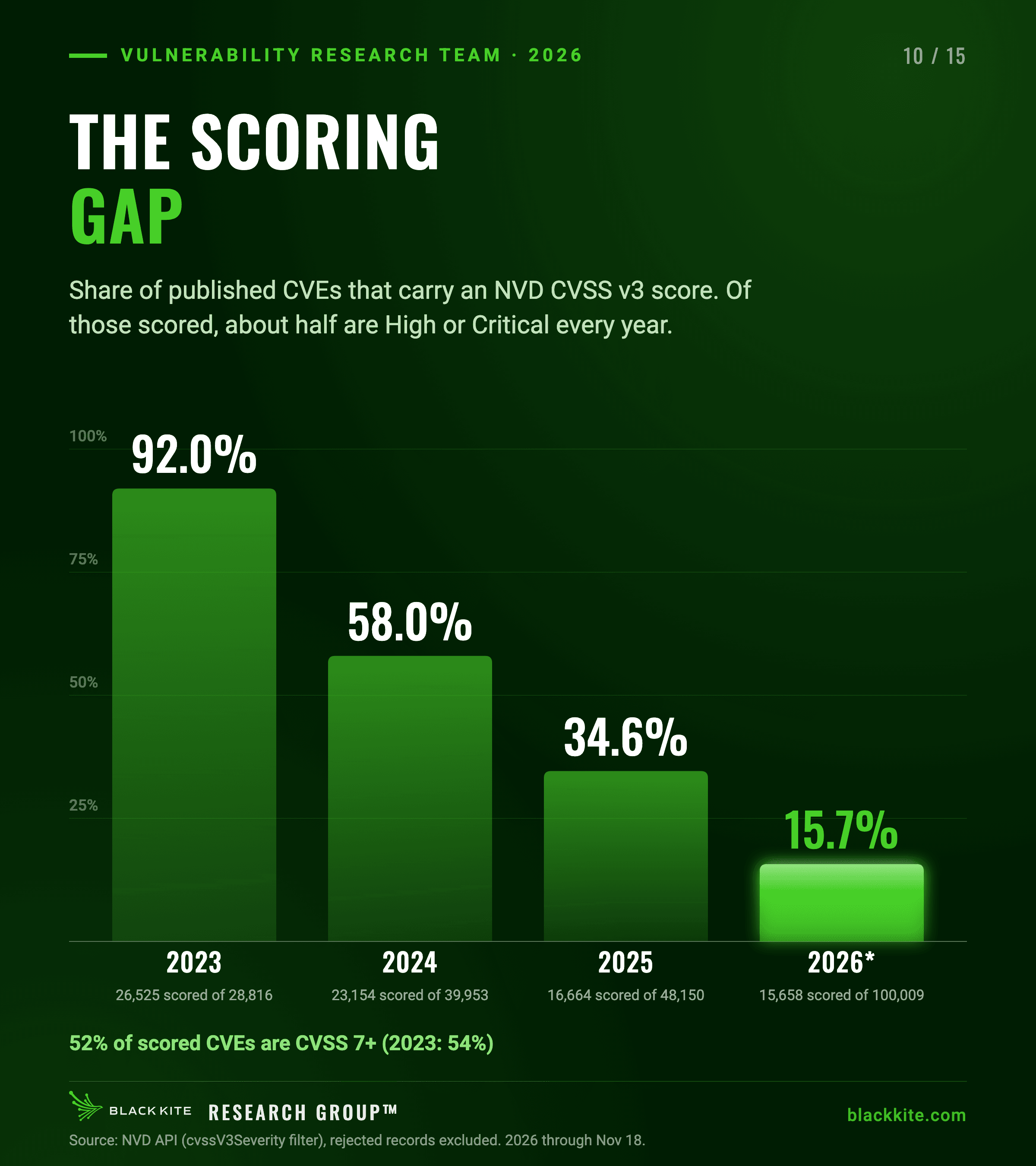
The share of published CVEs that carry an NVD CVSS v3 score fell from 92.0% in 2023 to 15.7% in 2026:
Of the CVEs that are scored, about half are High or Critical every year. 52% of scored CVEs are CVSS 7+ (2023: 54%).
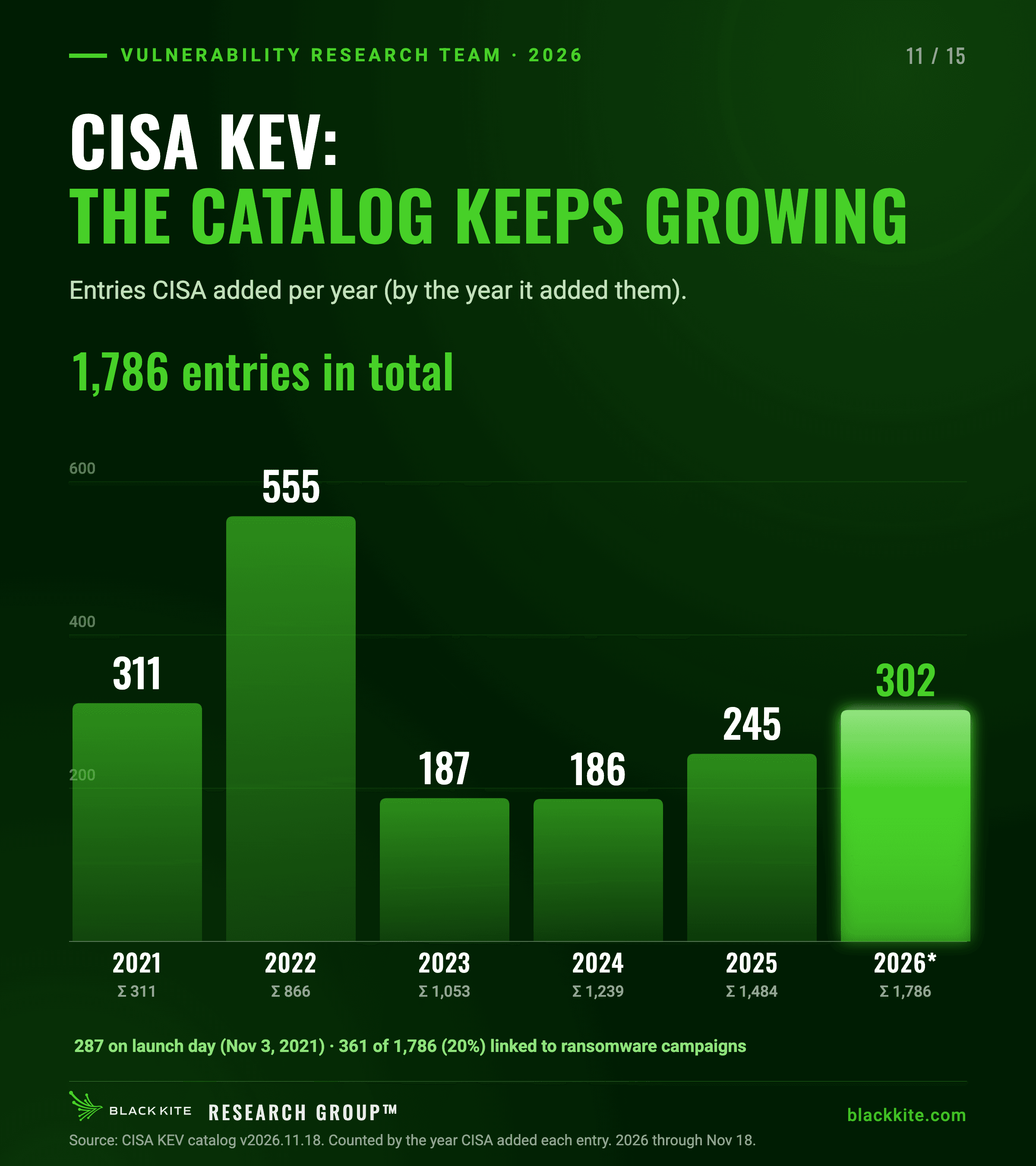
CISA has added 1,786 entries to the KEV catalog. 287 arrived on launch day (Nov 3, 2021), and 361 of the 1,786 (20%) are linked to ransomware campaigns. Entries added per year:
Counted by the year CISA added each entry. 2026 through Nov 18.
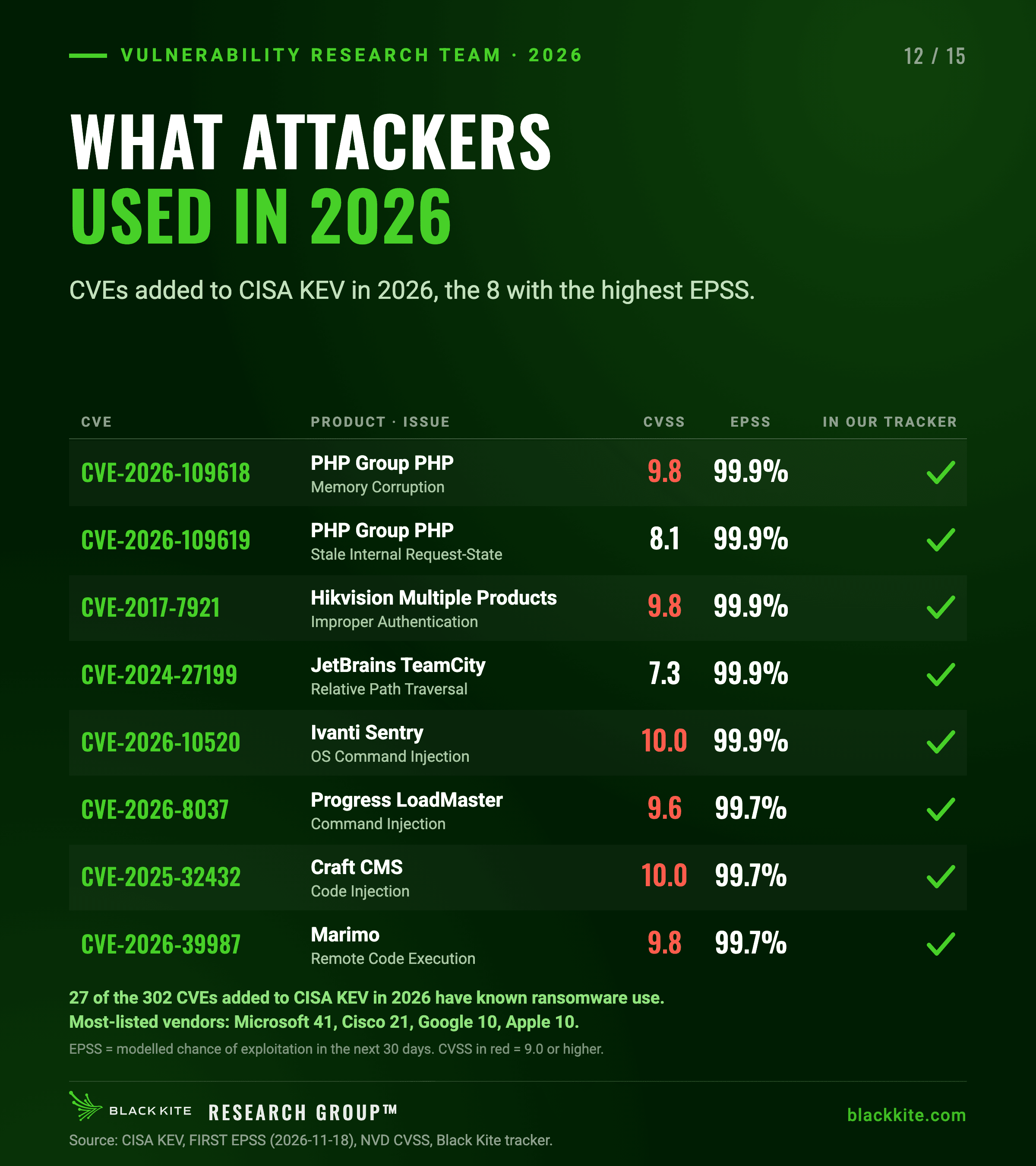
These are the 8 CVEs added to CISA KEV in 2026 with the highest EPSS, the modeled chance of exploitation in the next 30 days. All 8 are in our tracker.
| CVE | Product | Issue | CVSS | EPSS |
|---|---|---|---|---|
CVE-2026-109618 | PHP Group PHP | Memory Corruption | 9.8 | 99.9% |
CVE-2026-109619 | PHP Group PHP | Stale Internal Request-State | 8.1 | 99.9% |
CVE-2017-7921 | Hikvision Multiple Products | Improper Authentication | 9.8 | 99.9% |
CVE-2024-27199 | JetBrains TeamCity | Relative Path Traversal | 7.3 | 99.9% |
CVE-2026-10520 | Ivanti Sentry | OS Command Injection | 10.0 | 99.9% |
CVE-2026-8037 | Progress LoadMaster | Command Injection | 9.6 | 99.7% |
CVE-2025-32432 | Craft CMS | Code Injection | 10.0 | 99.7% |
CVE-2026-39987 | Marimo | Remote Code Execution | 9.8 | 99.7% |
CVE-2026-109618
PHP Group PHP
Memory Corruption
9.8
99.9%
CVE-2026-109619
PHP Group PHP
Stale Internal Request-State
8.1
99.9%
CVE-2017-7921
Hikvision Multiple Products
Improper Authentication
9.8
99.9%
CVE-2024-27199
JetBrains TeamCity
Relative Path Traversal
7.3
99.9%
CVE-2026-10520
Ivanti Sentry
OS Command Injection
10.0
99.9%
CVE-2026-8037
Progress LoadMaster
Command Injection
9.6
99.7%
CVE-2025-32432
Craft CMS
Code Injection
10.0
99.7%
CVE-2026-39987
Marimo
Remote Code Execution
9.8
99.7%
27 of the 302 CVEs added to CISA KEV in 2026 have known ransomware use. The most-listed vendors are Microsoft (41), Cisco (21), Google (10) and Apple (10).
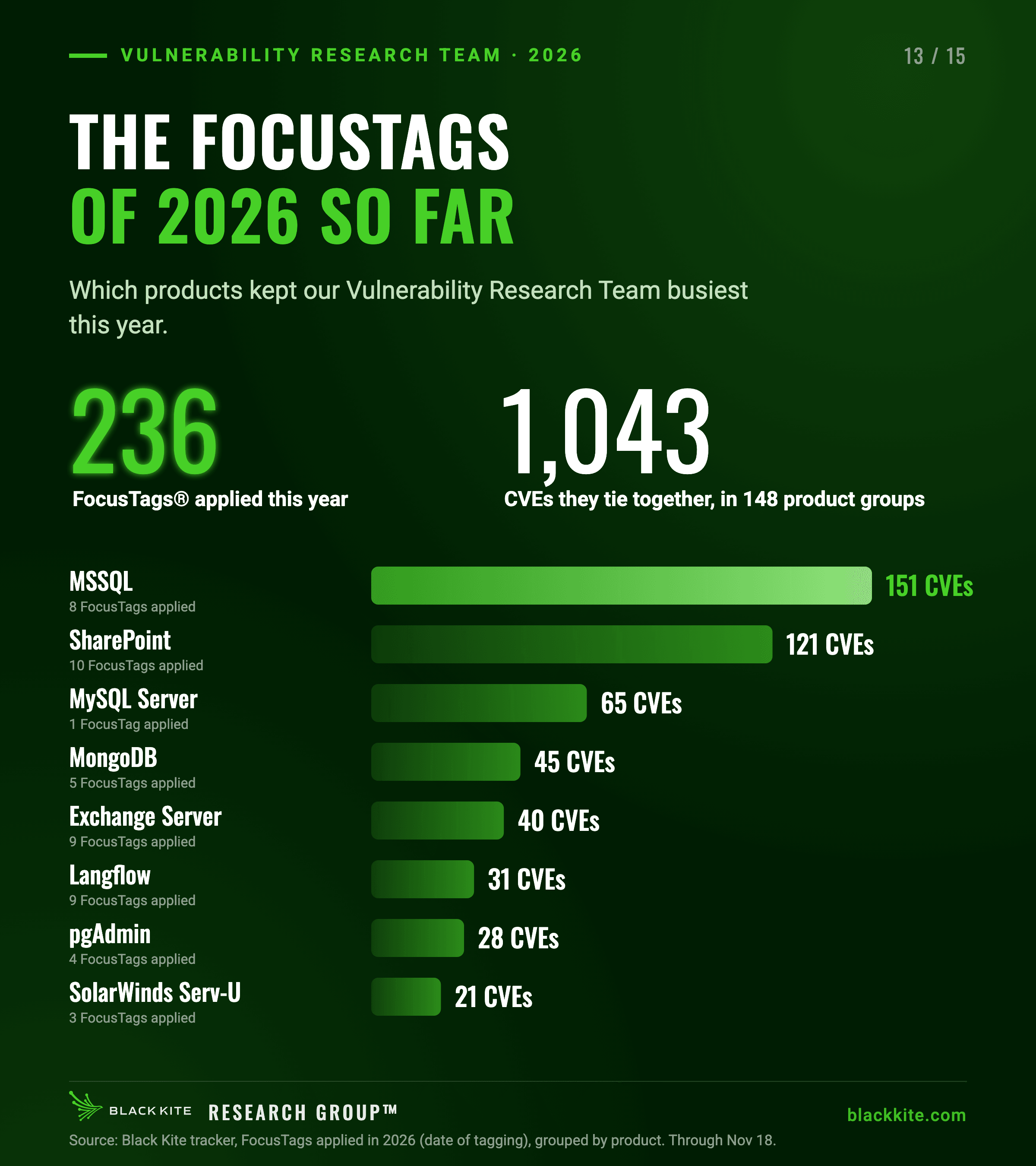
The Vulnerability Research Team applied 236 FocusTags® in 2026, tying together 1,043 CVEs across 148 product groups. A FocusTag is a bridge between a global threat and your specific ecosystem risk. These products kept the team busiest:
FocusTags applied in 2026 (date of tagging), grouped by product. Through Nov 18.
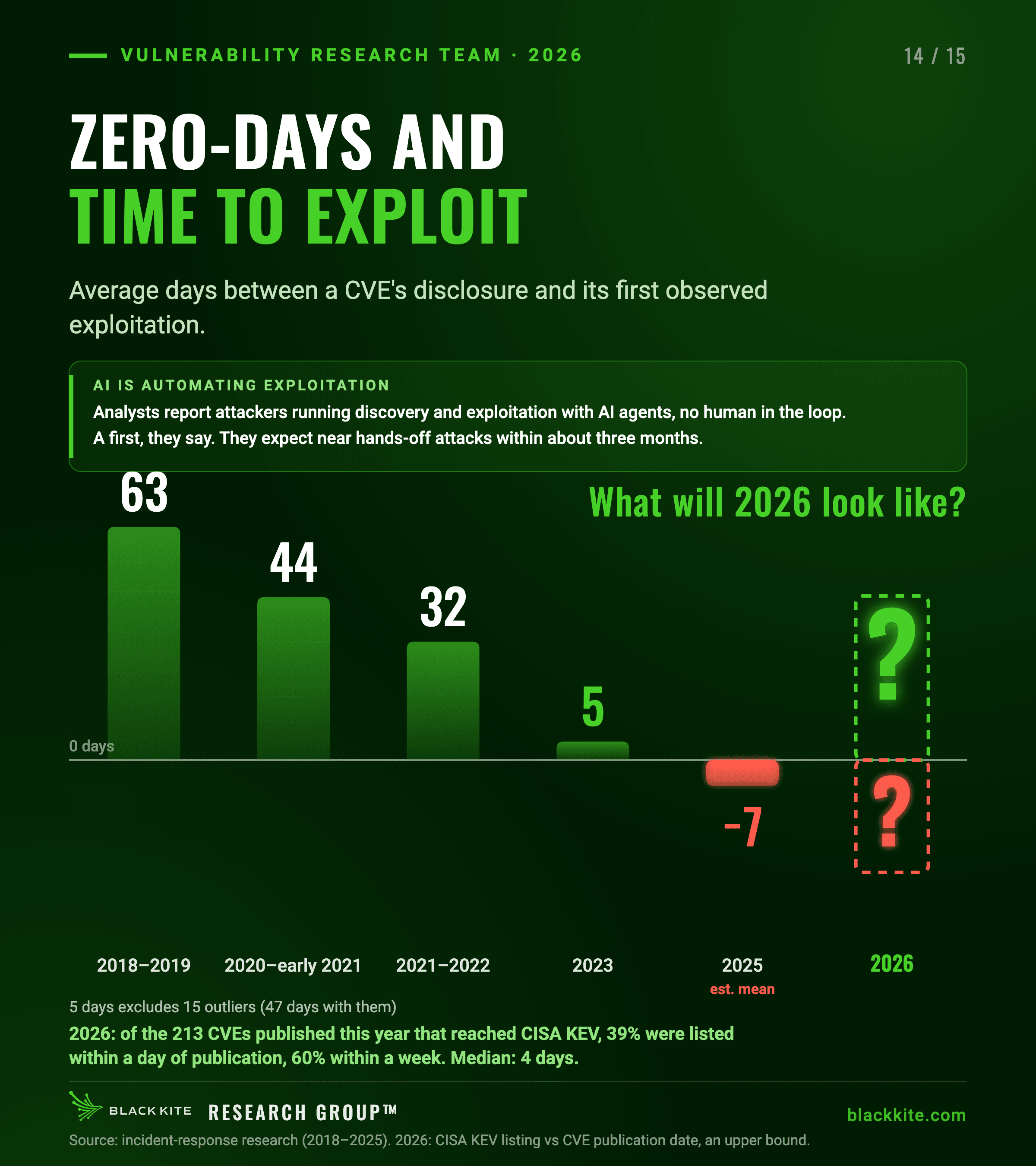
Average days between a CVE's disclosure and its first observed exploitation:
AI is automating exploitation. Analysts report attackers running vulnerability discovery and exploitation with AI agents and no human in the loop, a first, and expect near hands-off attacks within about three months.
What will 2026 look like? Of the 213 CVEs published this year that reached CISA KEV, 39% were listed within a day of publication and 60% within a week. The median is 4 days. KEV listing against CVE publication date is an upper bound.
Source: incident-response research (2018–2025).
100,009 CVEs have been published in 2026 so far. The Vulnerability Research Team has investigated 1,984 of them.
For third-party cyber risk management (TPCRM), the job is not counting every CVE. It is knowing which ones can be exploited and which of your vendors are exposed. FocusTag intelligence shows which vendors in your portfolio are exposed, so you can act first on those.
Every Supplier. Every Risk.™
Sources: NVD (by publication date, rejected records excluded), CISA KEV, EUVD, FIRST EPSS, NIST, Black Kite tracker. 2026 data through Nov 18.