FOCUS FRIDAY: TPRM Insights on Critical Vulnerabilities in Java4Shell [Suspected], Optimizely Supply Chain Attack, NGINX2Root, 4EverAble2Shell & Agent2Shell [Suspected], PostgreSQL, Oracle TNS Listener Expiration, and Oracle WebLogic Server
Introduction
This week's Focus Friday highlights seven significant vulnerability events that TPRM professionals must prioritize: a suspected memory-corruption flaw in Java's Base64 decoding that can enable remote code execution on specific hardware; an active supply-chain attack through a trusted JavaScript delivery service that compromised hundreds of customer websites; a cluster of remotely exploitable flaws in a widely used web server and reverse proxy that can lead to full host compromise; two linked exploit chains against a remote monitoring and management platform used by managed service providers, one already under active exploitation; a batch of high-severity code execution flaws in a widely deployed open-source database; a set of maximum-severity flaws in a database's network listener reachable with only the most basic login privilege; and a cluster of fully unauthenticated, unauthenticated-exploitable flaws in an enterprise application server.
These events share a common thread: each touches infrastructure or software components that sit deep inside enterprise technology stacks and supply chains, often invisible to a vendor's own customers until something goes wrong, yet each can translate into direct business impact—data theft, service disruption, or full system takeover—for any organization relying on the affected vendor. For a vendor portfolio, this underscores the need to look beyond self-reported assurances and into real exposure, since the same software or platform can sit behind dozens of seemingly unrelated vendors. Black Kite's FocusTag® intelligence identifies which vendors in a portfolio are exposed to each of these issues and surfaces the specific assets tied to that exposure, allowing TPRM teams to move from general awareness to targeted action.
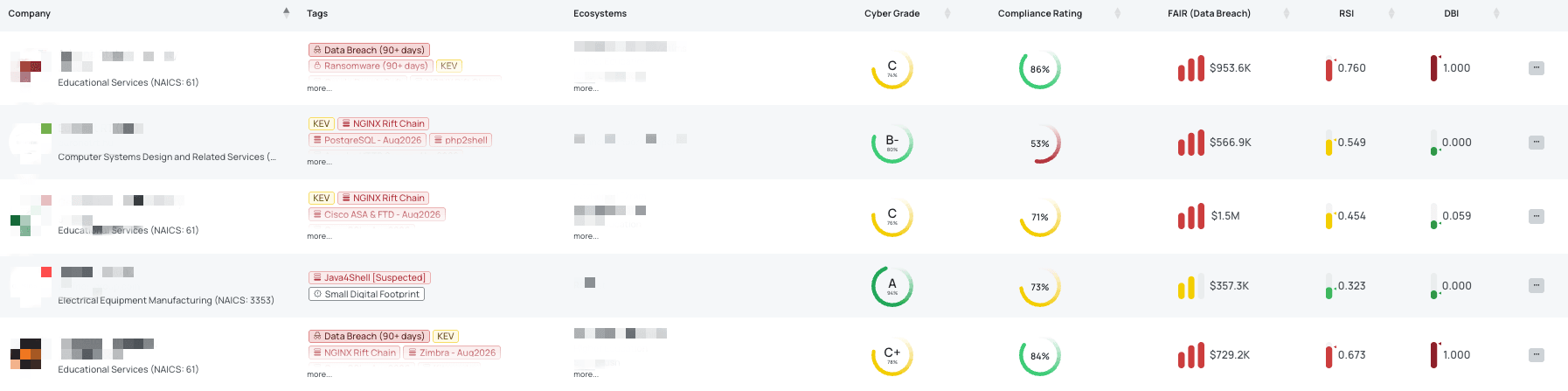
Filtered view of vendors with the Java4Shell [Suspected] FocusTag® on the Black Kite platform.
Java4Shell [Suspected]
What is this vulnerability?
CVE-2026-114938, publicly dubbed "Java4Shell" (suspected naming), is a heap out-of-bounds write vulnerability (CWE-787) in OpenJDK HotSpot's x86-64 Base64 decoding intrinsic. Researcher Quang Luong of Calif disclosed the flaw on November 17, 2026, when OpenJDK and Oracle released coordinated patches. Black Kite's analysis rates the flaw CVSS 8.1 with an EPSS of 0.734%. The bug sits in the JIT-compiled, AVX-512 VBMI-accelerated code path that Java uses to decode Base64 data after repeated calls trigger compilation to the native C2 tier. A malformed input ending in an extra padding character causes a miscalculated store mask, producing a 64-byte out-of-bounds write past a 50-byte heap allocation. Researchers demonstrated that chaining this primitive with controlled heap grooming ("remote Heap Feng Shui") can escalate a fixed-offset overwrite into a heap-read primitive they call JavaBleed and, in some configurations, into remote code execution.
The flaw is hardware-dependent: only x86-64 processors with AVX-512 VBMI support are affected, including Intel Xeon Ice Lake, Sapphire Rapids, Emerald Rapids, and Granite Rapids, and AMD EPYC/Ryzen Zen 4 and newer; ARM64 deployments are not vulnerable. Affected software spans Java 17.0.6 and later on the 17, 21, 25, and 27 lines across all major OpenJDK distributions, plus GraalVM for JDK 17.0.21.0.3, GraalVM for JDK 21.0.13.0.3, and GraalVM Enterprise Edition 21.3.20.0.3; Oracle and OpenJDK shipped fixes on November 17, 2026, Amazon has patched Corretto, and Red Hat's fix was still pending as of reporting. A public proof-of-concept exists that triggers the crash and memory leak, but Black Kite's analysis confirms the vulnerability is not yet exploited in the wild, is not in CISA's Known Exploited Vulnerabilities (KEV) Catalog, and is not a zero-day. Independent labs (Upwind, Blackpoint Cyber) have reproduced the memory corruption and crash conditions but not full remote code execution; the researchers withheld weaponized, application-specific exploit chains for products including Keycloak, Atlassian Jira, Atlassian Confluence, JFrog Artifactory, Jenkins, and PingFederate (pre-authentication) and Apache Kafka, Apache Solr, Elasticsearch, Gerrit, and Spinnaker (post-authentication). This [Suspected] tag designation reflects that actual exposure depends on underlying server CPU architecture, which cannot be confirmed from internet-facing data alone.
Why should TPRM professionals care?
Because the flaw lives inside the OpenJDK runtime itself rather than in a single library, it is inherited by every Java application built on an affected JDK version and run on vulnerable hardware, with no application-layer code change required to become exposed. For TPRM professionals, this creates a wide and hard-to-scope blast radius: a vendor's authentication layer, SSO provider, CI/CD pipeline, artifact repository, or search infrastructure could all be running the same vulnerable Base64 decoding path, and any feature that processes Base64 input — login headers, SAML artifacts, CSRF tokens, file uploads — is a potential entry point. The confirmed exposure in enterprise identity and DevOps platforms such as Keycloak, Jira, Confluence, Jenkins, and Artifactory means a successful exploit could compromise a vendor's authentication perimeter or software supply chain, both of which have downstream implications for every organization relying on that vendor. The hardware dependency also means risk cannot be assessed from software inventory alone, making vendor disclosure of both patch status and underlying CPU architecture essential.
What questions should TPRM professionals ask vendors?
- Have you identified which of your internet-facing Java applications run on x86-64 hardware with AVX-512 VBMI support (Intel Ice Lake/Sapphire Rapids/Emerald Rapids/Granite Rapids or AMD Zen 4 and newer), and have you confirmed whether any of them remain on an unpatched JDK 17.0.6+, 21, 25, or 27 build?
- Have you applied the November 17, 2026 OpenJDK and Oracle patches, or equivalent vendor-specific fixes, to all affected JDK and GraalVM installations, including Amazon Corretto and Red Hat OpenJDK builds?
- Do you operate any of the six products confirmed to allow pre-authentication exploitation (Keycloak, Atlassian Jira, Atlassian Confluence, JFrog Artifactory, Jenkins, PingFederate), and if so, what compensating controls have you applied pending patch deployment?
- Have you reviewed logs for unusual volumes of malformed Base64 input or repeated authentication attempts that could indicate exploitation attempts or JIT-warming behavior associated with CVE-2026-114938?
Remediation recommendations
- Upgrade all OpenJDK, Oracle JDK, GraalVM, and GraalVM Enterprise Edition installations to the patched builds released on November 17, 2026, prioritizing systems on AVX-512 VBMI-capable hardware.
- Confirm vendor-specific build status for Amazon Corretto (patched), and track Red Hat OpenJDK patch availability separately, applying it as soon as it ships.
- Inventory internet-facing and internally exposed Java applications that use the java.util.Base64 API for authentication, SAML, CSRF token, or file-upload processing, and prioritize patching for Keycloak, Jira, Confluence, Artifactory, Jenkins, and PingFederate deployments.
- Where immediate patching is not possible, consider placing a request-buffering reverse proxy in front of affected applications, noting that this mitigates but does not fully block all attack variants.
- Monitor JVM crash logs and application error rates for spikes correlated with malformed Base64 input, which may indicate failed exploitation attempts.
- Rotate session tokens, API keys, and credentials on systems where the JavaBleed heap-disclosure primitive could plausibly have exposed secrets, particularly on unpatched identity and SSO infrastructure.
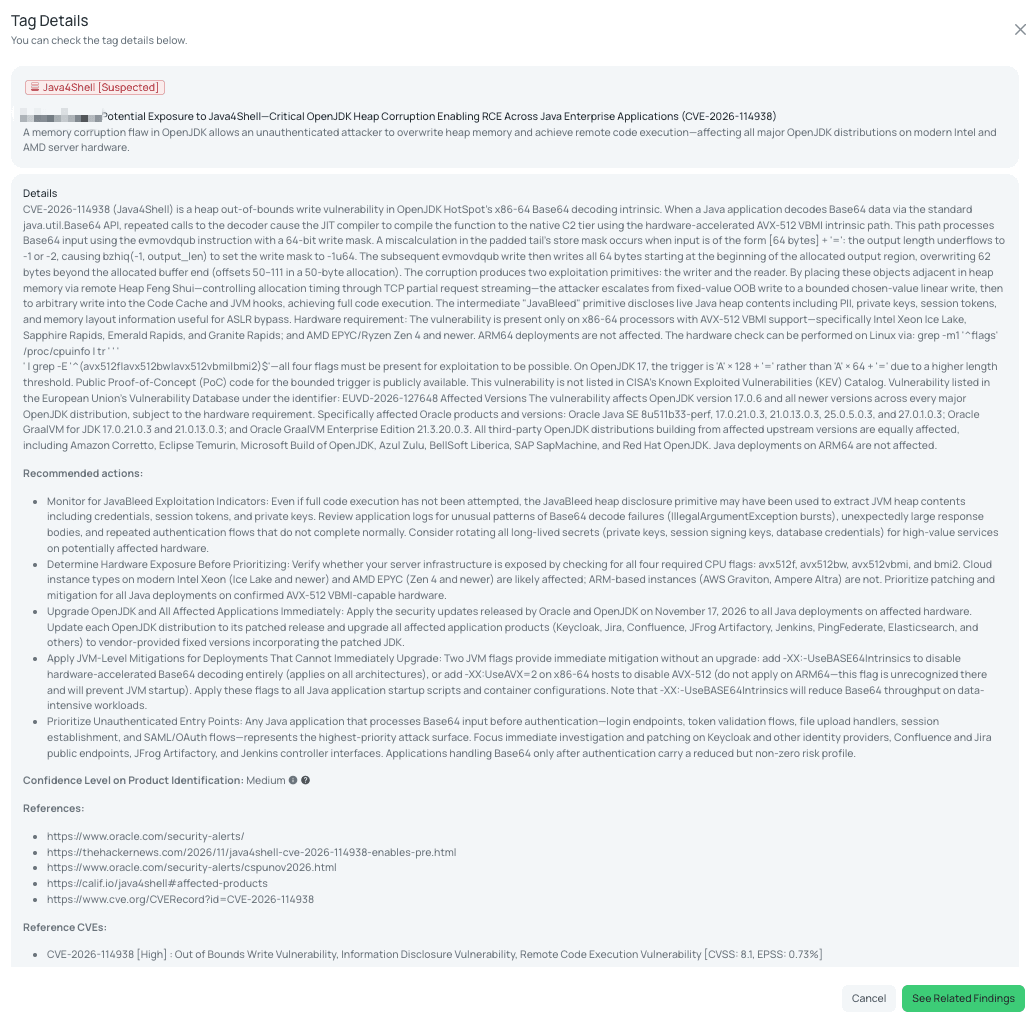
Black Kite's Java4Shell [Suspected] FocusTag® details critical insights on the event for TPRM professionals.
Optimizely Supply Chain Attack
What is this vulnerability?
On November 16, 2026, Optimizely confirmed that an unauthorized party exploited a vulnerability in the account signup flow of its Experimentation (Optimizely Web) product to inject malicious JavaScript into the "Project JavaScript" field of customer projects. No CVE identifier, CVSS score, or CWE classification has been published, and Optimizely has not disclosed the technical mechanism of the exploit. Because the tampered files continued to be served from Optimizely's own trusted content delivery network, cdn.optimizely.com, under its valid certificate, browsers treated the injected code as fully trusted, bypassing domain allow-lists and most Content Security Policies that simply permitted the Optimizely domain. Researcher Scott Helme of Report URI first uncovered the activity, identifying 188 infected Optimizely JavaScript files across 178 organizations out of 1,611 snippets analyzed, with researchers believing the actual number of affected organizations is higher. Affected sites included Zoom, CNN, Fox News, the BBC, Salesforce, GitLab, IKEA, HSBC, Equifax, Air France-KLM, Ledger, and Peacock; banks and financial firms made up the largest victim group at 32 organizations.
The injected code was a multi-purpose toolkit that scanned pages and clipboards for cryptocurrency wallet addresses across multiple chains and substituted attacker-controlled addresses, hooked payment form submissions to capture card numbers, expiry dates, and CVV codes, collected page URLs, JavaScript-readable cookies, and screenshots, and routed iPhone, iPad, and iPod visitors to the Coruna and DarkSword iOS exploit kits based on device version. The attacker built in resilience through Base64-obscured loaders and a backup payload that executed via eval if the primary domain was blocked, and rebuilt the payload at least 26 times in a single day. Verified cryptocurrency theft totaled roughly $7,000 to $7,150 before the wallets were emptied; the scale of card skimming and cookie theft remains unknown. Related tampered responses using similar loader and hosting infrastructure were traced to three other third-party services — Kissmetrics, StorifyMe, and minute-ly — as early as November 13, 2026, though shared infrastructure does not confirm a single operator. There is no CVE assignment and no indication this is listed in CISA's Known Exploited Vulnerabilities (KEV) Catalog, since no CVE exists to list; exploitation is confirmed active as a supply-chain attack rather than a traditional server-side vulnerability. Optimizely states it has blocked the vulnerable signup path, deployed a fix, removed injected code, ended active sessions, revoked tokens, reset access for affected accounts, and blocked unauthorized code delivery through Cloudflare. As a SaaS platform issue, no customer-side version number or patch applies, and no workaround exists beyond Optimizely's own remediation other than a sufficiently strict Content Security Policy that does not simply allow-list the Optimizely domain.
Why should TPRM professionals care?
Experimentation and personalization scripts like Optimizely Web run with full page-level trust on every website that embeds them, meaning a vendor's own content delivery pipeline can become a direct channel for compromising thousands of end users without the vendor's own servers or the customer's servers ever being breached. For TPRM professionals, this incident is a reminder that fourth-party and embedded-script risk can bypass a company's entire security posture: a strict internal security program offers no protection if a trusted third-party domain is itself delivering malicious code, and only 24 of 256 reviewed hosts in this campaign had a Content Security Policy strict enough to block the payload. Portfolio companies using Optimizely Web may have unknowingly distributed cryptocurrency-theft, payment-card-skimming, cookie-exfiltration, and iOS exploit-delivery code to their own customers and visitors, creating downstream liability, regulatory notification obligations, and reputational exposure that TPRM teams need to identify and track independent of any CVE or patch cycle.
What questions should TPRM professionals ask vendors?
- Have you reviewed the Project JavaScript field and the full change history of every Optimizely Web project your organization operates for unauthorized edits made on or around November 16, 2026?
- Has your organization obtained written confirmation from Optimizely that your specific account's tokens, sessions, and access have been reset following the incident?
- Did your website's Content Security Policy actually block script execution from cdn.optimizely.com during the exploitation window, or did it merely allow-list the domain without restricting script behavior?
- Have you searched DNS, proxy, WAF, and CSP logs back to November 13, 2026 for the indicators 1688360[.]cc, webshell[.]lol, and 5vobauua3ojpklx[.]icu, including Base64-obscured references to them?
Remediation recommendations
- Review the Project JavaScript field and all custom experiment code in every Optimizely Web project, checking change history for edits around November 16, 2026, and remove any code that is not recognized.
- If the snippet's integrity cannot be confirmed, disable it until a clean state is verified; do not rely on a clean scan today as proof the site was never affected, since injected code has already been removed platform-wide.
- Reset Optimizely account passwords, audit users and API tokens, and enforce MFA or SSO on all Optimizely accounts.
- Search DNS, proxy, WAF, and CSP logs back to November 13, 2026 for 1688360[.]cc, webshell[.]lol, and 5vobauua3ojpklx[.]icu, and also search page source for atob( calls and inline eval blocks since the malicious URL was Base64-obscured.
- Treat any payment cards entered on affected pages on November 16, 2026 as potentially exposed, notify payment processors, and follow PCI and applicable legal notification obligations; revoke sessions and tokens tied to cookies stored without the HttpOnly flag.
- Deploy a strict Content Security Policy with script-src and connect-src directives starting in report-only mode, avoid relying on Subresource Integrity for the Optimizely snippet since its content changes with experiments, and instead monitor the served file for unexpected changes while maintaining an inventory of all third-party scripts.
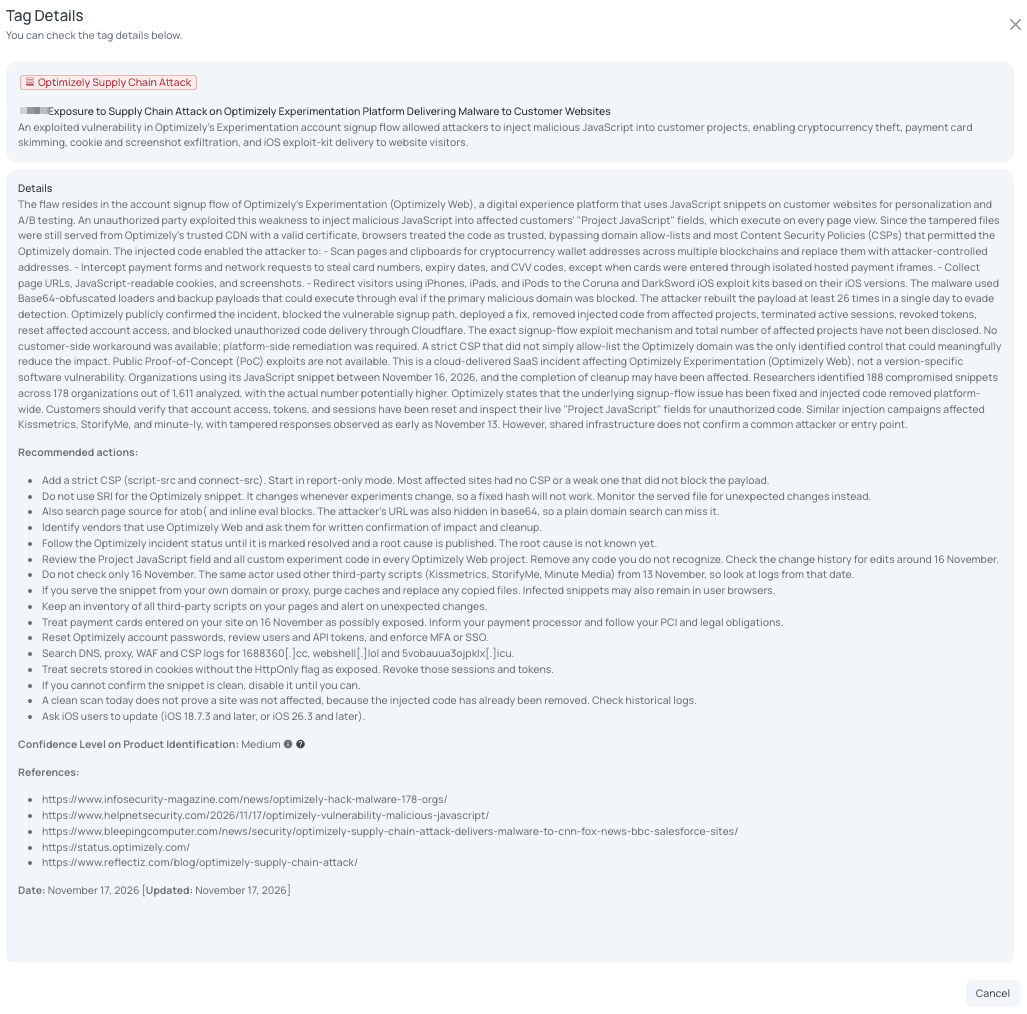
Black Kite's Optimizely Supply Chain Attack FocusTag® details critical insights on the event for TPRM professionals.
NGINX2Root
What is this vulnerability?
F5 has patched five vulnerabilities in NGINX Open Source and NGINX Plus, collectively disclosed as NGINX2Root by researchers at Xint: CVE-2026-123007, CVE-2026-123633, CVE-2026-123634, CVE-2026-121810, and CVE-2026-113425. All five carry a CVSS v3.1 score of 8.1 per Black Kite's analysis (vendor materials cite a CVSS v4.0 score of up to 9.2) and an EPSS of 0.02%. Four are use-after-free issues (CWE-416) in the HTTP/3 module, the HTTP/2 proxying path, the DNS resolver, and the mail proxy module, while CVE-2026-123007 is an integer underflow in the HTTP/2 flow control accounting logic (ngx_http_v2_module) that produces a heap buffer overflow. All five sit in the NGINX data plane and can be triggered remotely by unauthenticated attackers through crafted network traffic, without any prior authentication.
None of the five CVEs are listed in CISA's Known Exploited Vulnerabilities (KEV) Catalog as of this writing, and Black Kite's analysis confirms no in-the-wild exploitation has been observed. Public proof-of-concept exploit code exists for CVE-2026-123007 and has been published on GitHub, though reliable exploitation reportedly requires transmitting roughly 128 GB of HTTP/2 traffic and relies on specific x86-64 glibc AVX-512 memcpy routines; PoC status for the other four CVEs is unconfirmed. CVE-2026-123007 is the most severe finding because it affects every official NGINX release from 1.9.5 through 1.31.8 wherever HTTP/2 is enabled, a configuration used on most modern TLS-terminated endpoints, and researchers demonstrated it can be chained with a separate Linux kernel SCTP flaw to escalate from worker-process code execution to full host root compromise, including escaping a Docker container in testing. Fixes are available in NGINX Open Source 1.31.9 and 1.30.7, and in NGINX Plus 37.3.0.1 and 37.0.8.1; NGINX Plus R33 through R36 have no direct hotfix and must migrate to a patched 37.x release. Downstream products bundling NGINX, including NGINX Ingress Controller, NGINX Gateway Fabric, and various Linux distribution packages, are also affected pending vendor backports.
CVE | CVSS | Vulnerability Name | Short Description |
|---|---|---|---|
CVE-2026-113425 | 8.1 | Mail Proxy Use-After-Free (RCE) | UAF in ngx_mail_proxy_module via crafted mail sessions, can lead to worker RCE |
CVE-2026-121810 | 8.1 | HTTP/3 Use-After-Free (RCE) | UAF in ngx_http_v3_module during QUIC stream handling under connection limits |
CVE-2026-123007 | 8.1 | HTTP/2 Integer Underflow Heap Overflow (RCE) | Flow-control accounting underflow in ngx_http_v2_module, public PoC available |
CVE-2026-123633 | 8.1 | HTTP/2 Backend Proxy Use-After-Free (RCE) | UAF in ngx_http_v2_module when proxying to upstream under connection exhaustion |
CVE-2026-123634 | 8.1 | Resolver Use-After-Free (RCE) | UAF in DNS resolver triggered by variable proxy_pass with mirror/SSI subrequests |
Why should TPRM professionals care?
NGINX is deployed as a reverse proxy, load balancer, API gateway, and Kubernetes Ingress Controller across a large share of internet-facing infrastructure, meaning a vendor's exposure here often sits directly on the perimeter of its production environment. An unauthenticated, remote attack chain that can move from worker-process compromise to full host root — as demonstrated with CVE-2026-123007 chained against a Linux kernel SCTP flaw — represents a worst-case scenario for TPRM: a single misconfigured edge server can become a foothold for complete infrastructure takeover, with downstream risk to every application and data flow the vendor routes through that proxy layer. Because the vulnerable code has existed since 2015 and spans HTTP/2, HTTP/3, DNS resolution, and mail proxy configurations, portfolio-wide exposure is likely to be broad, and the availability of public PoC code for the most severe flaw shortens the window before opportunistic exploitation becomes practical.
What questions should TPRM professionals ask vendors?
- Have you upgraded all NGINX Open Source and NGINX Plus instances to 1.31.9/1.30.7 or 37.3.0.1/37.0.8.1 respectively, and did you perform a full service restart rather than a configuration reload to replace the vulnerable binary in memory?
- Do any of your internet-facing NGINX listeners have HTTP/2 enabled, and if patching is delayed, have you disabled HTTP/2 on those listeners to mitigate CVE-2026-123007 and CVE-2026-123633?
- Are you using NGINX Plus R33 through R36, and if so, what is your timeline for migrating to a patched 37.x release given that no direct hotfix exists for those versions?
- Do any of your NGINX configurations use variable-based proxy_pass destinations combined with mirror or SSI subrequests, which would expose CVE-2026-123634 even with HTTP/2 disabled?
Remediation recommendations
- Upgrade all affected NGINX Open Source deployments to 1.31.9 or 1.30.7, and NGINX Plus deployments to 37.3.0.1 or 37.0.8.1, migrating off R33-R36 as there is no direct hotfix for those releases.
- Perform a full service restart (systemctl restart nginx) after patching rather than a configuration reload, since a reload does not replace the running vulnerable binary in memory.
- If immediate patching is not possible, disable HTTP/2 on internet-facing listeners to mitigate CVE-2026-123007 and CVE-2026-123633, and verify externally with openssl s_client that ALPN no longer negotiates h2.
- Replace variable-based proxy_pass directives used with mirror or SSI subrequests with static upstream blocks to eliminate the request-time DNS resolution race behind CVE-2026-123634, and disable HTTP/3 (quic off, http3 off) and block inbound UDP/443 to mitigate CVE-2026-121810.
- Restrict mail proxy listeners to trusted networks only to reduce exposure to CVE-2026-113425, and verify Linux distribution packages for vendor-backported fixes where the upstream version string is unchanged.
- Enforce full ASLR (randomize_va_space = 2) on all Linux hosts running NGINX and apply kernel patches for the related SCTP flaw, disabling the SCTP kernel module where not required, to break the host root escalation chain; monitor NGINX error logs for worker segmentation faults, unexpected restarts, and abnormal HTTP/2 traffic volumes.
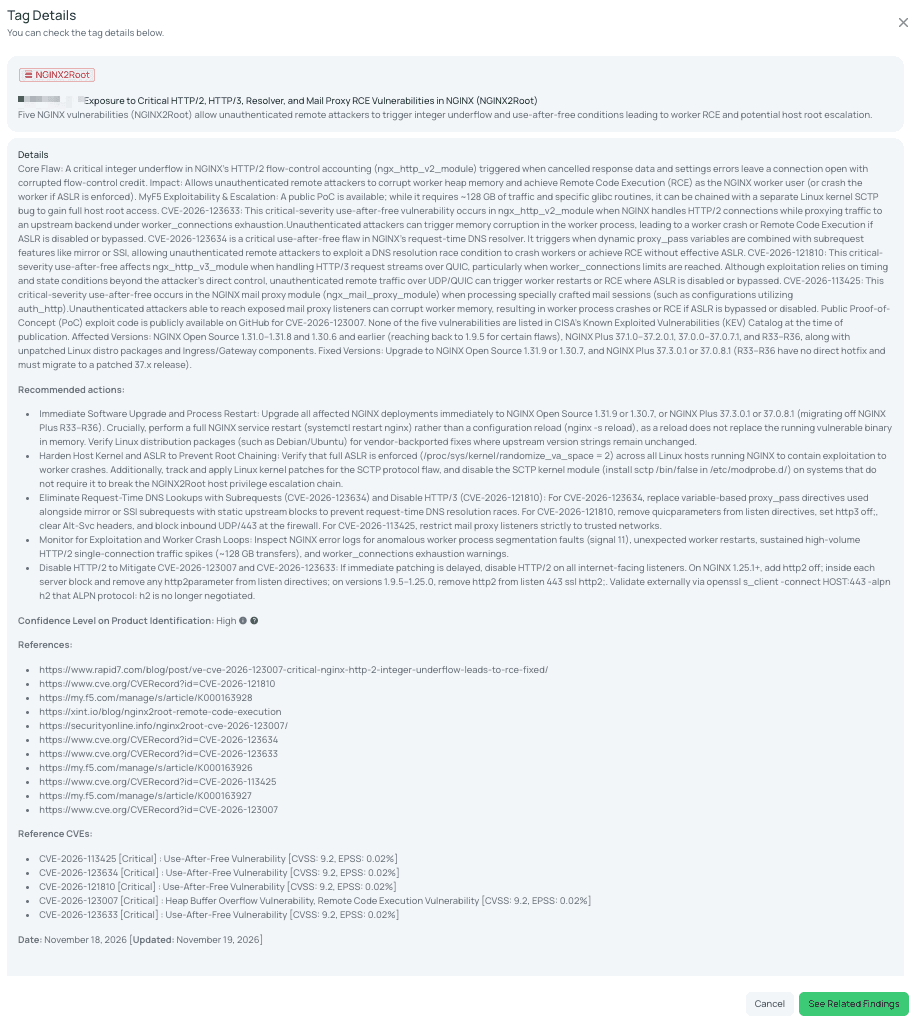
Black Kite's NGINX2Root FocusTag® details critical insights on the event for TPRM professionals.
4EverAble2Shell & Agent2Shell [Suspected]
What is this vulnerability?
4EverAble2Shell and Agent2Shell are two exploit sets published on November 12, 2026, by independent researcher Sean Bales against N-able N-central, a remote monitoring and management (RMM) platform used by managed service providers. 4EverAble2Shell is a two-stage, unauthenticated remote code execution chain: unsafe class instantiation in a bundled, end-of-life Apache Axis 1.x component (CVE-2026-90436, CVSS 9.8) lets a crafted SOAP fault achieve command execution as the low-privileged nable service account, after which abuse of the privileged setLDFileOwner helper and a symbolic link makes a root-owned script writable, allowing execution as root via serverControl. No CVE has been assigned to the chain as a whole, and the underlying Apache Axis component remains bundled and unpatched; N-able's remediation removes the attack path rather than fixing the flaw. Agent2Shell comprises more than ten reported zero-days in the communication between the N-central server and its Windows Agents and Probes, four of which N-able has now assigned CVE identifiers and fixed: CVE-2026-129274 (CVSS 8.7), a missing-authentication flaw in the ServerMMS2 RemoteExecutionTaskSubmit operation; CVE-2026-129276 (CVSS 6.9) and CVE-2026-129277 (CVSS 6.9), missing-authentication flaws in ServerMMS2 asset-data submission and ServerMMS maintenance-action read, respectively; and CVE-2026-129285 (CVSS 5.3), an origin-validation error in XMPP action-response handling. EPSS for these four ranges from 0.198% to 0.656%, and none of the four is listed in CISA's Known Exploited Vulnerabilities (KEV) Catalog or exploited in the wild according to Black Kite's analysis, though public proof-of-concept code exists for all of them. These disclosures followed three days after N-able's Able2Shell patch set (shipped November 10, 2026, as 2026.4 Hotfix 2) and were shown to work against that very hotfix, since the attack path depended on a non-default Legacy API configuration that HF2 did not address. Exploitation of the 4EverAble2Shell server chain began within roughly five hours of the proof-of-concept release, with 19 of 21 confirmed compromised servers already running Hotfix 2 — demonstrating that version-based exposure assessment was unreliable for this incident. N-able released 2026.4 Hotfix 3 on November 16, 2026, which permanently removes the Legacy API configuration option, closing the 4EverAble2Shell prerequisite, and patches the four assigned Agent2Shell CVEs. This was the sixth critical N-central security event of 2026 and the second within five days, following the Able2Shell disclosure.
CVE | CVSS | Vulnerability Name | Short Description |
|---|---|---|---|
CVE-2026-129274 | 8.7 | Missing Authentication (RCE Task Submission) | Unauthenticated submission of remote execution task results via ServerMMS2. |
CVE-2026-129276 | 6.9 | Missing Authentication (Asset Data Submission) | Unauthenticated submission of asset discovery data via ServerMMS2. |
CVE-2026-129277 | 6.9 | Missing Authentication (Information Disclosure) | Unauthenticated read of maintenance action data via ServerMMS MaintActionGet. |
CVE-2026-129285 | 5.3 | Origin Validation Error (Spoofing) | Server fails to verify origin of XMPP action responses, enabling spoofing. |
Why should TPRM professionals care?
RMM platforms like N-central sit at the center of a managed service provider's trust relationship with every downstream client network: the server holds credentials for, and push-execution capability against, every managed endpoint. A root compromise on an internet-facing N-central server is therefore not an isolated incident but a potential pivot point into every client environment the vendor manages, and the Agent2Shell component compounds this directly — root access on the server yields the appliance ID needed to attempt SYSTEM-level execution on managed Windows endpoints. For TPRM professionals, a vendor's exposure here is not fully captured by patch level alone, since compromised servers in this incident included systems already running the vendor's prior security update; exposure depended on configuration and network reachability, which is precisely the kind of detail that FocusTag® asset mapping is designed to surface.
What questions should TPRM professionals ask vendors?
- Have you upgraded your N-able N-central server to 2026.4 Hotfix 3 (build that permanently removes the Legacy API option), and can you provide the current build number as evidence?
- Have all Windows Agents and Probes connected to your N-central deployment been upgraded to the Hotfix 3-compatible release separately from the server, and what percentage remain unpatched or pending?
- Can you confirm whether your N-central web and SOAP endpoints (e.g., /dms/services/ServerUI and /dms2/services2/ServerMMS2) are fully isolated from the public internet behind a VPN or trusted management network rather than relying solely on IP allowlisting?
- Have you performed an indicator-of-compromise hunt on every N-central server that was ever internet-exposed – including checks for connections to 157.20.241[.]16, 139.99.69[.]109:10128, and 79.76.51[.]56:39100, and persistence artifacts like /etc/systemd/system/xvd.service or /etc/cron.d/xvd – and what were the results?
Remediation recommendations
- Apply N-able N-central 2026.4 Hotfix 3 immediately; it permanently removes the Legacy API configuration option that is the prerequisite for the 4EverAble2Shell server chain and patches CVE-2026-129274, CVE-2026-129276, CVE-2026-129277, and CVE-2026-129285.
- Upgrade all Agents and Probes separately and after the server upgrade, for both hosted and on-premises deployments; unupgraded Agents and Probes remain susceptible to impersonation even on a Hotfix 3 server.
- Remove internet exposure of N-central web and SOAP endpoints (including /dms/services/ServerUI and /dms2/services2/ServerMMS2) by placing them behind a VPN or trusted management network, and do not rely on IP allowlisting alone since Agents and Probes check in through the same endpoints.
- Hunt for indicators of compromise on every previously internet-exposed server regardless of patch status, including connections to 157.20.241[.]16 (ports 8080 and 19202-19418), 139.99.69[.]109:10128, and 79.76.51[.]56:39100, POST requests containing RemoteExecutionTaskSubmit or GenericAgentXMPPMessageExchange with sessionID -1, and persistence artifacts such as /etc/systemd/system/xvd.service and /etc/cron.d/xvd.
- Treat any matched indicator as a full compromise rather than a cleanup task, given that root access on the appliance exposes credentials and execution capability across the managed endpoint estate.
- Confirm with the vendor whether any integration previously dependent on the Legacy API has a supported alternative, since Remote control functionality and Microsoft Intune integration remain blocked following Hotfix 3.
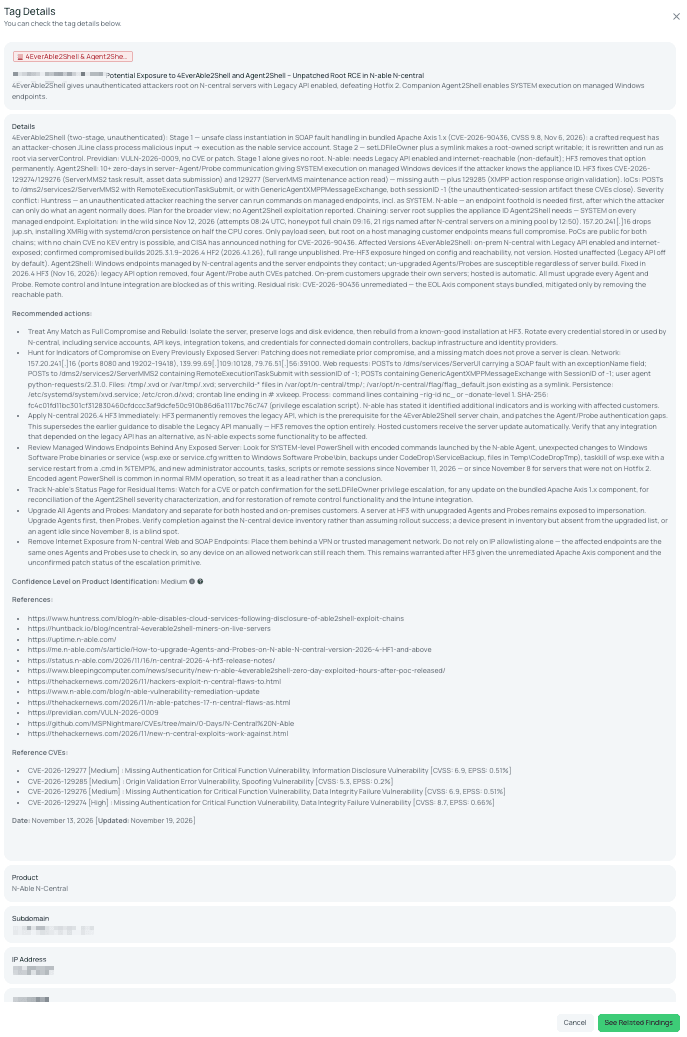
Black Kite's 4EverAble2Shell & Agent2Shell [Suspected] FocusTag® details critical insights on the event for TPRM professionals.
PostgreSQL - Nov2026
What is this vulnerability?
On November 12, 2026, the PostgreSQL Global Development Group released versions 18.7, 17.12, 16.16, 15.20, and 14.25, along with the second release candidate of PostgreSQL 19, fixing 52 security vulnerabilities. This FocusTag covers 14 of those CVEs: 13 High-severity flaws carrying CVSS 8.8 (vector AV:N/AC:L/PR:L/UI:N/S:U/C:H/I:H/A:H) and one Medium-severity pre-authentication denial-of-service issue, CVE-2026-116322, at CVSS 5.3. EPSS scores across the set range from roughly 0.37% to 0.60% per Black Kite's analysis. The weaknesses span type confusion (CWE-843), use-after-free (CWE-416), heap-based buffer overflow (CWE-122), integer wraparound, missing authorization (CWE-862), and improper input validation, and most allow an authenticated user holding object-creation or similar privileges to execute arbitrary code as the operating system user running PostgreSQL.
None of the 14 CVEs are confirmed exploited in the wild, and none appear in CISA's Known Exploited Vulnerabilities (KEV) Catalog as of this writing. A public GitHub proof-of-concept exists for CVE-2026-6460, reproducing a SIGSEGV crash through a zero-privilege role script, though it does not yet demonstrate full remote code execution. Two flaws stand out for lower attack complexity: CVE-2026-120139 and CVE-2026-120141 require only an ordinary database login rather than elevated object-creation rights, which matters in SaaS and shared analytics environments where tenants are routinely granted such access. Affected versions are all PostgreSQL releases prior to 18.7, 17.12, 16.16, 15.20, and 14.25; four of the fourteen CVEs (CVE-2026-116318, CVE-2026-116322, CVE-2026-116329, and CVE-2026-120144) affect only the PostgreSQL 18 branch, while the remaining ten span all five supported release lines. PostgreSQL 14.25 marks the final release for the 14.x branch, which is now end-of-life and will receive no further security updates. No official workarounds exist beyond upgrading; the vendor explicitly discourages disabling composite-type checks via the new composite_type_mismatch parameter as a substitute for patching.
CVE | CVSS | Vulnerability Name | Short Description |
|---|---|---|---|
CVE-2026-116314 | 8.8 | Arbitrary Code Execution via pg_restore (RCE) | Crafted non-plain archive lets a malicious provider execute code as the pg_restore OS user |
CVE-2026-116318 | 8.8 | SQL Injection in pg_dump | Inherited child-local NOT NULL constraint name injects SQL during pg_dump on PG 18 |
CVE-2026-116329 | 8.8 | Type Confusion in Statistics Import (RCE) | Nested SET DATA TYPE during statistics import executes arbitrary code on PG 18 |
CVE-2026-120139 | 8.8 | Integer Wraparound (RCE) | Oversized tuple data triggers in-memory tuple-size wraparound with only a standard login |
CVE-2026-120141 | 8.8 | Type Confusion in Set-Returning Functions (RCE) | json_populate_recordset() and similar functions allow code execution via standard login |
CVE-2026-120144 | 8.8 | Type Confusion via Type-Cache Invalidation (RCE) | Incomplete type-cache invalidation lets object creators execute code on PG 18 |
CVE-2026-120145 | 8.8 | Missing Authorization in Logical Replication | Compromised publisher writes to subscriber system catalogs when subscription is superuser-owned |
CVE-2026-120147 | 8.8 | Use-After-Free in dblink (RCE) | Reentrant dblink disconnect closes an active connection, enabling code execution |
CVE-2026-120149 | 8.8 | Heap-based Buffer Overflow in Foreign Batch Insert (RCE) | Malicious postgres_fdw server misreports row counts to overflow the heap |
CVE-2026-120150 | 8.8 | Use-After-Free in Expanded Record Checks | Repeated domain checks on expanded composite records trigger a use-after-free |
CVE-2026-120151 | 8.8 | Type Confusion in plpgsql Record Assignment (RCE) | Reentrant domain CHECK during record-field assignment allows arbitrary code execution |
CVE-2026-18447 | 8.8 | Type Confusion in SQL Functions (RCE) | Output parameter of type any lets object creators execute code as the OS user |
CVE-2026-6460 | 8.8 | Type Confusion after ALTER SET DATA TYPE (RCE) | DDL rollback sequences cause type confusion; public PoC demonstrates a crash |
CVE-2026-116322 | 5.3 | Pre-Authentication Denial of Service | Unauthenticated cancel request triggers a spinlock collision, restarting the server |
Why should TPRM professionals care?
PostgreSQL underpins transactional systems, SaaS backends, and analytics platforms across countless vendor environments, and a concentration of 13 CVSS 8.8 code-execution flaws in a single release is unusual for a database this widely deployed. For TPRM professionals, the risk is not limited to externally facing attack surface: several of these flaws require only a standard authenticated login or routine object-creation privileges, which are commonly granted to internal application accounts, SaaS tenants, and shared-analytics users. Successful exploitation grants OS-level code execution as the PostgreSQL service account, which can expose the full contents of a vendor's database instance and serve as a pivot point for lateral movement — a materially different risk profile than a typical application-layer bug, since it can compromise confidentiality, integrity, and availability of whatever sensitive data the vendor stores in that database simultaneously. The presence of a public crash proof-of-concept for CVE-2026-6460 also raises the likelihood that a working exploit chain surfaces before vendors complete patching.
What questions should TPRM professionals ask vendors?
- Have all PostgreSQL instances in your environment been upgraded to 18.7, 17.12, 16.16, 15.20, or 14.25, and if any remain on 14.x, what is your migration timeline off the now end-of-life 14 branch?
- Do any of your PostgreSQL deployments grant CREATE or object-creation privileges to tenants, application roles, or third parties in multi-tenant or shared analytics environments that could exploit CVE-2026-120139 or CVE-2026-120141 with only a standard login?
- Are your dblink or postgres_fdw extensions enabled, and if so, have you reviewed foreign server configurations against CVE-2026-120147 and CVE-2026-120149?
- Do you run pg_restore against archives received from external or untrusted parties, and if so, what controls are in place to validate archive provenance before CVE-2026-116314 can be mitigated by the 18.7/17.12/16.16/15.20/14.25 patches?
Remediation recommendations
- Upgrade all PostgreSQL instances to 18.7, 17.12, 16.16, 15.20, or 14.25 as appropriate; the binary upgrade does not require a dump/reload, but affected GIN, pg_trgm GiST, or bpchar B-tree indexes should be reindexed per the release notes.
- Prioritize patching for CVE-2026-6460, which has a public crash proof-of-concept, and for CVE-2026-120139 and CVE-2026-120141, which are exploitable by any authenticated user with a standard login.
- Restrict CREATE privileges on databases and schemas to trusted roles only, particularly in multi-tenant or shared analytics environments where object-creation rights are routinely granted.
- Limit or audit use of the dblink and postgres_fdw extensions, and verify that foreign server configurations cannot be manipulated to misreport batch-insert row counts or trigger reentrant disconnects.
- Ensure logical replication subscriptions are not superuser-owned unless strictly required, to prevent a compromised publisher from writing to subscriber system catalogs under CVE-2026-120145.
- Never run pg_restore against untrusted or unverified archive files, and plan migration off the now end-of-life PostgreSQL 14.x branch to a supported major version.
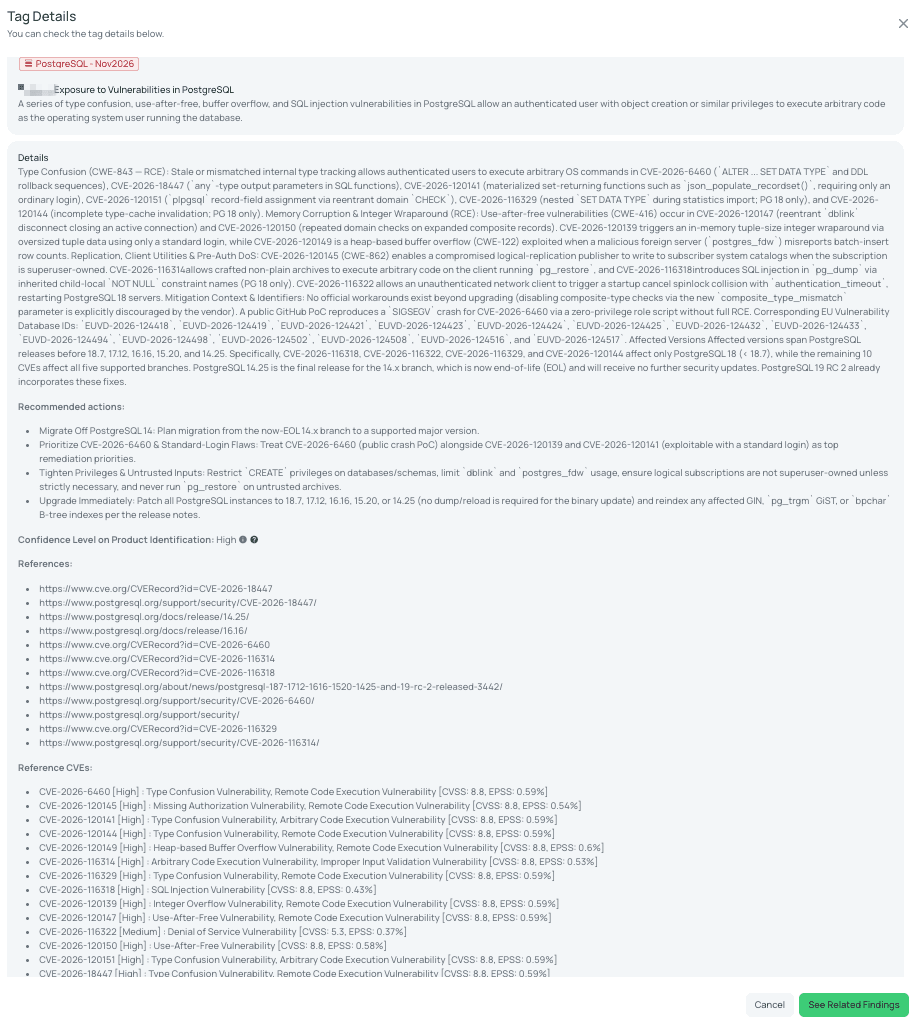
Black Kite's PostgreSQL - Nov2026 FocusTag® details critical insights on the event for TPRM professionals.
Oracle TNS Listener Expiration
What is this vulnerability?
On November 17, 2026, Oracle published its November Critical Patch Update (CPU), resolving three critical vulnerabilities in Oracle Database Server, each carrying a CVSS score of 9.9 (AV:N/AC:L/PR:L/UI:N/S:C/C:H/I:H/A:H) and an EPSS score of 0.479%. CVE-2026-114819 and CVE-2026-114848 affect the Oracle Text component (CWE-284, improper access control), while CVE-2026-114822 resides directly in the core RDBMS engine of the 23ai release line. All three are reachable over Oracle Net (typically TCP port 1521) and require only the Create Session privilege — the most basic login right assigned to virtually every database user and application service account. Successful exploitation gives a low-privileged, authenticated attacker full takeover of the affected component, with a changed scope that can impact confidentiality, integrity, and availability of connected products.
Oracle reports no confirmed exploitation in the wild for any of the three CVEs, there is no public proof-of-concept, and none of the identifiers currently appear in CISA's Known Exploited Vulnerabilities (KEV) Catalog. Affected versions span Oracle Database 19c (19.3 through 19.33), 21c (21.3 through 21.24), and 23ai (23.4.0 through 23.26.3 for the Oracle Text flaws, 23.4.0 through 23.26.4 for the RDBMS flaw). Oracle provides no workaround; fixes require applying the November 2026 Release Update (19.34+, 21.25+, 23.26.5+). A complicating factor is that TNS Listener network banners report only the major version string (19.0.0.0.0, 21.0.0.0.0, 23.0.0.0.0) rather than the applied Release Update level, so passive scanning can confirm exposure of an affected release line but cannot distinguish patched hosts from unpatched ones. Oracle Database has a long history of being targeted once CPU details become public, and the low privilege bar here — Create Session rather than a privileged DBA role — lowers the exploitation threshold compared to most prior Oracle Database critical flaws.
CVE | CVSS | Vulnerability Name | Short Description |
|---|---|---|---|
CVE-2026-114819 | 9.9 | Oracle Text Component Takeover | Low-privileged Create Session access over Oracle Net leads to full Oracle Text takeover |
CVE-2026-114822 | 9.9 | RDBMS Core Privilege Escalation | Create Session access over Oracle Net leads to full takeover of the 23ai RDBMS core |
CVE-2026-114848 | 9.9 | Oracle Text Component Takeover (Second Flaw) | Second Oracle Text flaw with identical Create Session/Oracle Net attack path |
Why should TPRM professionals care?
Oracle Database Server typically sits at the core of a vendor's operational and transactional data, and Create Session privileges are routinely handed out to web application service accounts, reporting users, and third-party integration connectors — meaning any SQL injection foothold, leaked application credential, or credential-stuffing hit against a low-privileged account can be escalated directly into full database component takeover. For TPRM professionals, this converts an everyday, low-value credential compromise into a critical-severity incident, and because thousands of Oracle TNS Listener endpoints are passively discoverable on the public internet without revealing patch level, a vendor's exposure cannot be ruled out just because its listener looks unremarkable from the outside.
What questions should TPRM professionals ask vendors?
- Have you applied Oracle's November 2026 Critical Patch Update to bring all Oracle Database 19c, 21c, and 23ai instances to 19.34+, 21.25+, or 23.26.5+ respectively?
- Is your Oracle Net (TNS Listener) service, typically on TCP port 1521, reachable from the public internet, and if so, what network controls restrict inbound connections to authorized application and administrative hosts only?
- Have you audited all database accounts and roles holding the Create Session privilege, including application service accounts and third-party integration connectors, to remove dormant or unnecessary grants?
- Have you enabled ADMIN_RESTRICTIONS_LISTENER and configured TCP.VALIDNODE_CHECKING in listener.ora to harden the TNS Listener against unauthorized connection attempts?
Remediation recommendations
- Apply Oracle's November 2026 Critical Patch Update immediately, upgrading all Oracle Database 19c, 21c, and 23ai instances to 19.34+, 21.25+, or 23.26.5+ as applicable, since Oracle provides no workaround.
- Prioritize patching systems that are internet-facing or that support externally reachable web applications before addressing internal-only instances.
- Restrict Oracle Net (TNS Listener) exposure by ensuring TCP port 1521 and any custom listener ports are never directly exposed to the public internet; enforce firewall rules, network segmentation, and IP allowlisting.
- Audit all database accounts and roles with Create Session rights, disabling or removing dormant, default, and unused accounts, and enforcing least-privilege access for application service accounts.
- Rotate passwords for shared and application service accounts that hold basic session privileges, given how widely Create Session is granted across an environment.
- Enable ADMIN_RESTRICTIONS_LISTENER = ON in listener.ora and configure TCP.VALIDNODE_CHECKING = YES to restrict which clients can establish Oracle Net connections at the listener layer.
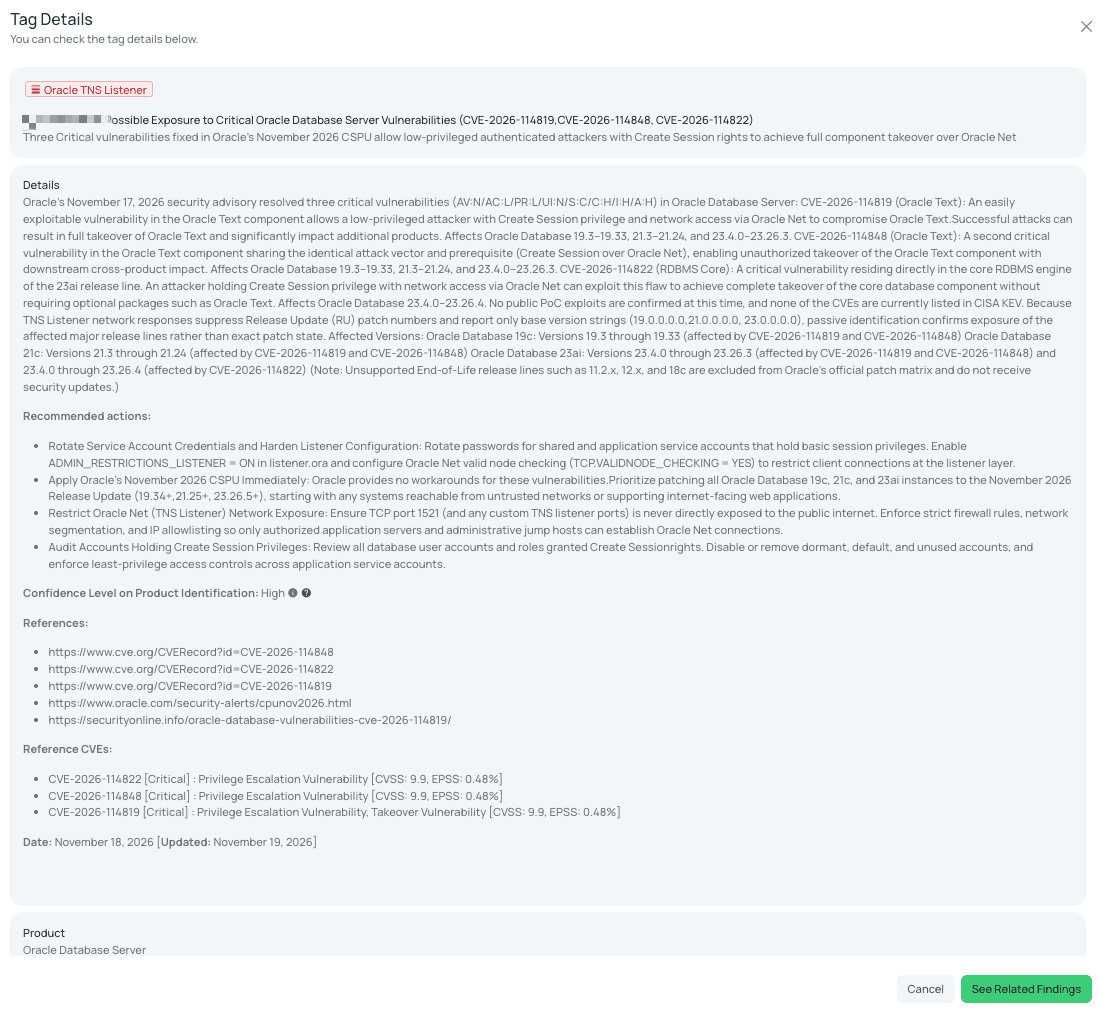
Black Kite's Oracle TNS Listener Expiration FocusTag® details critical insights on the event for TPRM professionals.
Oracle WebLogic Server
What is this vulnerability?
Oracle's November 2026 Critical Security Patch Update, released November 17, 2026, fixes seven critical, fully unauthenticated vulnerabilities in Oracle WebLogic Server, spread across the Core runtime engine and the default-enabled TopLink Integration component. CVE-2026-91569 is the most severe, scoring a perfect CVSS 10.0 (EPSS 0.522%): an easily exploitable flaw in TopLink Integration reachable over HTTP with no credentials or user interaction, and it carries a Changed Scope rating because successful exploitation can affect additional downstream connected products. Five more flaws score CVSS 9.8 — CVE-2026-91456 and CVE-2026-91470 in the Core component (reachable over SOAP and over the T3/IIOP clustering protocols respectively), and CVE-2026-91570, CVE-2026-91583, and CVE-2026-91585 in TopLink Integration (reachable over HTTP and raw TCP) — each allowing an unauthenticated attacker to achieve remote code execution and full server takeover. CVE-2026-91469 (CVSS 9.4, EPSS 0.438%) rounds out the cluster, allowing unauthenticated data tampering, unauthorized data read access, and repeatable denial of service over HTTP. All seven affect the four actively supported WebLogic branches: 12.2.1.4.0, 14.1.1.0.0, 14.1.2.0.0, and 15.1.1.0.0, and none have public proof-of-concept code, confirmed in-the-wild exploitation, or a listing in CISA's Known Exploited Vulnerabilities (KEV) Catalog as of this writing.
This FocusTag also includes CVE-2024-21182 (CVSS 7.5, EPSS 74.162%), an older unauthorized access flaw in the WebLogic Server Core component affecting versions 12.2.1.4.0 and 14.1.1.0.0. Unlike the November 2026 cluster, this one is actively exploited in the wild, has a public proof-of-concept, has been linked to Cobalt Strike deployment, and was added to the KEV Catalog on June 2, 2026 — a concrete precedent for how quickly WebLogic flaws move from disclosure to weaponization. WebLogic has a documented history of this pattern: CVE-2026-21962 in the WebLogic Server Proxy Plug-in was also added to KEV, and the product line is frequently targeted because it often sits directly on the internet running mission-critical Java EE applications.
CVE | CVSS | Vulnerability Name | Short Description |
|---|---|---|---|
CVE-2026-91569 | 10.0 | Unauthenticated RCE / Scope-Changing Takeover | Perfect-10 flaw in TopLink Integration; HTTP-exploitable, impacts downstream connected systems |
CVE-2026-91456 | 9.8 | Authentication Bypass (RCE) | Improper authentication (CWE-287) in Core component exploitable over SOAP |
CVE-2026-91470 | 9.8 | Missing Authentication (RCE) | CWE-306 flaw in Core component exploitable over T3 and IIOP protocols |
CVE-2026-91570 | 9.8 | Missing Authentication (RCE) | CWE-306 flaw in TopLink Integration exploitable over HTTP |
CVE-2026-91583 | 9.8 | Unauthenticated RCE | TopLink Integration flaw exploitable over HTTP with no privileges required |
CVE-2026-91585 | 9.8 | Unauthenticated RCE | TopLink Integration flaw exploitable directly over raw TCP, no login needed |
CVE-2026-91469 | 9.4 | Unauthenticated Data Tampering / DoS | Core component flaw over HTTP enabling data tampering and repeatable crash |
CVE-2024-21182 | 7.5 | Unauthorized Access (Actively Exploited) | KEV-listed flaw in Core component, linked to Cobalt Strike deployment |
Why should TPRM professionals care?
Oracle WebLogic Server typically serves as the central Java EE application tier for a vendor's ERP systems, financial transaction engines, and back-office databases, so a single unauthenticated compromise gives an attacker direct code execution and a pivot point into high-value business data rather than just a foothold. Because six of the seven new flaws require zero credentials and no user interaction, and the Core and TopLink Integration components ship enabled by default on standard HTTP and T3/IIOP ports, exposure assessment cannot rely on configuration assumptions — any internet-facing WebLogic instance on an unpatched supported branch is a viable target. The confirmed active exploitation and Cobalt Strike association tied to CVE-2024-21182 raises the stakes further: TPRM teams evaluating a vendor's WebLogic footprint need to know whether legacy flaws are still open in addition to the new CSPU items, since a single unpatched instance can expose an entire data exchange and transaction-processing layer to takeover.
What questions should TPRM professionals ask vendors?
- Have you updated all instances of Oracle WebLogic Server to versions beyond 12.2.1.4.0 and 14.1.1.0.0 to mitigate the risk of CVE-2024-21216 and CVE-2024-21182?
- Can you confirm if you have applied the latest security patches released by Oracle for WebLogic Server to address the vulnerabilities CVE-2024-21216, CVE-2024-21182, and CVE-2020-2883?
- Have you implemented measures to monitor network traffic for unusual activities that could indicate an attempt to exploit the vulnerabilities CVE-2024-21216, CVE-2024-21182, and CVE-2020-2883 in Oracle WebLogic Server?
- Have you disabled unnecessary protocols, such as T3 and IIOP, in your Oracle WebLogic Server environment to mitigate the risk of unauthorized access and remote code execution associated with CVE-2024-21216, CVE-2024-21182, and CVE-2020-2883?
Remediation recommendations
- Apply Oracle's November 17, 2026 Critical Security Patch Update to every WebLogic Server instance on branches 12.2.1.4.0, 14.1.1.0.0, 14.1.2.0.0, and 15.1.1.0.0 outside of standard maintenance windows, since no workaround exists for CVE-2026-91569 or the HTTP/SOAP TopLink vectors.
- Block T3 and IIOP traffic at the network edge and restrict it to authorized internal cluster nodes, and configure WebLogic's connection filter (weblogic.security.net.ConnectionFilterImpl) to deny untrusted T3/IIOP connections given CVE-2026-91470's exploitation path.
- Remove direct internet exposure of WebLogic administration consoles and internal SOAP/TopLink service endpoints, enforcing VPN or IP allowlisting and placing internet-facing application endpoints behind a WAF or reverse proxy.
- Confirm that any instance still running CVE-2024-21182-affected versions (12.2.1.4.0 or 14.1.1.0.0) has been patched, given its confirmed in-the-wild exploitation and Cobalt Strike association, and treat it as a higher-priority legacy gap than the newer, unexploited CSPU items.
- Audit WebLogic access logs, server logs, and outbound network telemetry for anomalous HTTP/SOAP requests to TopLink or Core endpoints, unauthorized T3/IIOP connection attempts, unexpected Java class loading or deserialization events, and unapproved administrative changes.
- Retire or migrate any WebLogic installation on unsupported end-of-life branches (10.3.x, 12.1.x, 12.2.1.3.0 or earlier), since these fall outside Oracle's patch matrix entirely.
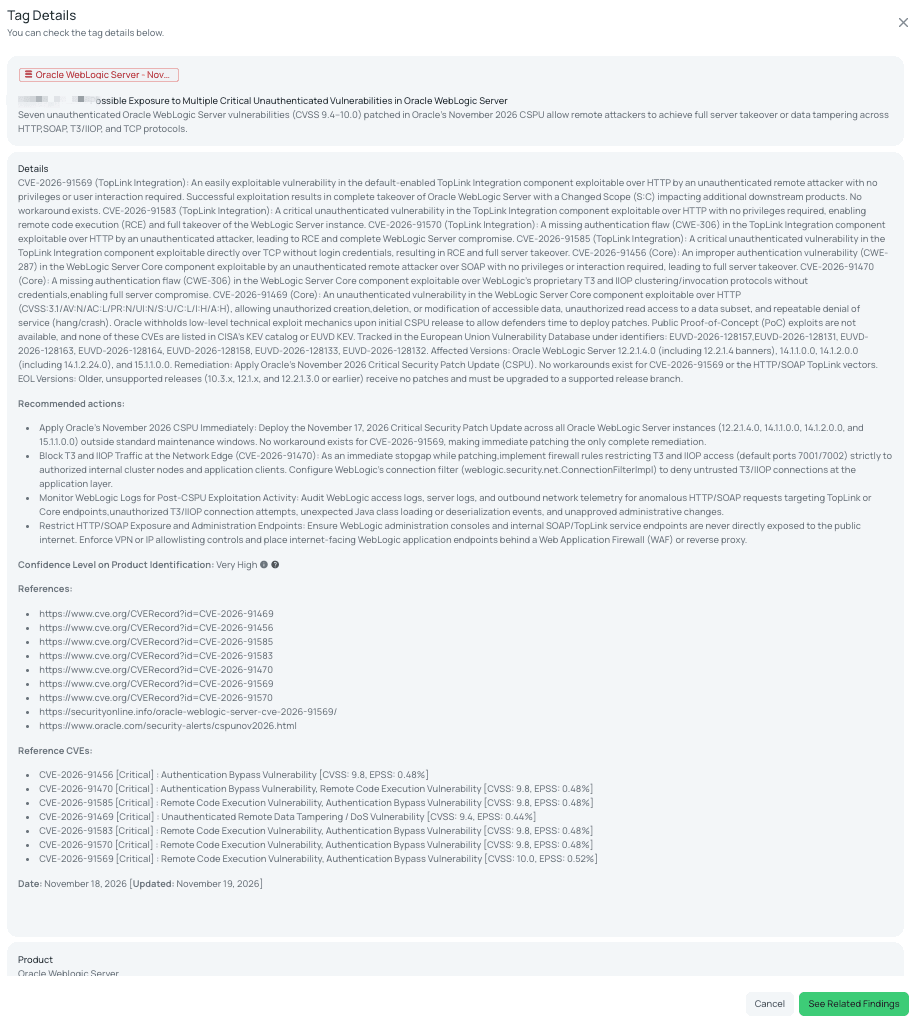
Black Kite's Oracle WebLogic Server FocusTag® details critical insights on the event for TPRM professionals.
How TPRM Professionals Can Leverage Black Kite for These Vulnerabilities
Black Kite's FocusTag® intelligence gives TPRM professionals a structured way to translate each of this week's disclosures into vendor-specific action, rather than treating them as generic advisories.
For Java4Shell [Suspected], the tag flags vendors whose infrastructure runs affected OpenJDK distributions on the specific hardware generations capable of triggering the flaw, helping teams separate theoretical exposure from confirmed risk. For the Optimizely Supply Chain Attack, the tag identifies vendors whose public-facing websites load the compromised JavaScript snippet from Optimizely's content delivery network, pointing directly to the domains and pages carrying the injected code.
For NGINX2Root, the tag surfaces vendors running exposed NGINX Open Source or NGINX Plus instances with the affected modules enabled on internet-facing assets. For 4EverAble2Shell & Agent2Shell [Suspected], the tag identifies vendors operating N-able N-central servers, including those still running vulnerable configurations regardless of patch level, given that version alone did not reliably indicate exposure in this incident.
For the PostgreSQL cluster, the tag flags vendors running affected PostgreSQL versions across their database footprint. For Oracle TNS Listener Expiration, the tag highlights vendors with Oracle Net listener instances reachable on their standard port, a configuration increasingly visible on public scanning services. For Oracle WebLogic Server, the tag identifies vendors operating WebLogic instances on the affected release branches with default ports and components exposed.
Once vendors are identified through these FocusTags®, The Bridge™ allows TPRM teams to send targeted questionnaires simultaneously to every vendor flagged across all seven tag populations, accelerating the collection of remediation status and reducing the manual effort typically required to triage a week with this many concurrent disclosures.
Strengthening TPRM Outcomes with Black Kite's FocusTags®
Black Kite's FocusTags® translate each of this week's disclosures into concrete, vendor-level actions that strengthen TPRM outcomes.
- Hardware-Aware Exposure Detection: The Java4Shell [Suspected] tag helps TPRM teams move past a blanket 'patch Java' directive by narrowing focus to vendors whose infrastructure combines affected OpenJDK distributions with the specific processor generations capable of triggering the flaw, avoiding wasted remediation effort on unaffected environments.
- Supply-Chain Compromise Visibility: The Optimizely Supply Chain Attack tag identifies vendors whose public websites served the compromised JavaScript from a trusted content delivery network, giving TPRM teams a direct line of sight into which vendor-facing properties may have exposed their visitors to credential theft or malicious code before the vendor's own fix was deployed.
- Perimeter Infrastructure Risk Mapping: The NGINX2Root tag pinpoints vendors running exposed NGINX instances with vulnerable modules active on internet-facing systems, allowing TPRM teams to prioritize outreach to vendors whose perimeter infrastructure could be chained into full host compromise.
- Configuration-Aware RMM Exposure: The 4EverAble2Shell & Agent2Shell [Suspected] tag identifies vendors running N-able N-central, including those where patch level alone does not confirm safety, steering TPRM teams toward configuration-specific questions rather than relying on version checks that proved unreliable during active exploitation.
- Database Version Exposure Tracking: The PostgreSQL tag flags vendors operating affected database versions across their environment, helping TPRM teams prioritize vendors where authenticated users with object-creation privileges could escalate to operating-system-level code execution.
- Network Listener Exposure Identification: The Oracle TNS Listener Expiration tag surfaces vendors with Oracle Net listener instances reachable on their standard port, directing attention to vendors where even a basic login privilege could be leveraged for full database takeover.
- Default-Configuration Risk Surfacing: The Oracle WebLogic Server tag identifies vendors running affected WebLogic branches with default ports and components exposed, helping TPRM teams target vendors most likely to be reachable by fully unauthenticated attackers.
- Coordinated Vendor Outreach at Scale: The Bridge™ lets TPRM teams send tailored questionnaires simultaneously to every vendor identified across all seven FocusTag® populations, consolidating what would otherwise be seven separate outreach efforts into a single coordinated workflow and accelerating collection of remediation evidence.
FocusTags® in the Last 30 Days
- Java4Shell [Suspected]: CVE-2026-114938 — Critical OpenJDK Base64 Heap Corruption Enabling Pre-Auth RCE Across Java Enterprise Applications
- Optimizely Supply Chain Attack: No CVE — Supply-Chain JavaScript Injection and Malware Delivery via Optimizely Experimentation Platform
- NGINX2Root: CVE-2026-113425, CVE-2026-121810, and 3 additional CVEs — NGINX2Root: Five Unauthenticated RCE Flaws in NGINX HTTP/2, HTTP/3, Resolver, and Mail Proxy
- 4EverAble2Shell & Agent2Shell [Suspected]: CVE-2026-129274, CVE-2026-129276, CVE-2026-129277, and CVE-2026-129285 — Unauthenticated Root RCE and Agent Communication Flaws in N-able N-central
- PostgreSQL - Nov2026: CVE-2026-116314, CVE-2026-116318, and 12 additional CVEs — Type Confusion and Memory Corruption Flaws Enabling Arbitrary Code Execution in PostgreSQL
- Oracle TNS Listener Expiration: CVE-2026-114819, CVE-2026-114822, and CVE-2026-114848 — Critical Create-Session Privilege Escalation in Oracle Database Server
- Oracle WebLogic Server: CVE-2026-91569, CVE-2026-91456, and 6 additional CVEs — Critical Unauthenticated Takeover Flaws in Oracle WebLogic Server
- Able2Shell: CVE-2026-125881, CVE-2026-125883, and 5 additional CVEs — Unauthenticated XXE-to-RCE and Rogue Admin Creation in N-able N-central
- FreeSWITCH - Nov2026: CVE-2026-116779 — Unauthenticated Remote Code Execution in FreeSWITCH SIP Telephony Platform
- IBM Aspera Faspex: CVE-2026-123218 — Actively Exploited Authorization Bypass and Privilege Escalation in IBM Aspera Faspex
- SonicWall SSLVPN - Nov2026: CVE-2026-19868 — Exploited SAML-Enforced MFA Bypass in SonicWall SonicOS SSLVPN
- SharePoint - Nov2026: CVE-2026-120002, CVE-2026-109454, and 25 additional CVEs — Critical Authorization Bypass and Multiple RCE Flaws in Microsoft SharePoint Server
- Exchange Server - Nov2026: CVE-2026-118149, CVE-2026-118150, and 7 additional CVEs — Authenticated Remote Code Execution and Privilege Escalation Flaws in Microsoft Exchange Server
- MSSQL - Nov2026: CVE-2026-116945, CVE-2026-116930, and 50 additional CVEs — Unauthenticated Remote Code Execution and Privilege Escalation in Microsoft SQL Server
- Apache HTTP Server - Nov2026: CVE-2026-119618 — Critical Unauthenticated Remote Code Execution in Apache HTTP Server's mod_http2
- Progress WS_FTP - Nov2026 (Latest): CVE-2026-115338, CVE-2026-115341, and 3 additional CVEs — Cleartext Transport Interception and Path Traversal in Progress WS_FTP Server
- MongoDB - Nov2026: CVE-2026-118383, CVE-2026-120808, and 16 additional CVEs — Pre-Authentication Use-After-Free Remote Code Execution in MongoDB Server
- Ivanti EPMM - Nov2026: CVE-2026-105425, CVE-2026-105426, and CVE-2026-107405 — Admin-Privileged Remote Code Execution and Privilege Escalation in Ivanti EPMM
- Progress WS_FTP - Nov2026: CVE-2026-84295, CVE-2026-90868, and 6 additional CVEs — Unauthenticated Administrative Credential Theft and OS Command Injection in Progress WS_FTP Server
- Fortinet - Nov2026 : CVE-2026-126170, CVE-2026-126254, and 6 additional CVEs — Critical Unauthenticated Remote Code Execution, SQL Injection, and Authentication Bypass Vulnerabilities in Fortinet Products
- WordPress Core - Nov2026: CVE-2026-119977 — Unauthenticated Race-Condition Remote Code Execution in WordPress Core
- MySQL - Oct2026: CVE-2026-9547, CVE-2026-101781, and 63 additional CVEs — Critical Bundled-curl Flaw and Group Replication Takeover in MySQL Server
- pgAdmin - Nov2026: CVE-2026-116241, CVE-2026-116238, and 13 additional CVEs — Critical OS Command Injection in pgAdmin
- MLflow - Nov2026: CVE-2026-116692, CVE-2026-116690, CVE-2026-116691 — Unauthenticated Remote Code Execution and API Key Disclosure in MLflow
- php2shell: CVE-2026-109618, CVE-2026-109619 — Two Critical Use-After-Free RCEs in PHP Core
- Plex2Shell: CVE-2026-96652, CVE-2026-96654, CVE-2026-96655, CVE-2026-96656 — Four-CVE Unauthenticated RCE Exploit Chain in Plex Media Server
- PAN-OS - Oct2026: CVE-2026-0322 — Code Injection in PAN-OS Management Interface
- Drupal Core: CVE-2026-108097, CVE-2026-108515, CVE-2026-108514 — Critical RCE in Drupal Field UI Module
- GitLab - Oct2026: CVE-2026-110264, CVE-2026-97229, CVE-2026-90970, CVE-2026-16301, CVE-2026-14814, CVE-2026-112212 — Unauthenticated RCE and Cache-Poisoning Vulnerabilities in GitLab CE/EE
- Oracle WebLogic - Oct2026: CVE-2026-91323, CVE-2026-87302, CVE-2026-91502, CVE-2026-101515 — Unauthenticated Full Server Takeover in Oracle WebLogic Server
- BeyondTrust Remote Support - Oct2026: CVE-2026-102764 — Authentication Bypass by Spoofing in BeyondTrust Remote Support
- Fortinet - Oct2026 [Suspected]: CVE-2026-104286, CVE-2026-106173 — Path Traversal and Unauthenticated RCE in FortiMail and FortiSIEM
References
https://nvd.nist.gov/vuln/detail/CVE-2026-114938
https://www.cve.org/CVERecord?id=CVE-2026-114938
https://euvd.enisa.europa.eu/vulnerability/EUVD-2026-127648
https://www.oracle.com/security-alerts/
https://calif.io/java4shell#affected-products
https://www.oracle.com/security-alerts/cspunov2026.html
https://thehackernews.com/2026/11/java4shell-cve-2026-114938-enables-pre.html
https://www.helpnetsecurity.com/2026/11/17/optimizely-vulnerability-malicious-javascript/
https://www.reflectiz.com/blog/optimizely-supply-chain-attack/
https://www.infosecurity-magazine.com/news/optimizely-hack-malware-178-orgs/
https://nvd.nist.gov/vuln/detail/CVE-2026-113425
https://www.cve.org/CVERecord?id=CVE-2026-113425
https://nvd.nist.gov/vuln/detail/CVE-2026-121810
https://www.cve.org/CVERecord?id=CVE-2026-121810
https://nvd.nist.gov/vuln/detail/CVE-2026-123007
https://www.cve.org/CVERecord?id=CVE-2026-123007
https://euvd.enisa.europa.eu/vulnerability/EUVD-2026-128948
https://www.cve.org/CVERecord?id=CVE-2026-123633
https://www.cve.org/CVERecord?id=CVE-2026-123634
https://my.f5.com/manage/s/article/K000163926
https://my.f5.com/manage/s/article/K000163927
https://my.f5.com/manage/s/article/K000163928
https://xint.io/blog/nginx2root-remote-code-execution
https://securityonline.info/nginx2root-cve-2026-123007/
https://nvd.nist.gov/vuln/detail/CVE-2026-129274
https://www.cve.org/CVERecord?id=CVE-2026-129274
https://nvd.nist.gov/vuln/detail/CVE-2026-129276
https://www.cve.org/CVERecord?id=CVE-2026-129276
https://nvd.nist.gov/vuln/detail/CVE-2026-129277
https://www.cve.org/CVERecord?id=CVE-2026-129277
https://euvd.enisa.europa.eu/vulnerability/EUVD-2026-126959
https://thehackernews.com/2026/11/hackers-exploit-n-central-flaws-to.html
https://thehackernews.com/2026/11/new-n-central-exploits-work-against.html
https://thehackernews.com/2026/11/n-able-patches-17-n-central-flaws-as.html
https://huntback.io/blog/ncentral-4everable2shell-miners-on-live-servers
https://previdian.com/VULN-2026-0009
https://github.com/MSPNightmare/CVEs/tree/main/0-Days/N-Central%20N-Able
https://www.n-able.com/blog/n-able-vulnerability-remediation-update
https://status.n-able.com/2026/11/16/n-central-2026-4-hf3-release-notes/
https://nvd.nist.gov/vuln/detail/CVE-2026-116314
https://www.cve.org/CVERecord?id=CVE-2026-116314
https://nvd.nist.gov/vuln/detail/CVE-2026-116318
https://www.cve.org/CVERecord?id=CVE-2026-116318
https://nvd.nist.gov/vuln/detail/CVE-2026-116329
https://www.cve.org/CVERecord?id=CVE-2026-116329
https://euvd.enisa.europa.eu/vulnerability/EUVD-2026-124494
https://www.cve.org/CVERecord?id=CVE-2026-6460
https://www.cve.org/CVERecord?id=CVE-2026-18447
https://www.postgresql.org/about/news/postgresql-187-1712-1616-1520-1425-and-19-rc-2-released-3442/
https://www.postgresql.org/support/security/
https://www.postgresql.org/support/security/CVE-2026-6460/
https://www.postgresql.org/support/security/CVE-2026-18447/
https://www.postgresql.org/support/security/CVE-2026-116314/
https://www.postgresql.org/docs/release/16.16/
https://www.postgresql.org/docs/release/14.25/
https://nvd.nist.gov/vuln/detail/CVE-2026-114819
https://www.cve.org/CVERecord?id=CVE-2026-114819
https://nvd.nist.gov/vuln/detail/CVE-2026-114822
https://www.cve.org/CVERecord?id=CVE-2026-114822
https://nvd.nist.gov/vuln/detail/CVE-2026-114848
https://www.cve.org/CVERecord?id=CVE-2026-114848
https://euvd.enisa.europa.eu/vulnerability/EUVD-2026-127734
https://securityonline.info/oracle-database-vulnerabilities-cve-2026-114819/
https://nvd.nist.gov/vuln/detail/CVE-2026-91569
https://www.cve.org/CVERecord?id=CVE-2026-91569
https://nvd.nist.gov/vuln/detail/CVE-2026-91456
https://www.cve.org/CVERecord?id=CVE-2026-91456
https://nvd.nist.gov/vuln/detail/CVE-2026-91470
https://www.cve.org/CVERecord?id=CVE-2026-91470
https://euvd.enisa.europa.eu/vulnerability/EUVD-2026-128157
https://securityonline.info/oracle-weblogic-server-cve-2026-91569/
https://www.cve.org/CVERecord?id=CVE-2026-91583
https://www.cve.org/CVERecord?id=CVE-2026-91585
About the author

Ferdi Gül · Vulnerability Research Strategist
Ferdi Gül is Vulnerability Research Strategist at Black Kite, leading development of FocusTag and authoring the weekly Focus Friday vulnerability series for third-party risk teams.
View full bio of Ferdi Gül LinkedIn profile of Ferdi Gül (opens in a new tab)