FOCUS FRIDAY: TPRM Insights on Critical Vulnerabilities in Able2Shell, FreeSWITCH, IBM Aspera Faspex, SonicWall SSLVPN, SharePoint, Exchange Server, MSSQL, Apache HTTP Server, Progress WS_FTP, MongoDB, Ivanti EPMM, and Fortinet Products
Introduction
This week’s Focus Friday highlights 12 significant vulnerability events affecting widely used third-party products. Key incidents include N-able N-central’s Able2Shell zero-day disclosure, FreeSWITCH and IBM Aspera Faspex vulnerabilities with confirmed exploitation, and a SonicWall SSLVPN authentication bypass.
Fortinet’s November 2026 security advisories also disclose eight critical vulnerabilities across FortiOS, FortiManager, and FortiAnalyzer, including unauthenticated remote code execution, SQL injection, and authentication bypass risks. While no exploitation has been confirmed, the vulnerabilities could expose critical enterprise network infrastructure.
Microsoft’s November Patch Tuesday addresses multiple vulnerabilities across SharePoint, Exchange, and SQL Server. Other affected products include Apache HTTP Server, Progress WS_FTP Server, MongoDB, and Ivanti Endpoint Manager Mobile.
These vulnerabilities affect critical areas such as remote access, network security, file transfer, databases, web servers, and enterprise infrastructure. TPRM teams should identify affected vendors, verify patch status, assess potential exposure, and prioritize outreach to vendors running vulnerable products.
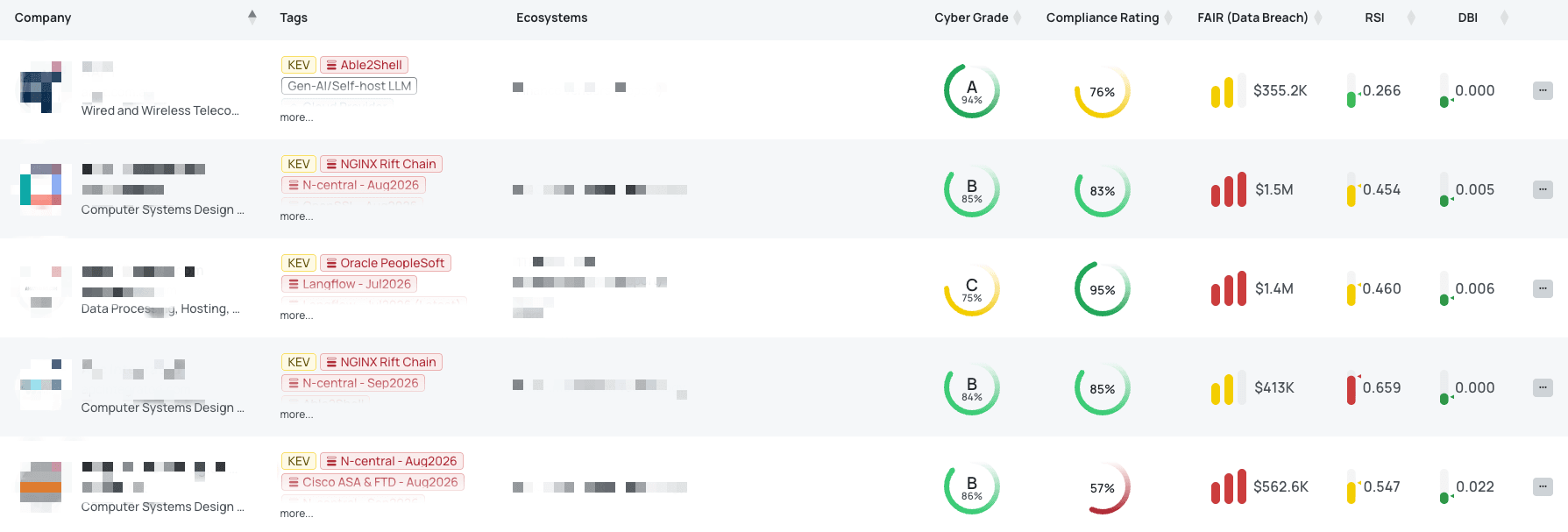
Filtered view of vendors with the Able2Shell FocusTag® on the Black Kite platform.
Able2Shell
What is this vulnerability?
On November 9, 2026, independent security researcher Sean Bales publicly disclosed 33 alleged zero-day vulnerabilities in N-able N-central, a centralized Remote Monitoring and Management (RMM) platform used by managed service providers (MSPs), in an event now referred to as Able2Shell. N-able responded by taking its hosted N-central platform offline globally and, on November 10, 2026, released N-central 2026.4 Hotfix 2 (build 2026.4.1.26), assigning seven CVEs to the most critical disclosed flaws, with CVSS scores ranging from 8.3 to 9.3. The most severe is CVE-2026-125883 (CVSS 9.3), an unauthenticated XML External Entity (XXE, CWE-611) injection in the service-import functionality that steals a trusted local session, resets account passwords, executes arbitrary commands as the nable service user, and creates an enabled rogue Default Administrator account — a full compromise chain requiring no credentials. It is paired with CVE-2026-125881 (CVSS 9.3), a Server-Side Request Forgery (SSRF, CWE-918) flaw via service-import schema validation. Additional CVEs cover a code injection / RCE path via OGNL expression evaluation triggered by stored XSS in patch metadata (CVE-2026-125878, CVSS 8.7, paired with the stored XSS itself, CVE-2026-125880, CVSS 8.3), local privilege escalation to root via a writable syslog-ng configuration (CVE-2026-125879, CVSS 8.6) and insecure IPC channels (CVE-2026-91000, CVSS 8.4), and a file repository upload path traversal leading to RCE (CVE-2026-125882, CVSS 8.6). EPSS scores for all seven are currently 0.02%, reflecting early-stage scoring shortly after CVE assignment rather than the actual operational risk, which is elevated given confirmed exploitation. All seven CVEs are confirmed exploited in the wild per Black Kite's tracker, with the exception of CVE-2026-125879, and public PoC exploit code is available for all seven; none are zero-days by the FACTS classification, and none currently appear in CISA's Known Exploited Vulnerabilities (KEV) Catalog, though N-central has had five KEV-listed flaws earlier in 2026 (CVE-2026-18556, CVE-2026-18577, CVE-2026-86218, CVE-2026-86206, CVE-2026-86207), establishing a clear precedent of sustained, successful exploitation against this platform. watchTowr observed exploitation attempts against N-central honeypots overnight following disclosure, and Defused reported internet-wide probing, including anonymous agent session creation and unauthenticated access to the remote control endpoint, within 24 hours. This is reported as N-central's fifth critical security event of 2026. HF2 (build 2026.4.1.26) addresses the most critical issues among the 33 disclosed but does not cover all of them, so residual unpatched attack surface should be assumed. Hosted environments have been upgraded by N-able; on-premises customers must upgrade their own servers, following supported upgrade paths from 2025.4, 2026.1, 2026.2, 2026.3/2026.3.1 (HF1–HF4), 2026.4.0.27, or 2026.4.0.32, and must upgrade Agents before Probes to preserve communication.
CVE | CVSS | Vulnerability Name | Short Description |
|---|---|---|---|
CVE-2026-125881 | 9.3 | Server-Side Request Forgery (SSRF) | Schema-hint SSRF via service-import schema validation, part of unauthenticated RCE chain |
CVE-2026-125883 | 9.3 | XXE Injection to Account Takeover and RCE | Unauthenticated XXE steals a session, resets passwords, creates a rogue admin, runs commands |
CVE-2026-125878 | 8.7 | Code Injection via OGNL Expression (RCE) | OGNL expression injection triggered by admin interaction, executes commands as root |
CVE-2026-125879 | 8.6 | Local Privilege Escalation to Root | Root escalation via nable-writable syslog-ng configuration file |
CVE-2026-125882 | 8.6 | Path Traversal to RCE | File repository upload path traversal enabling remote code execution |
CVE-2026-91000 | 8.4 | Insecure IPC Privilege Escalation | Insecure IPC channels allow unauthorized access control bypass and privilege escalation |
CVE-2026-125880 | 8.3 | Stored Cross-Site Scripting (XSS) | Stored XSS via MMS3 patch metadata, chains into root-level OGNL injection |
Why should TPRM professionals care?
N-central occupies a uniquely high-consequence position in the MSP supply chain: it is the centralized console an MSP uses to push scripts, deploy tools, open remote sessions, and modify security configurations across every endpoint of every downstream client network it manages. For TPRM professionals, a vendor's compromised N-central instance is not an isolated incident — it is a potential single point of entry into the vendor's entire client base, meaning the blast radius of this disclosure extends well past the MSP itself to every organization that relies on it for monitoring and management. The unauthenticated nature of the XXE-to-RCE chain, combined with confirmed exploitation attempts against internet-facing servers within hours of disclosure, means third parties running vulnerable N-central instances during the November 8–10, 2026 exposure window should be treated as a potential compromise vector into their own downstream environments, not merely a patching gap.
What questions should TPRM professionals ask vendors?
- Have you upgraded all on-premises N-central servers to build 2026.4.1.26 (2026.4 Hotfix 2), and if hosted, have you completed the required Agent and Probe upgrades in the correct order?
- Was your N-central environment, hosted or on-premises, internet-accessible at any point during the November 8–10, 2026 exposure window, and if so, has it undergone a full compromise assessment covering unexpected administrator accounts, privilege changes, and script deployments?
- Have you rotated all N-central administrative credentials, service account passwords, API keys, and integration tokens following the disclosure of CVE-2026-125883 and CVE-2026-125881?
- Is your N-central management web interface restricted to VPN or IP-allowlisted administrative ranges, and has this control been verified since the Able2Shell disclosure?
Remediation recommendations
- Upgrade all on-premises N-central servers to build 2026.4.1.26 (N-central 2026.4 Hotfix 2) immediately, following a supported upgrade path from 2025.4, 2026.1, 2026.2, 2026.3/2026.3.1, 2026.4.0.27, or 2026.4.0.32.
- For hosted N-central customers, confirm server-side upgrades have been applied by N-able and complete the required Agent upgrades before Probe upgrades to preserve Agent-to-Probe communication.
- Treat any N-central instance that was internet-accessible between November 8 and 10, 2026 as potentially compromised; review login and audit logs for unexpected Default Administrator accounts, privilege changes, new remote sessions, and unauthorized script or automation policy changes.
- Rotate all N-central administrative credentials, service account passwords, API keys, and integration tokens before restoring any affected server to production, and enable multi-factor authentication on all administrative accounts.
- Restrict the N-central management web interface from direct internet access using firewall controls, enforcing access only through VPN or IP allowlisting to authorized administrative ranges.
- Audit all downstream managed client networks connected to any potentially compromised N-central console for unexpected software deployments, new remote access tools, unauthorized administrator accounts, and lateral movement indicators.
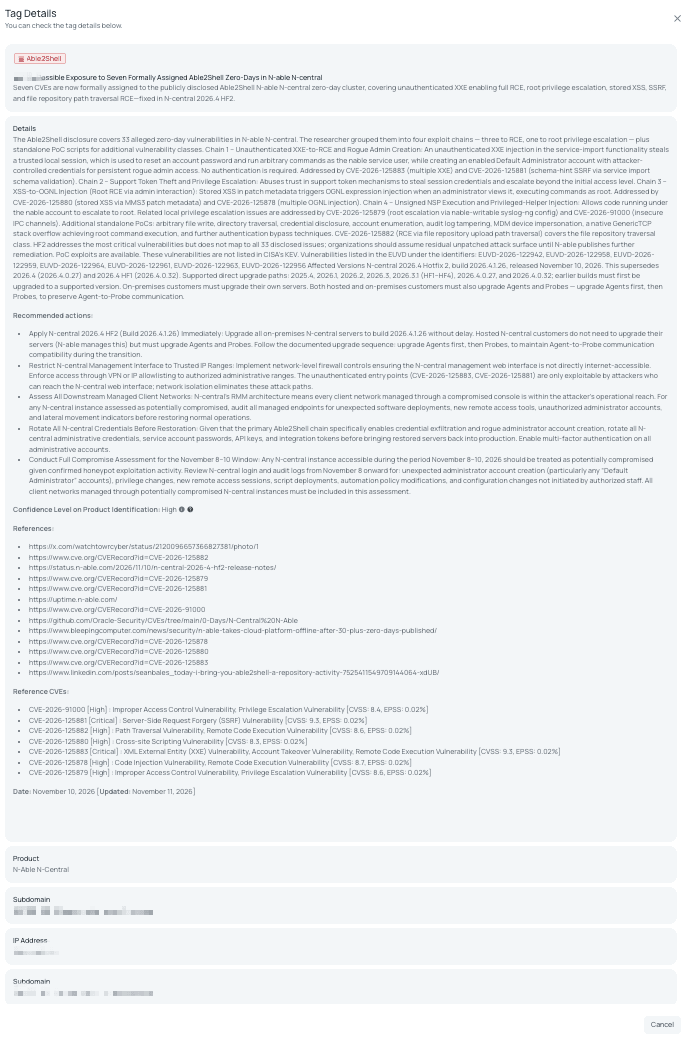
Black Kite's Able2Shell FocusTag® details critical insights on the event for TPRM professionals.
SignalWire FreeSWITCH
What is this vulnerability?
SignalWire's FreeSWITCH security team published advisory GHSA-mg63-h38w-8p9p on October 28, 2026, disclosing CVE-2026-116779, a critical unauthenticated remote code execution vulnerability (CWE-77, command injection) in FreeSWITCH, the widely deployed open-source VoIP and SIP telephony platform. The flaw carries a CVSS score of 9.8 and an EPSS score of 2.177%. The root cause sits in sofia_presence_handle_sip_i_message(): FreeSWITCH splits the To-user field of an inbound SIP MESSAGE on the "+" character and treats the left side as a chat protocol name, and the registered "api" handler forwards that input directly to the FreeSWITCH API. Any peer able to deliver a single crafted SIP MESSAGE to a reachable profile can therefore choose which API command the server executes, before any dialplan or application logic runs. The issue affects default configurations, since chat handling is enabled on both internal and external profiles out of the box, and with mod_lua present in the stock install, inline Lua provides a second route to arbitrary command execution. Where legacy sample configurations ship a directory user with no password, the path is fully unauthenticated.
Exploitation of this SIP MESSAGE path has been confirmed in the wild, and CISA added CVE-2026-116779 to its Known Exploited Vulnerabilities (KEV) Catalog on November 9, 2026, with a federal remediation deadline of November 12, 2026. A public proof-of-concept exists, and this is not a zero-day disclosure. The vulnerability affects FreeSWITCH 1.11.2 and all earlier releases (per NVD, the full 0.x through 1.11.2 range); the fix shipped in FreeSWITCH 1.11.3. No public indicators of compromise have been published to date. FreeSWITCH underpins PBX, contact center, and WebRTC deployments across carriers, enterprises, and hosting providers, making this core SIP flaw a direct path into high-value, internet-facing voice infrastructure, with Shodan-based detection identifying roughly 2,900 to 3,900 internet-exposed hosts running versions that disclose a vulnerable build in their SIP banner.
Why should TPRM professionals care?
FreeSWITCH sits at the core of a vendor's voice and telephony infrastructure, often carrying call routing, customer contact center traffic, and credentials for connected SIP trunks and backend systems. An unauthenticated remote code execution flaw in that core process gives an attacker full call control, access to configuration and credentials stored on the host, and a foothold that can be pivoted into the vendor's broader network. For TPRM professionals, this is not a peripheral IT system but a critical communications dependency: compromise can mean fraudulent call redirection, interception of customer conversations, or a vendor-side breach that cascades into downstream clients who rely on that vendor's voice services, and the confirmed in-the-wild exploitation combined with KEV Catalog inclusion elevates this from theoretical risk to an active, time-boxed remediation obligation.
What questions should TPRM professionals ask vendors?
- Have you upgraded every FreeSWITCH instance to version 1.11.3, including SIP stacks bundled inside PBX appliances, contact-center products, or WebRTC gateways?
- Have you set enable-chat=false on SIP profiles that do not require chat functionality, and confirmed the enable-chat-api-proto option remains disabled?
- Have you removed or secured any directory users configured with no password or hash in your FreeSWITCH deployment?
- Given that exploitation was observed prior to the advisory, have you reviewed FreeSWITCH scripting paths and host logs for unauthorized persistence or credential compromise, and rotated SIP and database credentials reachable from the FreeSWITCH process?
Remediation recommendations
- Upgrade all FreeSWITCH installations to version 1.11.3 and restart the service so the patched build is loaded, prioritizing internet-facing SIP profiles and stock configurations.
- Check with your Linux distribution, telephony appliance vendor, or hosting provider for backported fixes that may leave the reported version string unchanged.
- Set enable-chat=false on profiles that do not need SIP chat, keep enable-chat-api-proto disabled, and remove any directory users with no password or hash.
- Treat pre-patch exposure as a potential compromise: review web-writable and FreeSWITCH scripting paths for unexpected files, check for new cron jobs, modified authorized_keys, or unexpected SSH logins, and rotate SIP, database, and API credentials reachable from the FreeSWITCH process.
- Inventory every FreeSWITCH instance across the environment, restrict external SIP profiles (commonly port 5080) to known peers via firewall or ACL rules, and isolate internet-facing voice infrastructure until patched.
- Monitor FreeSWITCH and mod_sofia worker processes for anomalous shell, interpreter, or download-tool execution, and alert on bursts of inbound SIP MESSAGE requests followed by unexpected API command activity.
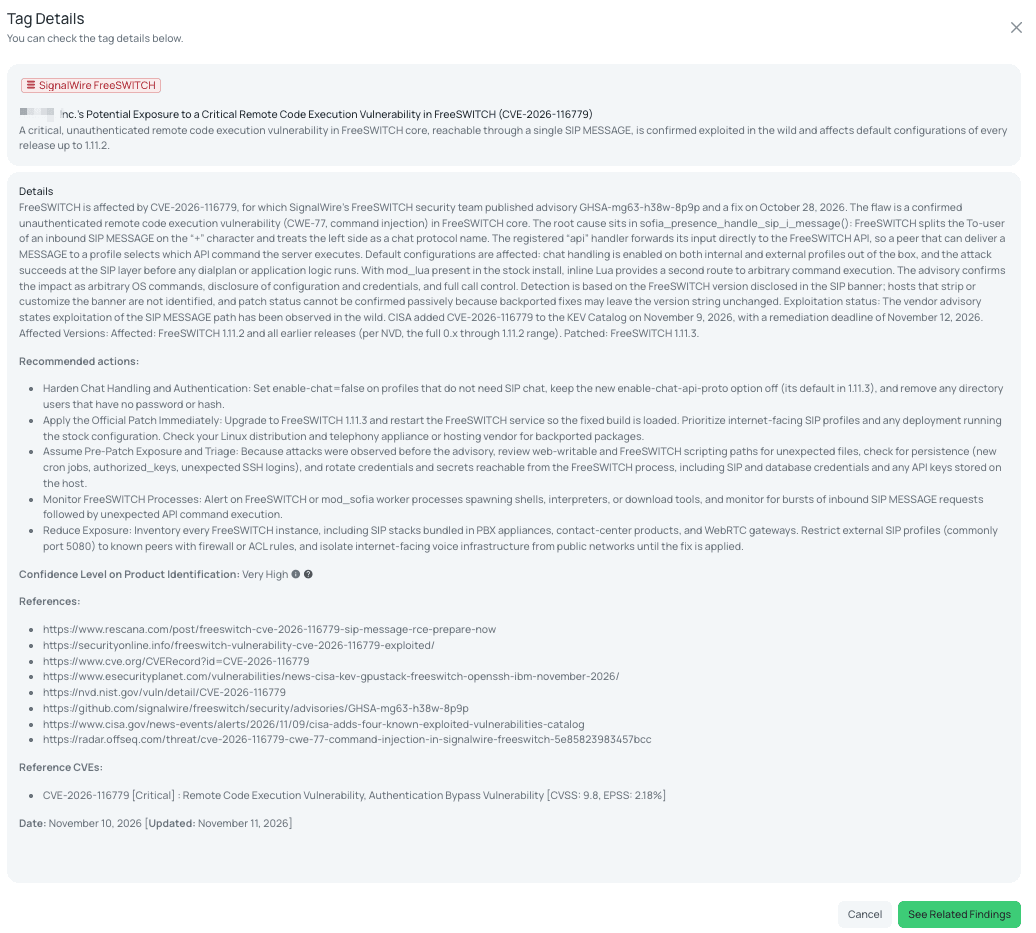
Black Kite's FreeSWITCH - Nov2026 FocusTag® details critical insights on the event for TPRM professionals.
IBM Aspera Faspex
What is this vulnerability?
IBM disclosed CVE-2026-123218, a critical incorrect authorization vulnerability (CWE-863) in Aspera Faspex 5, a web-based file exchange and workflow automation platform used by enterprises and media organizations for large-scale secure file transfer. The flaw carries a CVSS score of 9.8 and an EPSS of 0.705%. The vendor describes the issue as a specially crafted message that bypasses the authorization checks governing privilege level, but the CVSS vector (AV:N/AC:L/PR:N/UI:N/S:U/C:H/I:H/A:H) assigns no privileges required, meaning IBM scored the worst-case exploitation path as not requiring valid credentials. Successful exploitation grants the attacker full administrative privileges over the Faspex platform, including transfer policies, user accounts, workflow automation, and integration credentials for connected storage and cloud systems.
The vulnerability is confirmed as exploited in the wild and was added to CISA's Known Exploited Vulnerabilities (KEV) Catalog on November 9, 2026, with FCEB agencies required to remediate by November 12, 2026 — one of the shortest mandated windows CISA has issued, reflecting the pace of observed exploitation. A public proof-of-concept exists. No workarounds are available; IBM states that upgrading is the only protective action. All Faspex versions 5.0.0 through 5.0.19 on Linux are affected, with the fix delivered in 5.0.19 PL1 (faspex-core container image, Fix Pack 1). This is not the first time Aspera infrastructure has drawn rapid real-world exploitation: CVE-2023-27350, a critical flaw in a different IBM Aspera product line, established a precedent of fast weaponization against this product family once a patch becomes available.
Why should TPRM professionals care?
Faspex functions as the control plane for a vendor's high-speed, high-volume file transfer operations, meaning administrative compromise extends beyond the platform itself to every connected storage system, cloud integration, and downstream receiving endpoint it touches. For TPRM professionals, a vendor running an unpatched Faspex instance represents a live channel through which an attacker can read or exfiltrate files in transit, alter transfer workflows to redirect sensitive data, and harvest integration credentials that may grant access to the vendor's broader cloud and storage estate. The combination of KEV listing, confirmed active exploitation, and no available workaround means exposure in a vendor's portfolio should be treated as an urgent, time-sensitive risk rather than a routine patch-cycle item.
What questions should TPRM professionals ask vendors?
- Have you upgraded all IBM Aspera Faspex 5 deployments to version 5.0.19 PL1 (faspex-core container image, Fix Pack 1), and can you confirm the post-upgrade container image reports 5.0.19 (1ce4b13, Fix Pack: 1)?
- Is your Faspex administrative web interface reachable from the internet, and if so, have you restricted access to trusted internal IP ranges as an interim control while patching?
- Have you conducted a compromise assessment of Faspex administrative logs for unauthorized administrative actions, unexpected privilege changes, or new administrative account creation during the period your instance was exposed to CVE-2026-123218?
- Have you rotated all Faspex administrative account credentials, API keys, and integration credentials for connected storage and cloud systems regardless of whether compromise has been confirmed?
Remediation recommendations
- Upgrade all IBM Aspera Faspex 5 deployments to version 5.0.19 PL1 immediately following IBM's official upgrade instructions, as no workaround exists.
- Verify the fix post-upgrade by confirming the faspex-core container image reports 5.0.19 (1ce4b13, Fix Pack: 1).
- Restrict network access to the Faspex administrative web interface to trusted internal IP ranges and remove any direct internet exposure as an emergency interim control.
- Audit Faspex administrative logs for unauthorized administrative actions, unexpected user privilege changes, new administrative account creation, and transfer policy modifications that cannot be attributed to authorized administrators.
- Rotate all Faspex administrative account passwords, API keys, and integration credentials tied to connected storage systems, cloud providers, and automation workflows.
- Review exposure in related IBM Aspera products — Aspera Enterprise, Aspera Enterprise On Demand, Aspera Faspex On Demand, and Aspera on Demand — and apply any available fixes per IBM's cross-reference guidance.
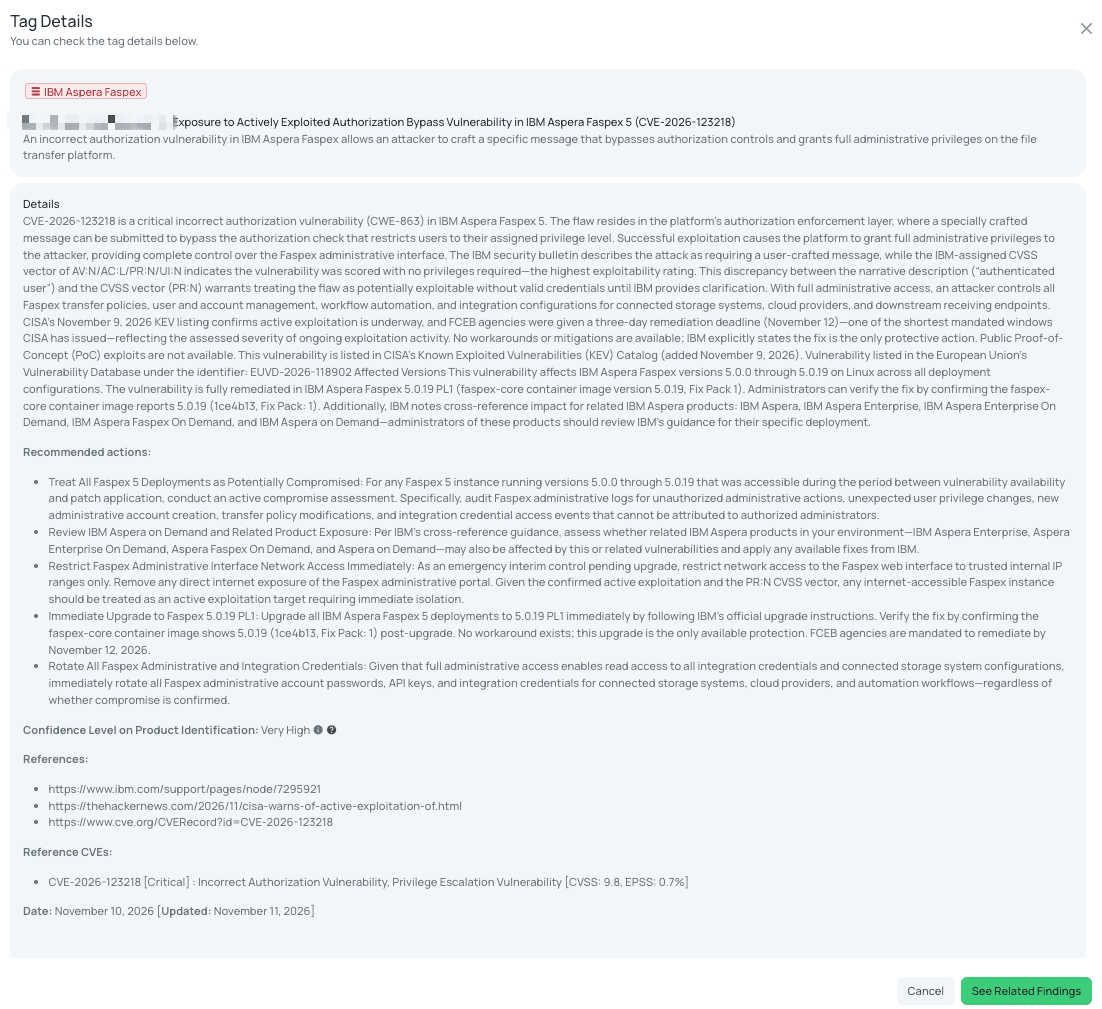
Black Kite's IBM Aspera Faspex FocusTag® details critical insights on the event for TPRM professionals.
SonicWall SSLVPN - Nov2026
What is this vulnerability?
SonicWall published advisory SNWLID-2026-0014 on October 30, 2026 for CVE-2026-19868, an authentication enforcement vulnerability (CWE-308, use of single-factor authentication) in the SonicOS SSLVPN service. Black Kite's tracker rates the flaw CVSS 7.5 with an EPSS of 0.532%. The bug applies only when SAML is enabled for SSLVPN logins: a user who holds valid credentials for a different, non-SAML login method can bypass the SAML authentication path entirely, including any MFA layered on top of it through the identity provider, and reach the SSLVPN portal with a password alone. It affects Gen7 firewalls (TZ, NSa, NSsp series and NSv virtual appliances) running SonicOS prior to 7.3.4-7015, and Gen8 firewalls (TZ, NSa series and NSv virtual appliances) running SonicOS prior to 8.2.2-8015. Fixes ship in SonicOS 7.3.4-7013 (Gen7) and 8.2.3-8015 (Gen8); SonicWall has not published a workaround.
CISA added CVE-2026-19868 to its Known Exploited Vulnerabilities (KEV) Catalog on November 6, 2026, with a remediation deadline of November 20, 2026, based on a report of potential exploitation; public proof-of-concept code is available. Neither SonicWall nor CISA has published indicators of compromise or details of the observed attacks, and it is not known whether the flaw was exploited as a zero-day before the patch shipped. The researcher credited with the finding is Ryan Harris of The Electronic Office. SonicWall SSLVPN has a well-established exploitation history: Akira ransomware affiliates compromised SonicWall firewalls even with OTP-based MFA enabled in 2025, and CVE-2024-12802, an earlier SonicWall SSLVPN MFA bypass, was separately observed under active exploitation. That pattern makes this device family a recurring, high-value target for credential-based VPN attacks.
Why should TPRM professionals care?
SonicWall firewalls are among the most widely internet-exposed perimeter and VPN devices in enterprise environments, and the SSLVPN service is typically the primary remote-access path into a vendor's internal network. A flaw that lets an attacker with any valid credential set bypass SAML-enforced MFA defeats the exact control most organizations rely on to neutralize stolen or weak passwords, meaning a vendor's remote-access perimeter can be breached without the attacker ever touching the identity provider. For TPRM teams, this converts a routine credential compromise at a vendor into a direct network intrusion vector, and because the device sits at the network edge, a successful bypass can be a foothold for lateral movement into systems that process shared data or connect back to the assessing organization.
What questions should TPRM professionals ask vendors?
- Is SAML enabled for SSLVPN login on your SonicWall firewalls? If yes, which SonicOS version are you running?
- Have you upgraded all Gen7 firewalls to 7.3.4-7013+ and Gen8 to 8.2.3-8015+? When will this finish?
- Do you allow any non-SAML login method for SSLVPN? Have you disabled the ones you don't need?
- Did you check SSLVPN login logs against your identity provider's logs for logins with no matching MFA event?
- If you found a bypassed login, did you reset that account's password and review what it accessed?
Remediation recommendations
- Upgrade all Gen7 SonicWall firewalls to SonicOS 7.3.4-7013 or later, and all Gen8 firewalls to 8.2.3-8015 or later, and confirm the running build after reboot.
- Inventory every SonicWall appliance, including NSv virtual instances, and prioritize patching on internet-facing devices with SSLVPN enabled.
- Determine whether SAML is enabled for SSLVPN logins on each device; treat any device with SAML enabled as directly exposed until the patch is applied.
- Review alternate (non-SAML) SSLVPN login methods configured on each device and disable any that are not strictly required.
- Audit SSLVPN authentication logs for logins that bypassed the SAML/MFA path, including sessions from accounts that should only authenticate via SAML, and compare them against identity provider sign-in logs for matching MFA events.
- Reset credentials for any account found to have logged in without a corresponding SAML/MFA event, and review what was accessed during those sessions.
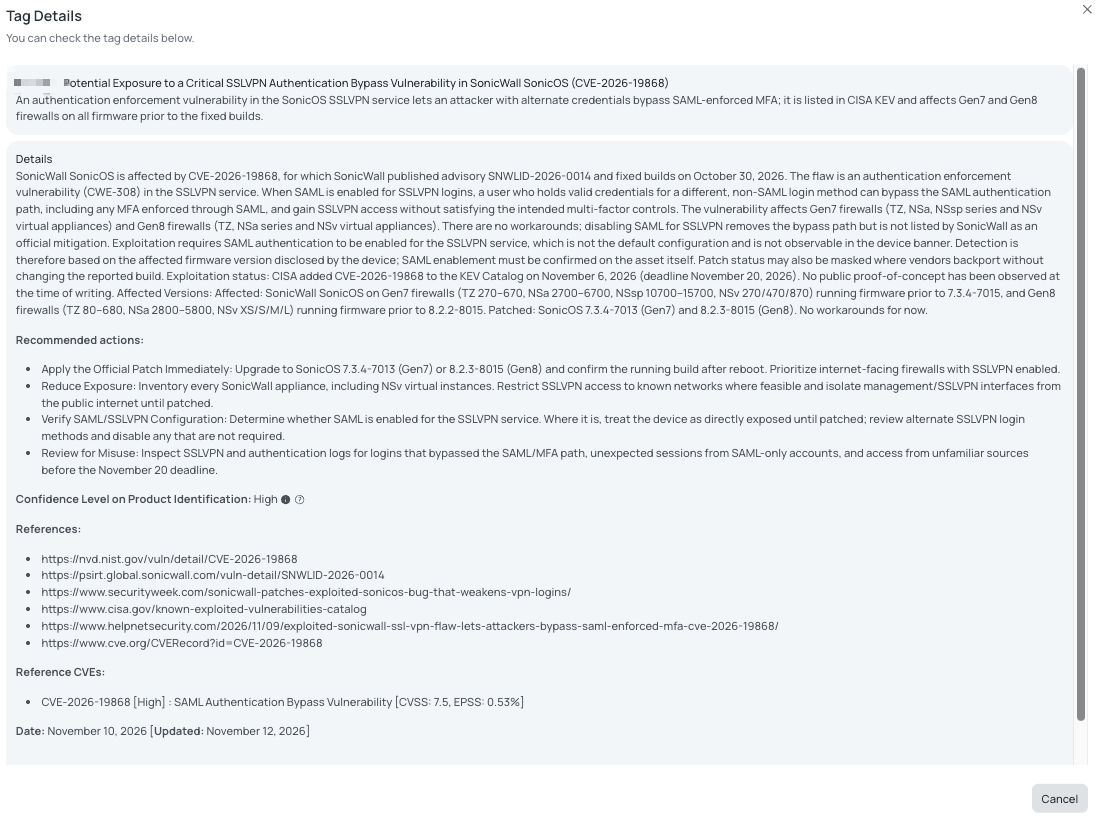
Black Kite's SonicWall SSLVPN - Nov2026 FocusTag® details critical insights on the event for TPRM professionals.
SharePoint - Nov2026
What is this vulnerability?
Microsoft's November 2026 Patch Tuesday fixes 27 vulnerabilities in Microsoft SharePoint Server Subscription Edition, a widely deployed collaboration and document management platform often exposed to external users and partners. The cluster spans six remote code execution flaws (mostly deserialization of untrusted data, plus one type confusion issue), eight elevation-of-privilege flaws, ten spoofing flaws (mostly stored or reflected cross-site scripting), and three information disclosure flaws. CVSS scores range from 4.6 to 9.9. The anchor flaw, CVE-2026-120002 (CWE incorrect authorization, elevation of privilege, CVSS 9.9, EPSS 0.02%), allows an authenticated attacker to gain unauthorized elevated access. Two other critical-rated issues follow close behind: CVE-2026-109454 (cross-site scripting, spoofing, CVSS 9.0) and CVE-2026-80095 (stored cross-site scripting, elevation of privilege, CVSS 9.0). Eight additional flaws score 8.8, including five deserialization-based RCEs and a type confusion RCE, and several issues stem from server-side request forgery and missing or incorrect authorization checks.
All 27 CVEs require an authenticated session, most at low privilege; CVE-2026-109466 additionally requires adjacent network access, and several of the XSS and SSRF flaws require user interaction. None of the 27 CVEs is listed in CISA's KEV Catalog, none has a public proof-of-concept, and Microsoft reports no exploitation in the wild as of this writing; none is a confirmed zero-day. The fixes are delivered through KB5002945, bringing SharePoint Server Subscription Edition to build 16.0.20326.20278; individual CVEs list varying upper bounds in source advisories (for example CVE-2026-123391 is fixed through 16.0.20326.20136 and CVE-2026-88176 through 16.0.20326.20190), but all are remediated by the November cumulative build. SharePoint Server has a documented history as a target for both opportunistic and targeted exploitation once patches are reverse-engineered, which keeps the pressure on to patch promptly even in the absence of current in-the-wild activity.
CVE | CVSS | Vulnerability Name | Short Description |
|---|---|---|---|
CVE-2026-120002 | 9.9 | Incorrect Authorization (Elevation of Privilege) | Authenticated attacker gains unauthorized elevated access via incorrect authorization check |
CVE-2026-109454 | 9.0 | Cross-Site Scripting (Spoofing) | Authenticated user triggers XSS leading to content spoofing in SharePoint pages |
CVE-2026-80095 | 9.0 | Stored XSS (Elevation of Privilege) | Stored cross-site scripting used to escalate privileges within SharePoint |
CVE-2026-109464 | 8.8 | Deserialization RCE | Untrusted data deserialization allows authenticated remote code execution |
CVE-2026-109472 | 8.8 | Deserialization RCE | Untrusted data deserialization allows authenticated remote code execution |
CVE-2026-109499 | 8.8 | Deserialization RCE | Untrusted data deserialization allows authenticated remote code execution |
CVE-2026-109502 | 8.8 | Elevation of Privilege | Authenticated attacker escalates privileges within SharePoint environment |
CVE-2026-110044 | 8.8 | Deserialization RCE | Untrusted data deserialization allows authenticated remote code execution |
CVE-2026-123390 | 8.8 | Deserialization RCE | Untrusted data deserialization allows authenticated remote code execution |
CVE-2026-123391 | 8.8 | Elevation of Privilege | Authenticated attacker escalates privileges within SharePoint environment |
CVE-2026-88176 | 8.8 | Elevation of Privilege | Authenticated attacker escalates privileges within SharePoint environment |
CVE-2026-109466 | 8.0 | Elevation of Privilege (Adjacent Network) | Adjacent-network attacker escalates privileges within SharePoint environment |
CVE-2026-111296 | 8.0 | Elevation of Privilege | Authenticated attacker escalates privileges within SharePoint environment |
CVE-2026-111297 | 8.0 | Spoofing | Authenticated attacker spoofs content or identity within SharePoint pages |
CVE-2026-120000 | 7.5 | Type Confusion RCE | Type confusion flaw allows authenticated remote code execution |
CVE-2026-109497 | 7.3 | Spoofing | Authenticated attacker spoofs content via crafted SharePoint requests |
CVE-2026-109504 | 7.3 | Spoofing | Authenticated attacker spoofs content via crafted SharePoint requests |
CVE-2026-110045 | 7.3 | Spoofing | Authenticated attacker spoofs content via crafted SharePoint requests |
CVE-2026-110065 | 7.3 | Spoofing | Authenticated attacker spoofs content via crafted SharePoint requests |
CVE-2026-111300 | 7.3 | Spoofing | Authenticated attacker spoofs content via crafted SharePoint requests |
CVE-2026-111303 | 7.3 | Spoofing | Authenticated attacker spoofs content via crafted SharePoint requests |
CVE-2026-109495 | 6.6 | Elevation of Privilege | Authenticated attacker escalates privileges within SharePoint environment |
CVE-2026-109455 | 6.5 | Information Disclosure | Authenticated attacker accesses sensitive SharePoint data beyond authorized scope |
CVE-2026-110057 | 6.5 | Information Disclosure | Authenticated attacker accesses sensitive SharePoint data beyond authorized scope |
CVE-2026-124210 | 6.5 | Information Disclosure | Authenticated attacker accesses sensitive SharePoint data beyond authorized scope |
CVE-2026-112736 | 5.3 | Spoofing | Authenticated attacker spoofs content via crafted SharePoint requests |
CVE-2026-109456 | 4.6 | Spoofing | Authenticated attacker spoofs content via crafted SharePoint requests |
Why should TPRM professionals care?
SharePoint typically sits at the center of a vendor's internal collaboration and document workflows, and farms are frequently exposed to external users through extranet sites, partner portals, or shared document libraries. A chain that starts with an authenticated low-privilege session and ends in elevation of privilege, server-side code execution, or persistent cross-site scripting gives an attacker who has already obtained any valid account — through phishing, credential stuffing, or a compromised contractor — a path to compromise the entire farm, exfiltrate sensitive documents, or plant malicious content that is served back to other authenticated users, including the vendor's own staff and customers. Because the flaws require authentication rather than being wormable, TPRM teams should focus on how broadly a vendor extends authenticated access to its SharePoint environment and how quickly that vendor patches once credentials are inevitably compromised elsewhere in its environment.
What questions should TPRM professionals ask vendors?
- Have you applied the November 2026 SharePoint Server Subscription Edition update (KB5002945, build 16.0.20326.20278) to every server in the farm, and has the SharePoint Products Configuration Wizard been run to complete the upgrade?
- Is your SharePoint farm patch level currently at or above the September 2025 CU, and if so, have you applied the folder permission fix script required before this update can install successfully?
- Which SharePoint sites or document libraries are reachable by external or low-privilege authenticated users, and have you reviewed those access grants in light of CVE-2026-120002's incorrect authorization flaw?
- Do you monitor SharePoint servers for anomalous outbound requests that could indicate exploitation of the SSRF-related flaws in this cluster?
Remediation recommendations
- Apply the November 2026 SharePoint Server Subscription Edition security update (KB5002945) to bring all farm servers to build 16.0.20326.20278 or later.
- Run the SharePoint Products Configuration Wizard on every server after installing the update to complete the upgrade process.
- If the farm is currently at the September 2025 CU patch level, run the documented folder-permission correction script before attempting to install the November fixes, as installation will otherwise fail.
- Restrict SharePoint access to trusted networks where possible, and prioritize patching for internet-facing or externally shared farms.
- Enforce least privilege and review which accounts hold authenticated or contributor access, since every flaw in this cluster requires an authenticated session.
- Monitor SharePoint logs for unexpected script content in pages, unusual outbound requests from SharePoint servers, and anomalous privilege changes consistent with the elevation-of-privilege flaws.
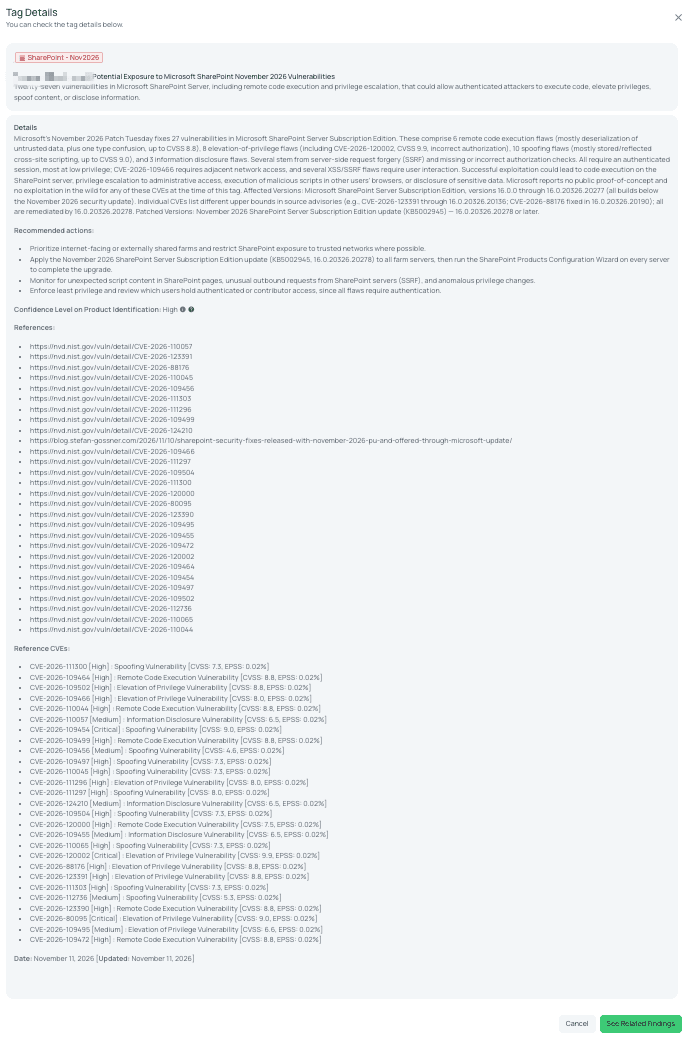
Black Kite's SharePoint - Nov2026 FocusTag® details critical insights on the event for TPRM professionals.
Exchange Server - Nov2026
What is this vulnerability?
Microsoft's November 10, 2026 Patch Tuesday release addressed nine vulnerabilities in on-premises Exchange Server, spanning CVSS 6.5 to 8.8: two Remote Code Execution flaws, four Elevation of Privilege flaws, two Spoofing flaws, and one Denial of Service flaw. The anchor issue, CVE-2026-118207 (CVSS 8.8, CWE-706, improper input validation), is the only flaw in the cluster that Microsoft rates Exploitation More Likely, meaning an authenticated attacker with only low-level access can send a specially crafted request and execute arbitrary code on the Exchange server with no user interaction required. CVE-2026-118149 (CVSS 8.8, CWE-94) offers a second, independent code-injection path to RCE for similarly low-privileged authenticated attackers, while CVE-2026-118150 (CVSS 8.8, CWE-639) and CVE-2026-118154 (CVSS 8.8, CWE-807) allow low-privilege authenticated users to escalate to full confidentiality, integrity, and availability impact. CVE-2026-118151 (CVSS 7.2, CWE-73, path traversal) is notable because Microsoft's advisory explicitly confirms that successful exploitation yields SYSTEM-level privileges, the highest privilege tier on Windows, making it a logical escalation step once a foothold exists. CVE-2026-118153 (CVSS 7.5) and CVE-2026-118152 (CVSS 6.5) are reachable without any authentication at all — the former an algorithmic-complexity denial-of-service, the latter a CSRF-based spoofing flaw.
None of the nine CVEs show evidence of active exploitation, public proof-of-concept code, or zero-day status, and none are listed in CISA's Known Exploited Vulnerabilities (KEV) Catalog as of this writing; EPSS for every CVE sits at 0.02%. All nine affect Exchange Server Subscription Edition RTM, versions 15.02.0.0 through 15.02.2562.056, on-premises only — Exchange Online is not affected. Microsoft fully remediates the cluster in build 15.02.2562.057, delivered through KB5133453, released November 10, 2026. Exchange Server has a well-established precedent of becoming a high-value exploitation target shortly after disclosure, including multiple prior quarters of active exploitation of authenticated RCE and privilege escalation chains in the same product line, which is the basis for treating the Exploitation More Likely designation on CVE-2026-118207 as a near-term weaponization risk rather than a theoretical one.
CVE | CVSS | Vulnerability Name | Short Description |
|---|---|---|---|
CVE-2026-118149 | 8.8 | Code Injection (RCE) | Authenticated low-privilege code injection enables arbitrary code execution on Exchange server |
CVE-2026-118150 | 8.8 | Authorization Bypass (EoP) | User-controlled key allows authenticated bypass of authorization controls and privilege escalation |
CVE-2026-118154 | 8.8 | Untrusted Input Security Bypass (EoP) | Reliance on untrusted inputs lets authenticated users manipulate security decisions |
CVE-2026-118207 | 8.8 | Improper Input Validation (RCE) | Exploitation More Likely flaw enabling low-privilege authenticated arbitrary code execution |
CVE-2026-118153 | 7.5 | Algorithmic Complexity (DoS) | Unauthenticated requests trigger excessive computational load, causing denial of service |
CVE-2026-118151 | 7.2 | Path Traversal to SYSTEM (EoP) | High-privilege attacker escalates to full SYSTEM privileges via file path traversal |
CVE-2026-118157 | 7.2 | Weak Authentication (EoP) | High-privilege authenticated attacker further elevates privileges over the network |
CVE-2026-118208 | 7.1 | Improper Access Control (Spoofing) | Low-privilege authenticated attacker spoofs communications, impersonating legitimate senders |
CVE-2026-118152 | 6.5 | CSRF (Spoofing) | Unauthenticated CSRF enables state-modifying requests via crafted link clicks |
Why should TPRM professionals care?
Exchange Server typically sits at the center of a vendor's internal communications, calendar, and directory infrastructure, and a compromise there can cascade into mailbox access, credential harvesting, and lateral movement across the vendor's broader network. For TPRM professionals, an authenticated RCE chain rated Exploitation More Likely on a vendor's on-premises mail infrastructure raises the realistic possibility of business email compromise, fraudulent messages sent from a trusted vendor domain, or exposure of sensitive correspondence with downstream partners. The presence of both authenticated RCE paths and an unauthenticated DoS and CSRF flaw in the same cluster also means a single unpatched vendor instance can be attacked from several different angles, which should raise the priority of confirming patch status for any vendor running on-premises Exchange Server rather than Exchange Online.
What questions should TPRM professionals ask vendors?
- Have you applied the November 10, 2026 security update (KB5133453) to every on-premises Exchange Server Subscription Edition instance, and can you confirm the installed build has reached 15.02.2562.057?
- Is your organization's Exchange administrative interface (ECP/EAC) restricted to known administrative IP ranges, or is it reachable from the broader internet?
- Given that CVE-2026-118207 is rated Exploitation More Likely by Microsoft, have you reviewed Exchange and IIS access logs for anomalous authenticated requests or unexpected code execution events since the patch release?
- Have you implemented SameSite cookie enforcement or web application firewall rules to mitigate the CSRF spoofing vulnerability (CVE-2026-118152) while the patch is being rolled out across your environment?
Remediation recommendations
- Install KB5133453 on all on-premises Exchange Server Subscription Edition deployments immediately and verify the installed build reaches 15.02.2562.057.
- Treat patching as a priority action outside normal maintenance windows given the Exploitation More Likely rating on CVE-2026-118207 and the multiple CVSS 8.8 authenticated RCE and EoP flaws in this cluster.
- Review Exchange Server and IIS access logs for anomalous authenticated requests, unexpected code execution events, new service or scheduled task creation, and configuration changes from low-privilege accounts.
- Restrict access to Exchange administrative functions and the ECP/EAC interfaces to known and authorized administrative IP ranges to reduce the exploitable attacker population.
- Enforce SameSite cookie policies on Exchange session cookies and deploy web application firewall rules blocking cross-origin state-modifying requests as defense-in-depth against the CSRF spoofing flaw (CVE-2026-118152).
- Apply network-level rate limiting and request filtering on inbound Exchange server ports as an interim mitigation against the unauthenticated algorithmic-complexity denial-of-service flaw (CVE-2026-118153) while patching is completed.
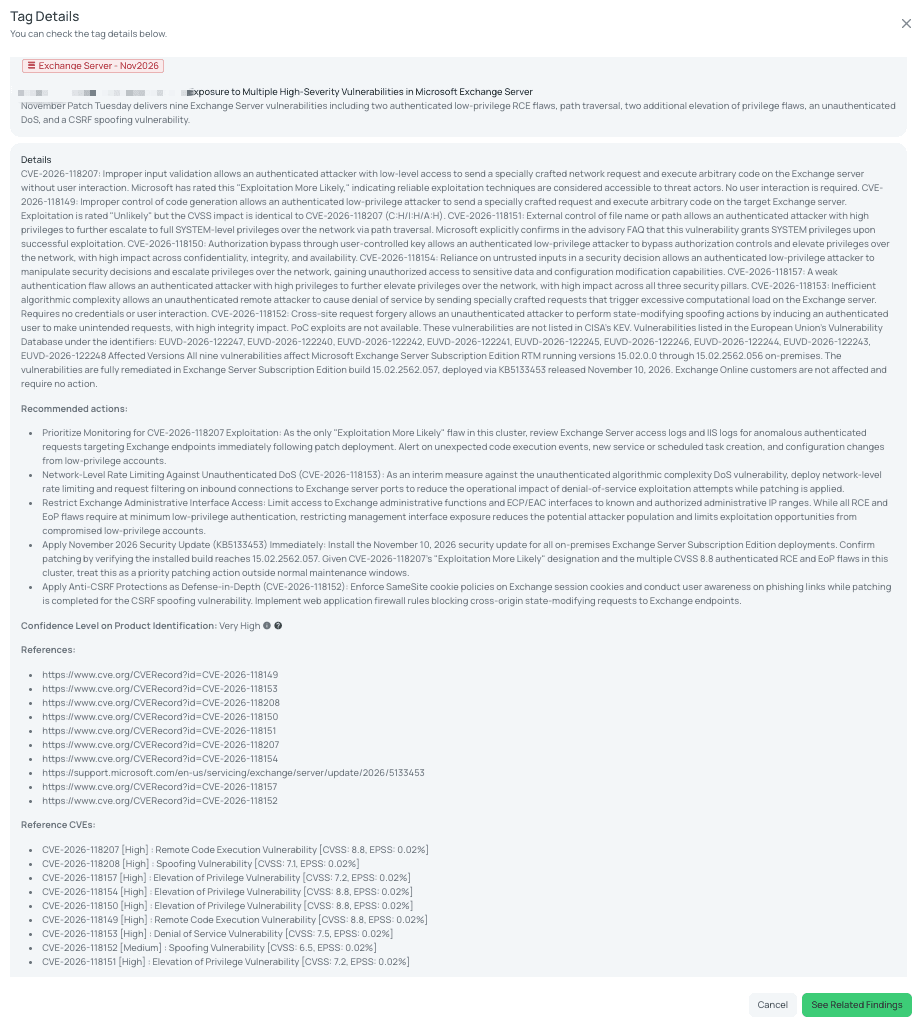
Black Kite's Exchange Server - Nov2026 FocusTag® details critical insights on the event for TPRM professionals.
MSSQL - Nov2026
What is this vulnerability?
Microsoft's November 2026 Patch Tuesday addresses 52 vulnerabilities in Microsoft SQL Server, spanning the 2017, 2019, 2022, and 2025 releases. The set breaks down into 20 remote code execution flaws, 22 elevation-of-privilege flaws, and 10 information disclosure flaws, with CVSS scores ranging from 4.9 to 9.8. The anchor flaw, CVE-2026-116945 (CVSS 9.8, EPSS 0.02%), is an unauthenticated heap-based buffer overflow (CWE-122) that an attacker can trigger over the network without holding any credentials, leading to remote code execution with the privileges of the SQL Server service. Eighteen additional flaws score 8.8, most of them heap- or stack-based buffer overflow RCEs, SQL injection elevation-of-privilege bugs, or untrusted pointer dereference issues, and a further block of flaws score 7.5 to 8.1, including CVE-2026-118106 (RCE, CVSS 8.1), CVE-2026-66813 (EoP, CVSS 8.1), and CVE-2026-116943 (information disclosure, CVSS 7.5). The large majority of the 52 CVEs require an authenticated, typically low-privileged, session to exploit; only CVE-2026-116945, CVE-2026-118106, CVE-2026-66813, CVE-2026-116943, and CVE-2026-118102 can be triggered without authentication.
None of the 52 CVEs is listed in CISA's Known Exploited Vulnerabilities (KEV) Catalog, none has a confirmed public proof-of-concept, and none is a zero-day; Microsoft and Black Kite's tracker report no exploitation in the wild for this cluster as of this writing. Affected builds span the RTM/GDR and cumulative-update branches below the November 2026 security update: SQL Server 2017 (through CU31/GDR), 2019 (through CU32/GDR), 2022 (through CU27/GDR), and 2025 (through GDR 17.0.1155.3 or CU10 17.0.5045.3). Several CVEs affect only a subset of versions — CVE-2026-88111, CVE-2026-116933, and CVE-2026-94513 apply only to 2022 and 2025; CVE-2026-67372 and CVE-2026-67646 apply only to 2025; CVE-2026-118115 does not affect 2019; and CVE-2026-116944 is scoped to the 2017 GDR branch only. SQL Server has a documented history of both authenticated and remote exploitation paths being weaponized quickly once patch diffing reveals the underlying memory-corruption logic, which is why the volume and severity of this month's batch warrants prompt attention even in the absence of current exploitation.
CVE | CVSS | Vulnerability Name | Short Description |
|---|---|---|---|
CVE-2026-116945 | 9.8 | Heap-Based Buffer Overflow (RCE) | Unauthenticated remote code execution via heap overflow in SQL Server |
CVE-2026-116930 | 8.8 | Remote Code Execution | Authenticated memory-corruption flaw enabling code execution |
CVE-2026-116934 | 8.8 | Elevation of Privilege | Authenticated flaw allowing privilege escalation within SQL Server |
CVE-2026-116941 | 8.8 | Remote Code Execution | Authenticated memory-corruption flaw enabling code execution |
CVE-2026-116942 | 8.8 | Remote Code Execution | Authenticated memory-corruption flaw enabling code execution |
CVE-2026-116946 | 8.8 | Remote Code Execution | Authenticated memory-corruption flaw enabling code execution |
CVE-2026-118105 | 8.8 | Elevation of Privilege | Authenticated SQL injection or pointer issue enabling privilege escalation |
CVE-2026-118109 | 8.8 | Elevation of Privilege | Authenticated SQL injection or pointer issue enabling privilege escalation |
CVE-2026-118110 | 8.8 | Elevation of Privilege | Authenticated SQL injection or pointer issue enabling privilege escalation |
CVE-2026-118120 | 8.8 | Elevation of Privilege | Authenticated SQL injection or pointer issue enabling privilege escalation |
CVE-2026-67372 | 8.8 | Remote Code Execution | Authenticated memory-corruption flaw affecting SQL Server 2025 |
CVE-2026-67374 | 8.8 | Remote Code Execution | Authenticated memory-corruption flaw enabling code execution |
CVE-2026-67375 | 8.8 | Elevation of Privilege | Authenticated flaw allowing privilege escalation within SQL Server |
CVE-2026-67387 | 8.8 | Elevation of Privilege | Authenticated flaw allowing privilege escalation within SQL Server |
CVE-2026-67391 | 8.8 | Remote Code Execution | Authenticated memory-corruption flaw enabling code execution |
CVE-2026-67632 | 8.8 | Remote Code Execution | Authenticated memory-corruption flaw enabling code execution |
CVE-2026-67637 | 8.8 | Remote Code Execution | Authenticated memory-corruption flaw enabling code execution |
CVE-2026-67646 | 8.8 | Remote Code Execution | Authenticated memory-corruption flaw affecting SQL Server 2025 only |
CVE-2026-94511 | 8.8 | Remote Code Execution | Authenticated memory-corruption flaw enabling code execution |
CVE-2026-118106 | 8.1 | Remote Code Execution | Unauthenticated flaw enabling remote code execution |
CVE-2026-66813 | 8.1 | Elevation of Privilege | Unauthenticated flaw allowing privilege escalation |
CVE-2026-118111 | 8.0 | Elevation of Privilege | Authenticated SQL injection enabling privilege escalation |
CVE-2026-118112 | 8.0 | Elevation of Privilege | Authenticated SQL injection enabling privilege escalation |
CVE-2026-118113 | 8.0 | Elevation of Privilege | Authenticated SQL injection enabling privilege escalation |
CVE-2026-118117 | 8.0 | Elevation of Privilege | Authenticated SQL injection enabling privilege escalation |
CVE-2026-118118 | 8.0 | Elevation of Privilege | Authenticated SQL injection enabling privilege escalation |
CVE-2026-118119 | 8.0 | Elevation of Privilege | Authenticated SQL injection enabling privilege escalation |
CVE-2026-94513 | 8.0 | Elevation of Privilege | Authenticated flaw affecting SQL Server 2022 and 2025 only |
CVE-2026-116929 | 7.5 | Elevation of Privilege | Authenticated flaw allowing privilege escalation within SQL Server |
CVE-2026-116931 | 7.5 | Remote Code Execution | Authenticated memory-corruption flaw enabling code execution |
CVE-2026-116937 | 7.5 | Remote Code Execution | Authenticated memory-corruption flaw enabling code execution |
CVE-2026-116938 | 7.5 | Remote Code Execution | Authenticated memory-corruption flaw enabling code execution |
CVE-2026-116943 | 7.5 | Information Disclosure | Unauthenticated flaw disclosing server memory contents |
CVE-2026-116947 | 7.5 | Remote Code Execution | Authenticated memory-corruption flaw enabling code execution |
CVE-2026-118108 | 7.5 | Elevation of Privilege | Authenticated SQL injection enabling privilege escalation |
CVE-2026-118114 | 7.5 | Elevation of Privilege | Authenticated SQL injection enabling privilege escalation |
CVE-2026-118115 | 7.5 | Elevation of Privilege | Authenticated flaw not affecting SQL Server 2019 |
CVE-2026-84010 | 7.5 | Elevation of Privilege | Authenticated flaw allowing privilege escalation within SQL Server |
CVE-2026-88111 | 7.5 | Remote Code Execution | Authenticated memory-corruption flaw affecting 2022 and 2025 only |
CVE-2026-116933 | 7.2 | Remote Code Execution | Authenticated memory-corruption flaw affecting 2022 and 2025 only |
CVE-2026-116936 | 7.2 | Remote Code Execution Vulnerability | Authenticated memory-corruption flaw enabling code execution |
CVE-2026-116944 | 7.2 | Elevation of Privilege Vulnerability | Authenticated memory-corruption flaw enabling privilege escalation |
CVE-2026-118116 | 7.0 | Elevation of Privilege Vulnerability | Authenticated SQL injection enabling privilege escalation |
CVE-2026-116932 | 6.5 | Information Disclosure Vulnerability | Authenticated flaw disclosing server memory contents |
CVE-2026-116935 | 6.5 | Information Disclosure Vulnerability | Authenticated buffer over-read flaw disclosing memory contents |
CVE-2026-118103 | 6.5 | Information Disclosure Vulnerability | Unauthenticated flaw disclosing server memory contents |
CVE-2026-118104 | 6.5 | Information Disclosure Vulnerability | Authenticated flaw disclosing uninitialized memory contents |
CVE-2026-67382 | 6.5 | Information Disclosure Vulnerability | Authenticated flaw disclosing uninitialized memory contents |
CVE-2026-68783 | 6.5 | Information Disclosure Vulnerability | Authenticated flaw disclosing memory, SQL Server 2025 only |
CVE-2026-118102 | 5.9 | Information Disclosure Vulnerability | Unauthenticated flaw exposing data via weak cryptography |
CVE-2026-116939 | 5.7 | Information Disclosure Vulnerability | Authenticated flaw disclosing server memory contents |
CVE-2026-116940 | 4.9 | Information Disclosure Vulnerability | Authenticated flaw disclosing server memory contents |
Why should TPRM professionals care?
Microsoft SQL Server underpins transaction processing, customer records, and application back ends across a vendor's environment, so a database compromise is rarely an isolated event — it typically cascades into every application and workflow that depends on that data store. An unauthenticated RCE like CVE-2026-116945 gives an external attacker a direct path to code execution on a system that often holds the most sensitive and highly regulated data a vendor processes, while the SQL injection and privilege-escalation flaws in this batch raise the risk of lateral movement from a low-privileged application account to full administrative database control. For TPRM professionals, this FocusTag also carries a differentiator: Black Kite can enumerate which vendor-exposed IP addresses and subdomains report SQL Server Browser Service responses at vulnerable build numbers, turning a 52-CVE patch bundle into a concrete, externally observable exposure list rather than a generic advisory to track.
What questions should TPRM professionals ask vendors?
- Have you confirmed the exact build number of every SQL Server 2017, 2019, 2022, and 2025 instance in your environment using SERVERPROPERTY('ProductVersion'), and have you applied the corresponding November 2026 GDR or CU+GDR update?
- Is the SQL Server Browser Service (UDP 1434) or any SQL Server instance reachable from the public internet, and if so, what compensating controls are in place pending patch deployment?
- For CVE-2026-116945, which requires no authentication to trigger remote code execution, what is your timeline for patching internet-facing or perimeter-adjacent SQL Server instances?
- Given that most of the 22 elevation-of-privilege flaws require only a low-privileged authenticated session, how are SQL logins and database role memberships scoped under least privilege in your deployment?
Remediation recommendations
- Apply the November 2026 SQL Server security update matching your installed servicing branch: 2017 CU31/GDR, 2019 CU32/GDR, 2022 CU27/GDR, or 2025 GDR 17.0.1155.3 / CU10 17.0.5045.3 or later.
- Determine the exact build level of each instance via SERVERPROPERTY('ProductVersion') before selecting the update, since several CVEs affect only specific version subsets (for example 2022/2025 only, 2025 only, or the 2017 GDR branch only).
- Remove public internet exposure of SQL Server instances and the SQL Server Browser Service (UDP 1434); restrict access to internal network ranges and trusted application tiers only.
- Enforce least privilege on SQL logins and database roles, since the majority of the elevation-of-privilege and SQL injection flaws in this batch require only an authenticated, low-privileged session.
- Monitor logs for unexpected query patterns, SQL injection indicators, or unexplained SQL Server process crashes that could indicate attempted exploitation of the memory-corruption flaws.
- Prioritize patching for CVE-2026-116945, CVE-2026-118106, CVE-2026-66813, CVE-2026-116943, and CVE-2026-118102 given their unauthenticated attack vector, even though none is currently reported as exploited.
Black Kite's MSSQL - Nov2026 FocusTag® details critical insights on the event for TPRM professionals.
Apache HTTP Server - Nov2026
What is this vulnerability?
Apache fixed CVE-2026-119618 in HTTP Server 2.4.71, released November 11, 2026, a critical flaw in mod_http2, the module that implements HTTP/2. The issue is a concurrent execution flaw with improper synchronization (CWE-362) in the assign_headers() function that leads to heap corruption and remote code execution. Black Kite rates it CVSS 9.8 with an EPSS of 0.02%, and it carries no public proof-of-concept, no confirmed zero-day status, and no listing in CISA's Known Exploited Vulnerabilities (KEV) Catalog as of this writing. Red Hat, which ships the module in Red Hat Enterprise Linux, states that public research has demonstrated a reliable exploit against a default configuration with mod_http2 enabled, though it does not name or link that research; Wiz separately reported that no exploit was publicly available and no in-the-wild exploitation had been observed at the time of its analysis. The flaw affects Apache HTTP Server 2.4.55 through 2.4.70, and standalone GitHub releases of mod_h2 2.0.8 through 2.0.42; the mod_h2 GitHub project has been archived since June 9 and has not shipped a fix.
Exploitation requires no authentication, only network reach to a server with HTTP/2 enabled through the Protocols directive (h2 for HTTP/2 over TLS, h2c over plain TCP), which can be set server-wide or per virtual host. Notably, servers already patched against an earlier HTTP/2 flaw, CVE-2026-23918 (fixed in 2.4.67, released May 4, 2026), remain exposed to this new issue since it affects every version up to 2.4.70. Red Hat rates the flaw Important rather than Critical on RHEL 9 and 10 because its mod_http2 packages use a per-stream memory allocator that raises the exploitation bar; RHEL 6, 7 and 8 do not contain the vulnerable code. Debian's unstable branch has a fix (apache2 2.4.71-1) while bookworm, trixie and forky remain vulnerable with no fix listed, and Amazon Linux lists the issue as pending. Apache HTTP Server is among the most widely deployed web server software on the internet, and the product has a history of actively exploited HTTP/2 implementation flaws, underscoring the need for prompt patching.
Why should TPRM professionals care?
Apache HTTP Server sits at the front door of a vendor's internet-facing infrastructure, often serving as the public entry point for customer portals, APIs, and other externally reachable applications. An unauthenticated remote code execution flaw in a component this widely deployed means a successful exploit could hand an attacker full control of the server process, enabling lateral movement into backend systems, data exfiltration, or use of the compromised host to stage further attacks against the vendor's customers. Because exposure depends on whether HTTP/2 is enabled via the Protocols directive — a setting invisible to external scanners — TPRM teams cannot rely on version banners alone to judge real risk and must engage vendors directly on configuration details.
What questions should TPRM professionals ask vendors?
- Have you upgraded all Apache HTTP Server instances to version 2.4.71, and if running a Linux distribution, have you confirmed the distribution-specific package update (for example mod_http2-2.0.26-7.el9_9.1 on RHEL 9) has been applied?
- Is the Protocols directive set to h2 or h2c on any server-wide or virtual host configuration, and if patching is not yet complete, have you removed h2/h2c and limited Protocols to http/1.1 as an interim mitigation?
- Are any of your externally reachable servers still running a standalone mod_h2 build from the archived GitHub project, and if so, what is your plan given that no fixed release exists?
- Do you operate Apache HTTP Server instances on Debian bookworm, trixie, forky, or Amazon Linux where a fix was not yet listed at the time of this assessment, and what is your remediation timeline for those hosts?
Remediation recommendations
- Upgrade all Apache HTTP Server project installations to version 2.4.71 immediately.
- On Red Hat Enterprise Linux 9 and 10, apply the distribution-specific fixes (mod_http2-2.0.26-7.el9_9.1 and mod_http2-2.0.29-5.el10_3.1 respectively) referenced in RHSA-2026:98981 and RHSA-2026:98978.
- Where immediate patching is not possible, remove h2 and h2c from every server-wide and virtual host Protocols directive, restricting it to http/1.1 as an interim mitigation.
- Identify any servers running standalone mod_h2 builds from the archived GitHub project (versions 2.0.8 through 2.0.42) and migrate them to a supported, patched Apache HTTP Server distribution since no fix is available upstream.
- Monitor vendor security trackers (Debian, Amazon Linux, Ubuntu) for fix availability, since several distributions listed the issue as pending or vulnerable with no fix at publication time.
- Review internet-facing Apache deployments for HTTP/2 exposure and prioritize patching of externally reachable instances over internal-only servers.
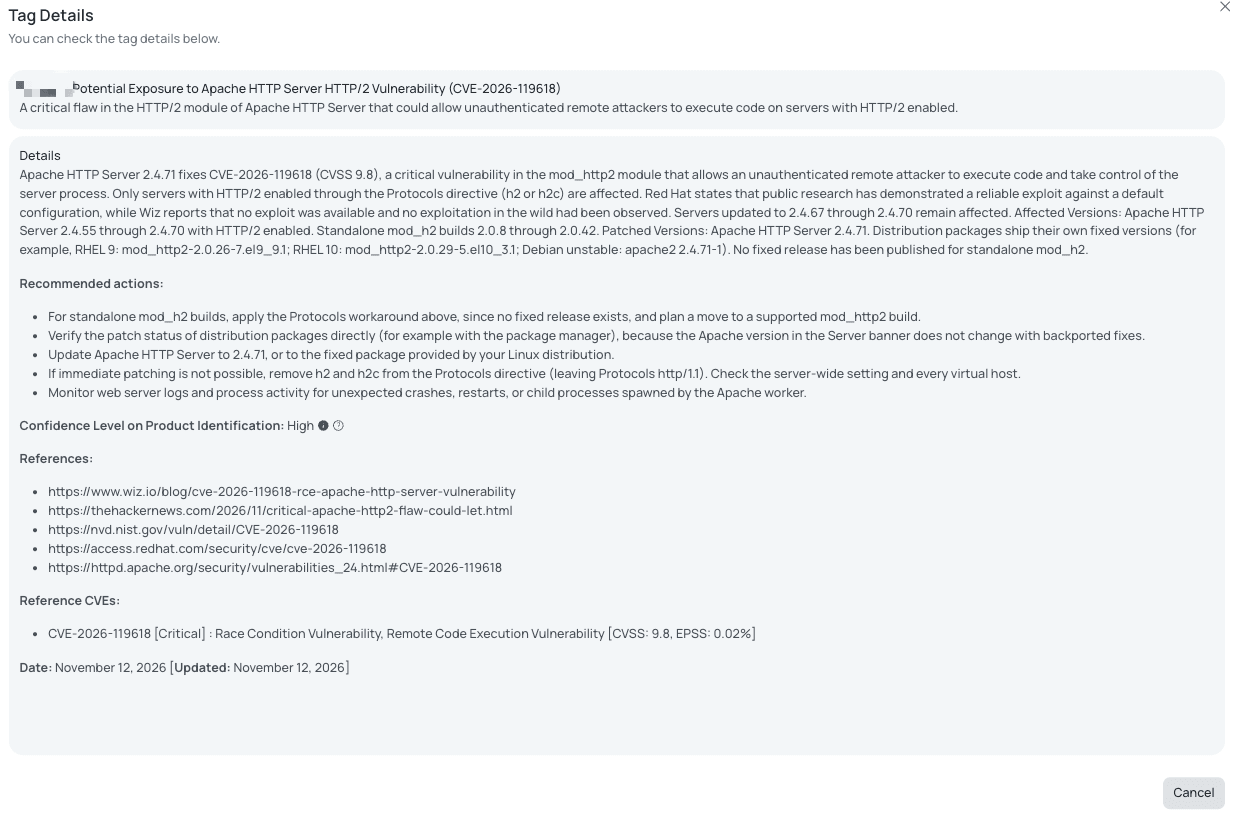
Black Kite's Apache HTTP Server - Nov2026 FocusTag® details critical insights on the event for TPRM professionals.
Progress WS_FTP - Nov2026 (Latest)
What is this vulnerability?
Progress Software released its November 2026 Service Pack for WS_FTP Server on November 9, 2026, addressing five distinct vulnerabilities with CVSS scores ranging from 5.3 to 8.1. The most severe, CVE-2026-115338 (CVSS 8.1, EPSS 0.16%), is a cleartext transmission of sensitive information flaw (CWE-319) in the XFT transport protocol: when the XFT service is configured to allow unencrypted HTTP connections, a network-positioned attacker can intercept and modify file transfer data and requests in transit, undermining both confidentiality and integrity. CVE-2026-115341 (CVSS 7.7, EPSS 0.41%, the highest EPSS in the cluster) is an authenticated path traversal vulnerability (CWE-22) in the Thin Client Web Transfer component that lets any logged-in FTP user read files outside their authorized directory scope, breaking tenant isolation in multi-user deployments. CVE-2026-115339 (CVSS 7.5, EPSS 0.37%) is an unauthenticated resource-allocation flaw in XFT that can be abused for memory-exhaustion denial of service. CVE-2026-115340 (CVSS 7.1, EPSS 0.08%) stems from insecure storage of credentials and session data in temporary files, exposing plaintext secrets to any process or user with filesystem access to the temp directory. CVE-2026-35189 (CVSS 5.3, EPSS 0.35%) is a denial-of-service issue inherited from OpenSSL's CRLDP handling that permits excessive memory allocation.
None of the five vulnerabilities has confirmed active exploitation or a public proof-of-concept, and none currently appears in CISA's Known Exploited Vulnerabilities (KEV) Catalog. All five are remediated in WS_FTP Server 2025.0.5; CVE-2026-35189 is additionally addressed in 2024.0.8 through an OpenSSL update to version 3.5.9. Progress notes that applying the service pack causes a service outage, which administrators should plan for. This is the second significant WS_FTP Server security release in two weeks, following the October 29, 2026 release that fixed the maximum-severity unauthenticated credential-theft flaw CVE-2026-84295 (CVSS 10.0) and seven other high-severity issues. That pattern, combined with the 2023 exploitation of WS_FTP's CVE-2023-40044 by Clop ransomware operators and the mass exploitation of Progress's MoveIT Transfer the same year, confirms file transfer infrastructure from this vendor as a sustained target of security research and real-world attack interest.
CVE | CVSS | Vulnerability Name | Short Description |
|---|---|---|---|
CVE-2026-115338 | 8.1 | Cleartext Transmission (MitM Interception/Modification) | Unencrypted XFT HTTP transport allows interception and tampering of file transfers |
CVE-2026-115341 | 7.7 | Authenticated Path Traversal | Thin Client Web Transfer flaw lets authenticated users read files outside their scope |
CVE-2026-115339 | 7.5 | Resource Exhaustion (DoS) | Unauthenticated XFT memory exhaustion denial of service |
CVE-2026-115340 | 7.1 | Insecure Credential Storage | Temporary files store credentials and session data in plaintext |
CVE-2026-35189 | 5.3 | OpenSSL CRLDP Resource Exhaustion (DoS) | Excessive memory allocation in OpenSSL CRLDP handling causes denial of service |
Why should TPRM professionals care?
Managed file transfer platforms like WS_FTP Server sit at the center of a vendor's most sensitive data exchange pipelines, carrying regulated financial, healthcare, and personal data between organizations. A cleartext transport flaw such as CVE-2026-115338 means that if a vendor still permits unencrypted HTTP connections for file transfers — a configuration that often lingers in legacy deployments — any attacker positioned on the network path can read or tamper with that data without needing credentials. The path traversal and insecure credential storage issues compound the risk by allowing authenticated users to breach tenant boundaries or by leaving plaintext secrets exposed in temporary files, both of which can lead to unauthorized data access or lateral movement. Given the established history of ransomware and extortion actors targeting Progress's file transfer products, TPRM teams should treat any vendor running an unpatched WS_FTP Server as a heightened risk to the confidentiality and integrity of shared data, and should verify remediation promptly rather than wait for a future exploitation event.
What questions should TPRM professionals ask vendors?
- Have you upgraded WS_FTP Server to version 2025.0.5, or at minimum applied the 2024.0.8 update with OpenSSL 3.5.9 to remediate CVE-2026-35189?
- Is the XFT service in your environment configured to permit unencrypted HTTP connections, and if so, have you disabled that option to close the cleartext interception path described in CVE-2026-115338?
- Have you reviewed Thin Client Web Transfer access logs for signs of directory traversal attempts tied to CVE-2026-115341?
- Have you purged and secured the temporary file storage locations referenced in CVE-2026-115340 and rotated any credentials or session tokens that may have been written there in plaintext?
Remediation recommendations
- Upgrade all WS_FTP Server instances to version 2025.0.5, which remediates all five November 2026 vulnerabilities.
- Where upgrading to 2025.0.5 is not immediately feasible, apply the 2024.0.8 update to address CVE-2026-35189 via the OpenSSL 3.5.9 upgrade.
- Plan for a service outage during the upgrade window, as Progress has confirmed the update process interrupts the WS_FTP Server service.
- Disable support for unencrypted HTTP connections on the XFT service and enforce TLS-only transport to close the cleartext interception and modification path in CVE-2026-115338.
- Audit and restrict Thin Client Web Transfer directory scope permissions, and monitor for anomalous file access patterns outside assigned user directories.
- Identify and purge temporary files that may contain plaintext credentials or session data, and rotate any secrets discovered in those locations.
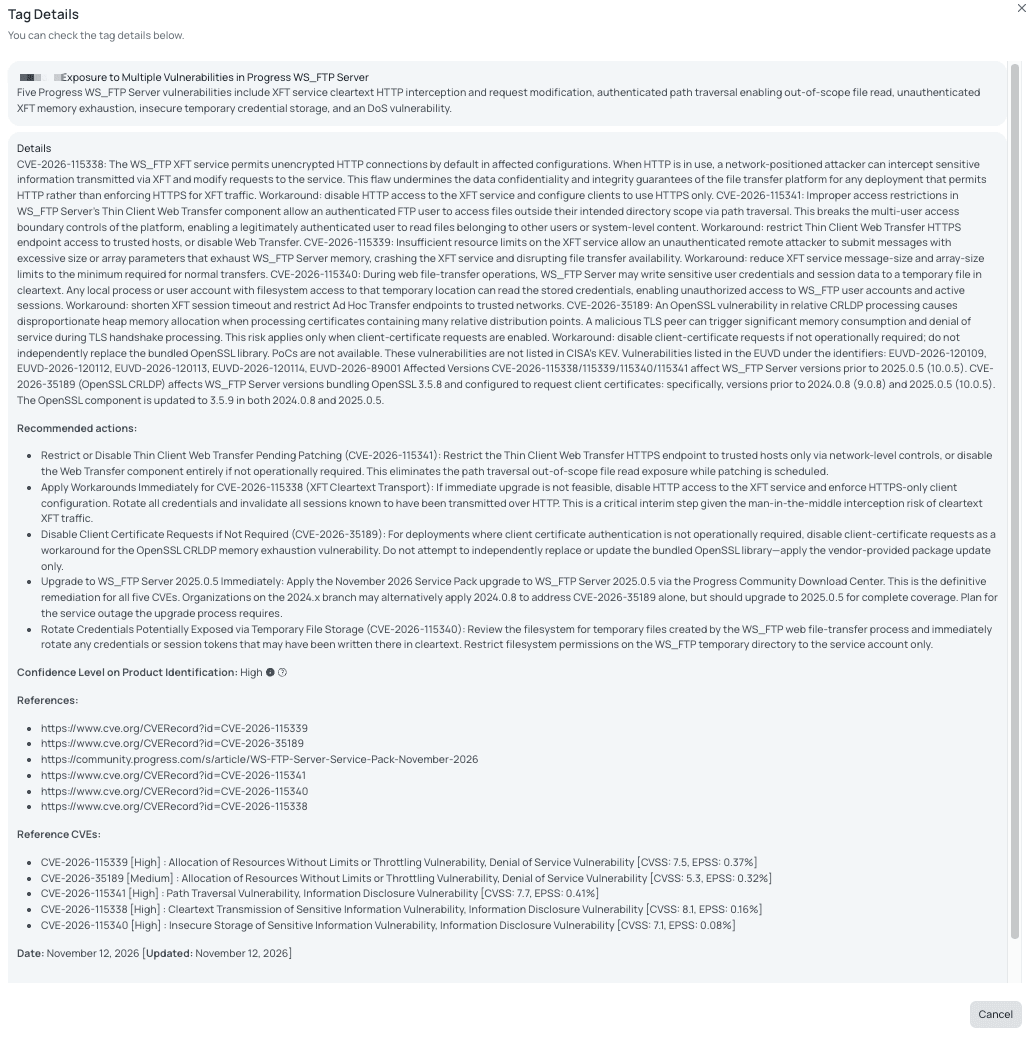
Black Kite's Progress WS_FTP - Nov2026 (Latest) FocusTag® details critical insights on the event for TPRM professionals.
MongoDB - Nov2026
What is this vulnerability?
On November 10, 2026, MongoDB disclosed a cluster of eighteen vulnerabilities in MongoDB Server, CVSS scores ranging from 7.0 to 9.5, spanning the replication, TLS, authorization, aggregation, time-series, and query-execution subsystems. The anchor flaw, CVE-2026-118383 (CVSS 9.5, EPSS 0.71%), is a pre-authentication use-after-free (CWE-416) in the replica set primary catch-up process. An unauthenticated client can send two ping requests carrying a readConcern.afterOpTime value, planting stale 'waiters' that persist indefinitely. If that same member later wins an election while behind on replication, the catch-up cleanup routine runs twice, reuses freed memory, and crashes the new primary; MongoDB states the flaw may also permit arbitrary code execution in the server process under certain conditions, though Datadog Security Labs, which reproduced the crash on version 8.0.34, said it did not achieve code execution in its lab testing. The flaw affects replica set members, including shard and config server members in sharded clusters, across branches 4.4 through 9.0; standalone mongod instances are not affected. A public proof-of-concept is available on GitHub, and researchers note it still triggered the bug on the unaffected-per-advisory 8.2 branch (newest release 8.2.12) using a test-only setting, though 8.2 reached end of life on July 31, 2026, and no longer receives fixes. Fixed releases are 9.0.7, 8.3.16, 8.0.37, 7.0.48, 6.0.30, 5.0.35, and 4.4.32. MongoDB said it discovered the flaw internally and was not aware of exploitation attempts at disclosure; it is not currently listed in CISA's Known Exploited Vulnerabilities (KEV) Catalog.
The remaining seventeen CVEs round out a broad, multi-layered attack surface. CVE-2026-120808 (CVSS 9.1) is an improper certificate validation flaw in the Apple SecureTransport TLS client that silently discards trust evaluation for IPv6-addressed peers, letting a network-positioned attacker present a self-signed certificate and intercept inter-node cluster traffic on macOS deployments. CVE-2026-120815 (CVSS 8.6) is an authorization bypass in MongoDB's localhost exception handling that can grant unauthenticated administrative access, a configuration risk that is heightened in containerized and cloud-native environments where 'localhost' may be reachable from adjacent containers or pods. CVE-2026-120813 (CVSS 8.2) is a client-side field-level encryption schema-parsing defect that silently drops encryption metadata, causing data intended to be encrypted to be stored in plaintext with no warning, which can create long-running compliance exposure. Several additional CVEs (CVE-2026-120822, CVE-2026-120825, CVE-2026-120826, CVE-2026-120806, CVE-2026-120807, CVE-2026-120814) are authorization or privilege-escalation issues in the aggregation framework, view definitions, and replication administrative commands, while the balance are use-after-free, race condition, and resource-exhaustion bugs causing denial of service across the aggregation, time-series, SBE query engine, schema validation, and query plan cache components. This is MongoDB's largest single-day security disclosure in recent history, and it follows a pattern of MongoDB Server previously being targeted for unauthenticated access and ransomware-style data destruction via exposed, misconfigured instances, which underscores the importance of promptly applying this round of fixes.
CVE | CVSS | Vulnerability Name | Short Description |
|---|---|---|---|
CVE-2026-118383 | 9.5 | Pre-Auth Use-After-Free (RCE/DoS) | Unauthenticated replica set primary catch-up flaw enabling crash or possible RCE |
CVE-2026-120808 | 9.1 | TLS Certificate Validation Bypass (MITM) | macOS SecureTransport client ignores trust checks for IPv6 peers, enabling MITM |
CVE-2026-120824 | 8.7 | Use-After-Free (RCE/DoS) | Memory corruption flaw risking server crash or code execution |
CVE-2026-120828 | 8.7 | Uncontrolled Resource Consumption (DoS) | Unauthenticated memory exhaustion affecting replica set members |
CVE-2026-120815 | 8.6 | Localhost Exception Authorization Bypass | Incorrect authorization check grants unauthenticated admin privileges |
CVE-2026-120822 | 8.6 | Authorization Bypass (Information Disclosure) | Aggregation framework flaw lets users access unauthorized database data |
CVE-2026-120804 | 8.2 | Kerberos Resource Exhaustion (DoS) | Windows Kerberos credential handle flaw causes resource exhaustion |
CVE-2026-120813 | 8.2 | CSFLE Plaintext Storage Flaw | Schema parsing bug silently stores encrypted-intended data in plaintext |
CVE-2026-120807 | 7.5 | Improper Authentication (Privilege Escalation) | Authentication weakness enabling privilege escalation |
CVE-2026-120814 | 7.5 | Improper Privilege Management (Privilege Escalation) | Replication administrative command flaw enabling privilege escalation |
CVE-2026-120803 | 7.1 | Use-After-Free / Out-of-Bounds Read (DoS) | Memory safety flaw in query processing causing denial of service |
CVE-2026-120810 | 7.1 | Uncontrolled Resource Consumption (DoS) | Resource exhaustion vulnerability affecting server availability |
CVE-2026-120817 | 7.1 | Race Condition (DoS) | Timing flaw in server component leading to denial of service |
CVE-2026-120818 | 7.1 | Use-After-Free (Information Disclosure/DoS) | Memory corruption flaw risking data exposure or crash |
CVE-2026-120821 | 7.1 | Use-After-Free (DoS) | Memory corruption flaw causing server crash |
CVE-2026-120825 | 7.1 | Authorization Bypass (Information Disclosure) | View definition flaw allows unauthorized data access |
CVE-2026-120826 | 7.1 | Authorization Bypass (Information Disclosure) | Collection catalog flaw allows unauthorized data modification |
CVE-2026-120806 | 7.0 | Improper Access Control (Privilege Escalation) | Access control flaw enabling privilege escalation |
Why should TPRM professionals care?
MongoDB Server frequently sits underneath application backends, analytics pipelines, and customer-facing platforms as the primary datastore, so a vendor running an affected, internet-reachable replica set member carries risk that extends well beyond that one server — a crash or compromise of a primary can take down the applications and data flows that depend on it, and the plaintext-storage flaw in field-level encryption (CVE-2026-120813) can silently undermine a vendor's data protection controls without any visible failure. Because several of the eighteen CVEs are authorization bypasses that let a low-privileged or even unauthenticated user read or modify data outside their granted scope, TPRM teams assessing vendors that store regulated or sensitive data in MongoDB should treat this cluster as a potential pathway to both availability loss and unauthorized data access, particularly given that a working proof-of-concept already exists for the most severe flaw.
What questions should TPRM professionals ask vendors?
- Have you upgraded every MongoDB Server replica set member, including shard and config server members in sharded clusters, to the fixed release for your branch (9.0.7, 8.3.16, 8.0.37, 7.0.48, 6.0.30, 5.0.35, or 4.4.32)?
- If any of your MongoDB deployments are still on the 8.2 branch, are you aware that it reached end of life on July 31, 2026, and no longer receives security fixes, and what is your migration timeline?
- Do you restrict network access to MongoDB replica set members to only the systems that require it, given that CVE-2026-118383 can be triggered by unauthenticated requests even with authentication enabled?
- Have you verified whether client-side field-level encryption configurations were affected by the schema-parsing defect in CVE-2026-120813, and if so, have you audited data stored under that configuration for unintended plaintext storage?
Remediation recommendations
- Upgrade every MongoDB Server replica set member, shard member, and config server to the fixed release for its branch: 9.0.7, 8.3.16, 8.0.37, 7.0.48, 6.0.30, 5.0.35, or 4.4.32.
- Verify the running version on every member after upgrading, including members in containers and any members that were offline during the maintenance window.
- Restrict network access to MongoDB deployments to only the specific systems that require connectivity, as an interim mitigation for CVE-2026-118383 until all members are patched.
- Migrate any deployments still running the end-of-life 8.2 branch to a supported, patched branch, since 8.2 no longer receives security fixes.
- Review and harden the localhost exception configuration in containerized or cloud-native deployments to prevent adjacent containers or pods from inheriting unauthenticated administrative access under CVE-2026-120815.
- Audit client-side field-level encryption (CSFLE) schema configurations for the plaintext-storage defect in CVE-2026-120813, and re-encrypt any data found to have been stored unencrypted.
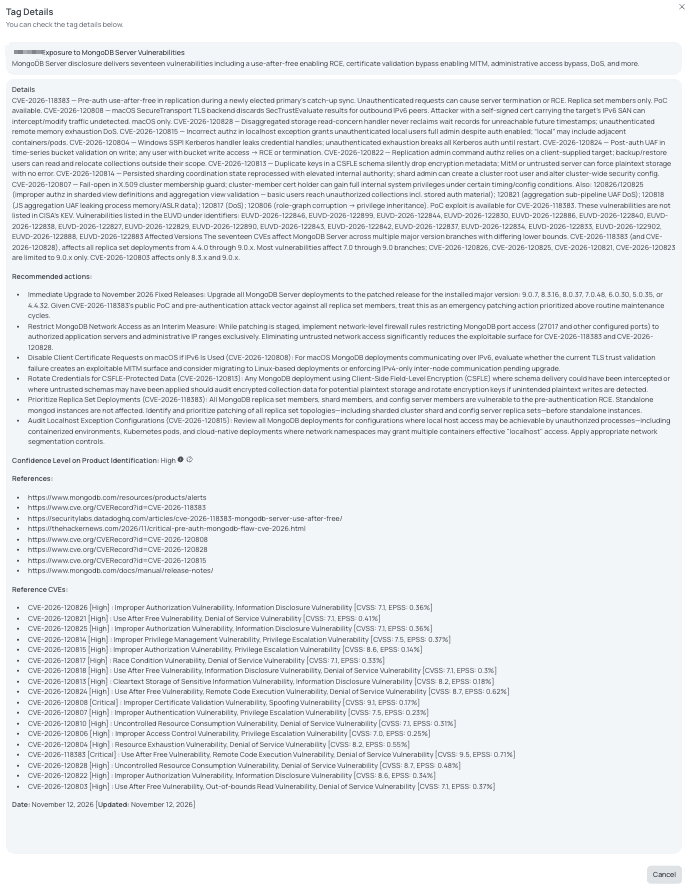
Black Kite's MongoDB - Nov2026 FocusTag® details critical insights on the event for TPRM professionals.
Ivanti EPMM - Nov2026
What is this vulnerability?
Ivanti published its November 2026 security advisories on November 10, 2026, and this FocusTag covers three vulnerabilities disclosed for Ivanti Endpoint Manager Mobile (EPMM), a platform used to manage and secure enterprise mobile devices. CVSS scores in this cluster range from 5.5 to 7.2. The most severe, CVE-2026-105425 (CVSS 7.2, EPSS 0.02%), is an OS command injection flaw (CWE-78) that lets a remote, authenticated attacker holding administrator privileges execute arbitrary commands on the appliance; a public proof-of-concept exploit script for this flaw is already circulating on GitHub, and the source advisory credits a researcher identified as btaol of Aquila Sec Lab with the report. CVE-2026-105426 (CVSS 6.7, EPSS 0.02%) is an improper input validation flaw (CWE-20) that allows an admin-privileged attacker to set arbitrary Linux kernel parameters as root, which can disable security controls or destabilize the system. CVE-2026-107405 (CVSS 5.5, EPSS 0.02%) is a denial-of-service issue (CWE-749, exposed dangerous function) exploitable by a local authenticated user.
None of the three CVEs is listed in CISA's Known Exploited Vulnerabilities (KEV) Catalog, and Ivanti states it is not aware of any customer exploitation at the time of disclosure. All three require an attacker to already hold admin-level or local authenticated access, which limits — but does not eliminate — their usefulness as a first entry point; they are most dangerous when chained after credential theft or combined with other access vectors. Ivanti EPMM carries a heavy exploitation precedent: CISA's KEV Catalog lists 38 exploited Ivanti flaws overall, with eight added in 2026 alone across EPM, EPMM, Sentry, and Connect Secure, making this product family a recurring and high-value target. Affected versions are EPMM 12.10.0.0 and prior, and 12.9.0.2 and prior; fixes are available in EPMM 12.11.0.0, 12.10.0.1, or 12.9.0.3.
CVE | CVSS | Vulnerability Name | Short Description |
|---|---|---|---|
CVE-2026-105425 | 7.2 | OS Command Injection (RCE) | Admin-privileged remote attacker executes arbitrary commands; public PoC exploit script exists |
CVE-2026-105426 | 6.7 | Privilege Escalation (Improper Input Validation) | Admin-privileged attacker sets arbitrary Linux kernel parameters as root |
CVE-2026-107405 | 5.5 | Denial of Service (Exposed Dangerous Function) | Local authenticated attacker triggers service disruption via exposed function |
Why should TPRM professionals care?
Ivanti EPMM sits at the management layer for a vendor's mobile device fleet, meaning compromise of the appliance can translate into compromise of every managed endpoint it controls — configuration profiles, device policies, and potentially data on enrolled devices. For TPRM professionals, an admin-privileged RCE with a public exploit script available is a meaningful signal even without confirmed in-the-wild use, because Ivanti's product line has a well-documented history of mass exploitation once a working exploit becomes public; EPMM and sibling products account for a large share of CISA's KEV additions in 2026. A vendor running an exposed, outdated EPMM instance also indicates weaker administrative access controls, since these specific flaws depend on an attacker already holding admin or local authenticated access — a condition that points back to credential hygiene and network segmentation practices worth probing directly.
What questions should TPRM professionals ask vendors?
- Have you upgraded all Ivanti EPMM instances to 12.11.0.0, 12.10.0.1, or 12.9.0.3 to remediate CVE-2026-105425, CVE-2026-105426, and CVE-2026-107405?
- Is your EPMM administrative console reachable from the internet, and if so, what controls restrict it to trusted management networks?
- Are multi-factor authentication and least-privilege access enforced for all EPMM administrator accounts given that CVE-2026-105425 and CVE-2026-105426 both require admin-level access to exploit?
- Have you reviewed EPMM logs for unexpected administrative logins, kernel parameter changes, or abnormal service crashes that could indicate attempted exploitation of these flaws?
Remediation recommendations
- Update Ivanti EPMM to version 12.11.0.0, 12.10.0.1, or 12.9.0.3 to remediate all three CVEs in this cluster.
- Restrict access to the EPMM administrative interface to trusted internal networks and remove any unnecessary internet exposure.
- Enforce strong, unique credentials and multi-factor authentication for all EPMM administrator accounts, since these flaws require admin-level or local authenticated access.
- Review existing EPMM admin accounts for unauthorized entries and rotate credentials if any compromise is suspected.
- Monitor EPMM appliances for unexpected administrative logins, unauthorized kernel parameter changes, and abnormal service crashes that could indicate exploitation attempts.
- Treat the public proof-of-concept exploit script for CVE-2026-105425 as a priority driver for accelerated patching even in the absence of confirmed in-the-wild exploitation.
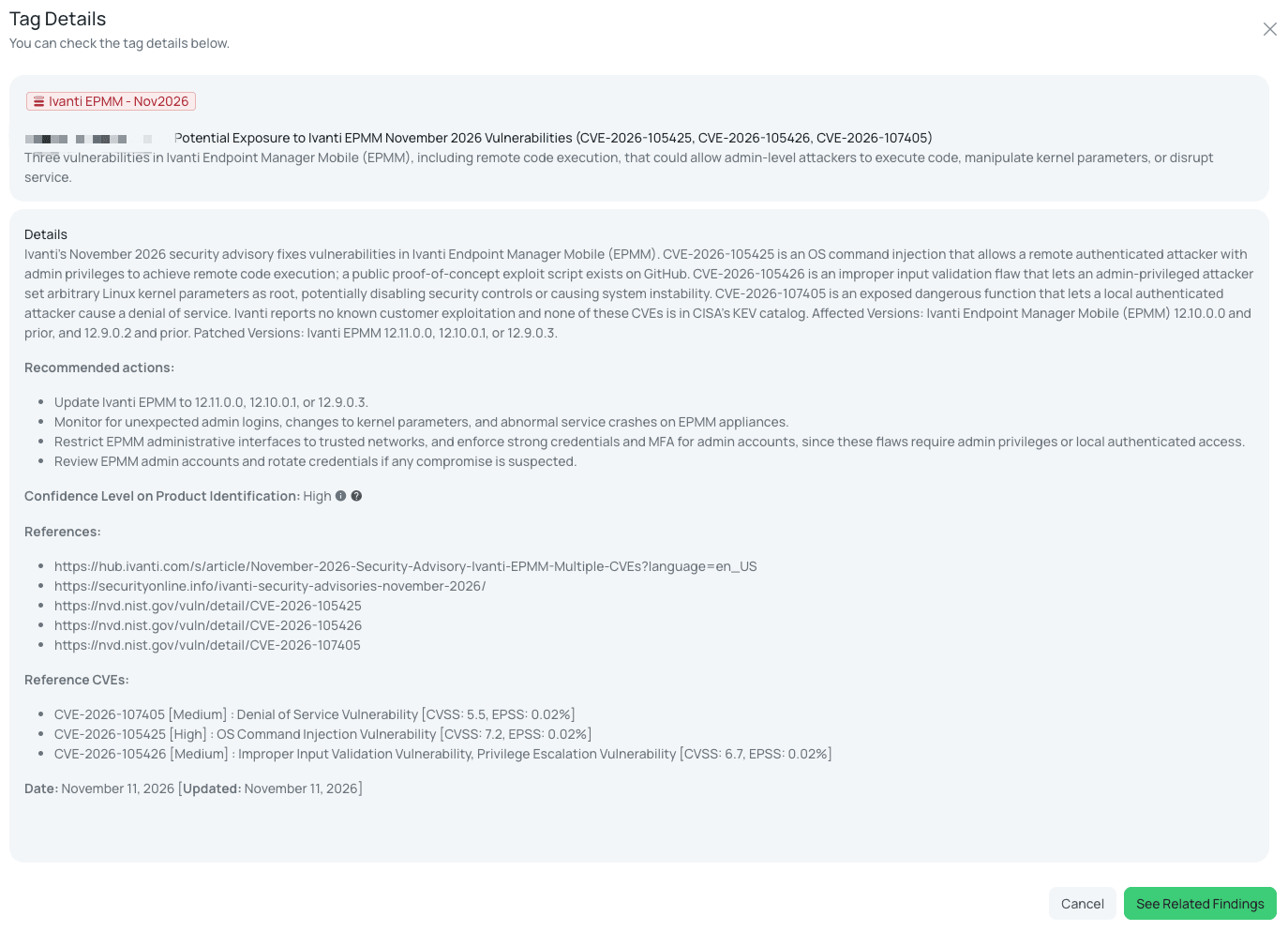
Black Kite's Ivanti EPMM - Nov2026 FocusTag® details critical insights on the event for TPRM professionals.
Fortinet - Nov2026
What is this vulnerability?
Fortinet's November 2026 security advisories address eight critical vulnerabilities across FortiOS, FortiManager, FortiAnalyzer, and FortiSASE. These vulnerabilities have CVSS scores ranging from 9.0 to 9.8 and include unauthenticated remote code execution, SQL injection, authentication bypass, improper authorization, and server-side request forgery.
The most severe, CVE-2026-126170 (CVSS 9.8, EPSS 0.02%), is an output encoding vulnerability in the JSON RPC API of FortiManager and FortiAnalyzer that may allow an unauthenticated remote attacker to execute unauthorized code or commands when the API is enabled. Although the JSON RPC API is disabled by default, exposed and improperly configured instances may be at risk.
CVE-2026-126262 (CVSS 9.3) is an SQL injection vulnerability exploitable through crafted OFTP packets, while CVE-2026-126260 (CVSS 9.0) is a pre-authentication server-side request forgery (SSRF) vulnerability affecting the OFTP service. CVE-2026-126261 (CVSS 9.0) is an improper authorization flaw in the FGFM protocol that could allow an attacker with access to the FGFM port to execute commands. Additionally, CVE-2026-126229 (CVSS 9.1) allows an authenticated administrator to access other Virtual Domains (VDOMs), potentially bypassing intended security boundaries.
Three additional vulnerabilities affect FortiOS network infrastructure components. CVE-2026-126254 (CVSS 9.6) is a numeric truncation error in the BGP daemon that could allow a configured iBGP neighbor to send malformed attributes to connected routers. CVE-2026-126253 (CVSS 9.3) is an OSPF authentication bypass that can be exploited by an adjacent unauthenticated attacker. Finally, CVE-2026-126259 (CVSS 9.0) is a missing authentication vulnerability in High Availability (HA) functionality that may allow an attacker to execute commands with super-admin privileges. This vulnerability specifically affects FGSP configurations using standalone-config-sync or autoscale.
None of these eight CVEs is currently listed in CISA's Known Exploited Vulnerabilities (KEV) Catalog, and Fortinet reports no known exploitation at the time of disclosure. However, six of the eight vulnerabilities do not require authentication, increasing their potential attack surface. Fortinet also has a significant exploitation history, with 32 vulnerabilities from its product portfolio already listed in CISA's KEV Catalog.
Affected products and versions vary by vulnerability and include FortiOS, FortiManager, FortiAnalyzer, FortiManager Cloud, FortiAnalyzer Cloud, FortiAnalyzer-BigData, FortiSASE, and FortiSASE-Sovereign. Exact affected version ranges should be verified against the corresponding FortiGuard advisories.
CVE | CVSS | Vulnerability Name | Short Description |
CVE-2026-126170 | 9.8 | Remote Code Execution (Output Encoding) | Unauthenticated attacker may execute unauthorized commands through the FortiManager/FortiAnalyzer JSON RPC API. |
CVE-2026-126254 | 9.6 | Numeric Truncation Error | Malformed BGP attributes from a configured iBGP neighbor may affect connected routers. |
CVE-2026-126262 | 9.3 | SQL Injection | Attacker may exploit crafted OFTP packets to perform SQL injection. |
CVE-2026-126253 | 9.3 | Authentication Bypass | Adjacent unauthenticated attacker may bypass OSPF authentication. |
CVE-2026-126229 | 9.1 | Authorization Bypass | Authenticated administrator may access other VDOMs, bypassing intended isolation. |
CVE-2026-126261 | 9.0 | Improper Authorization | Attacker with access to the FGFM port may execute unauthorized commands. |
CVE-2026-126260 | 9.0 | Server-Side Request Forgery (SSRF) | Unauthenticated attacker may exploit the OFTP service to perform SSRF attacks. |
CVE-2026-126259 | 9.0 | Missing Authentication | Specific FGSP HA configurations may allow unauthenticated command execution with super-admin privileges. |
Why should TPRM professionals care?
Fortinet products frequently operate at the core of enterprise network security infrastructure. FortiGate firewalls, FortiManager, and FortiAnalyzer provide centralized security management, configuration control, and network visibility. A compromise of these systems could therefore affect multiple firewalls, network segments, and security monitoring capabilities across an organization.
For TPRM professionals, the presence of multiple critical vulnerabilities with unauthenticated attack paths is particularly concerning. Six of the eight vulnerabilities do not require authentication, potentially allowing attackers to target exposed network management and infrastructure services without first obtaining legitimate credentials.
CVE-2026-126170 is especially important because successful exploitation could compromise centralized management infrastructure through the JSON RPC API when enabled. Similarly, the OFTP and FGFM vulnerabilities introduce additional risks to services responsible for communication and management between Fortinet components.
Fortinet's historical exploitation record further increases the significance of this vulnerability cluster. With 32 Fortinet vulnerabilities already included in CISA's KEV Catalog, organizations should not assume that the absence of confirmed exploitation for these newly disclosed CVEs means there is no immediate risk.
Additionally, some fixes were still marked as upcoming at the time of disclosure. This creates a remediation gap for organizations that cannot immediately install the relevant security updates, making temporary mitigations, network restrictions, and configuration reviews particularly important.
What questions should TPRM professionals ask vendors?
1. Have you identified all FortiOS, FortiManager, and FortiAnalyzer instances within your environment and upgraded affected systems to the fixed versions specified in the relevant FortiGuard advisories?
2. Are your FortiManager and FortiAnalyzer management interfaces, OFTP services, and FGFM ports exposed to the internet? If so, what network restrictions and access controls protect these services?
3. Is the FortiManager/FortiAnalyzer JSON RPC API enabled in your environment? If enabled, what security controls restrict access to this interface?
4. Have you reviewed your BGP, OSPF, and Fortinet HA configurations to determine whether they are affected by CVE-2026-126254, CVE-2026-126253, and CVE-2026-126259?
5. Have you reviewed Fortinet device logs for unexpected administrative activity, unauthorized API requests, suspicious OFTP/FGFM connections, or unusual configuration changes that could indicate exploitation attempts?
Remediation recommendations
- Upgrade affected FortiOS, FortiManager, and FortiAnalyzer instances to the fixed versions specified in the corresponding FortiGuard security advisories. Verify the exact affected and patched version ranges for each CVE.
- Where patches are not yet available, apply Fortinet's recommended temporary mitigations. For the JSON RPC API vulnerability, disable unnecessary API access using set rpc-permit none on applicable administrator profiles and follow the relevant FortiGuard guidance.
- Apply the FortiGuard virtual patch for the HA vulnerability where applicable, particularly for affected FGSP configurations using standalone-config-sync or autoscale.
- Restrict access to OFTP and FGFM ports and avoid exposing these services directly to the internet. Limit FortiManager and FortiAnalyzer management interfaces to trusted administrative networks.
- Review BGP and OSPF neighbor configurations, validate trusted routing relationships, and enable appropriate routing authentication mechanisms.
- Monitor Fortinet appliances for unexpected administrative logins, suspicious API activity, unauthorized configuration changes, and unusual network connections.
- Prioritize remediation of internet-exposed management infrastructure, especially systems with enabled JSON RPC APIs or accessible OFTP and FGFM services.
- Treat all eight vulnerabilities as high-priority remediation items despite the absence of confirmed exploitation or CISA KEV inclusion at the time of disclosure.

How TPRM Professionals Can Leverage Black Kite for These Vulnerabilities
Black Kite's FocusTag® intelligence allows TPRM professionals to move from a published vulnerability to a specific list of exposed vendors and assets without waiting for self-reported disclosures, and the following summarizes how each of this week's FocusTags identifies that exposure.
For Able2Shell, Black Kite tracks confirmed exploitation and public PoC availability across the seven assigned CVEs affecting N-central, surfacing vendors running vulnerable on-premises builds so that upgrade status to Hotfix 2 (build 2026.4.1.26) can be verified.
For FreeSWITCH, Shodan-based detection identifies internet-exposed hosts whose SIP banner discloses a vulnerable FreeSWITCH-mod_sofia version, pinpointing voice infrastructure that remains unpatched against CVE-2026-116779.
For IBM Aspera Faspex, the FocusTag flags vendors operating Faspex 5 instances in the 5.0.0 through 5.0.19 range, correlating exposure with the confirmed active exploitation and KEV listing of CVE-2026-123218.
For SonicWall SSLVPN, Shodan dorks identify exposed SonicWall firewalls whose device banner discloses model and firmware version, matching against the affected Gen7 and Gen8 build ranges for CVE-2026-19868.
For SharePoint, detection relies on the MicrosoftSharePointTeamServices HTTP response header to confirm exposed Subscription Edition instances, flagging vendors for verification of the fourth build segment that determines patch status.
For Exchange Server, Black Kite surfaces vendors running on-premises Exchange builds that predate KB5133453, directing attention to the nine-CVE cluster and its authenticated RCE risk.
For MSSQL, version-based detection through the SQL Server Browser Service (UDP 1434) enumerates instance builds across the 2017, 2019, 2022, and 2025 branches that fall below the November 2026 fix level.
For Apache HTTP Server, Shodan detection reads the Apache version from the Server response banner, enumerating versions in the 2.4.55 through 2.4.70 range affected by CVE-2026-119618.
For Progress WS_FTP, the FocusTag identifies vendors operating WS_FTP Server instances below version 2025.0.5, covering the five vulnerabilities addressed in the November 2026 Service Pack.
For MongoDB, the FocusTag flags vendors running MongoDB Server replica set members across the affected 4.4 through 9.0 branches, highlighting exposure to the pre-authentication use-after-free in CVE-2026-118383.
For Ivanti EPMM, version-based detection through Shodan's product fingerprint and the X-MobileIron-Version header enumerates exposed EPMM instances at or below the affected version lines.
For Fortinet, the FocusTag highlights vendors potentially affected by eight critical vulnerabilities across FortiOS, FortiManager, and FortiAnalyzer, including unauthenticated remote code execution, SQL injection, authentication bypass, and authorization flaws.
Once exposed vendors are identified through these FocusTags, The Bridge™ allows TPRM teams to send tailored questionnaires to every vendor in a given FocusTag® population simultaneously, accelerating the collection of patch status, compensating controls, and remediation timelines across the full set of affected relationships.
Strengthening TPRM Outcomes with Black Kite's FocusTags®
The following points summarize how each FocusTag® strengthens TPRM outcomes for this week's vulnerability cluster.
- Mass Zero-Day Exposure Tracking: The Able2Shell FocusTag identifies vendors running N-central builds predating Hotfix 2, enabling TPRM teams to confirm whether confirmed-exploited CVEs have been remediated across on-premises deployments.
- Default-Configuration Risk Flagging: The FreeSWITCH FocusTag surfaces internet-exposed VoIP infrastructure vulnerable to a KEV-listed, unauthenticated RCE reachable through default chat-handling configurations.
- Active Exploitation Prioritization: The IBM Aspera Faspex FocusTag flags vendors operating affected Faspex 5 versions, aligning outreach priority with confirmed active exploitation and KEV Catalog status.
- Authentication Bypass Visibility: The SonicWall SSLVPN FocusTag identifies exposed Gen7 and Gen8 firewalls whose firmware falls within the range vulnerable to SAML and MFA bypass.
- Large-Scale Patch Tuesday Coverage: The SharePoint FocusTag pinpoints exposed Subscription Edition instances for follow-up on the 27-vulnerability November cluster, including the CVSS 9.9 elevation-of-privilege flaw.
- On-Premises Messaging Infrastructure Tracking: The Exchange Server FocusTag identifies unpatched on-premises deployments exposed to the nine-CVE cluster, including the Exploitation More Likely RCE flaw.
- Database Patch Verification at Scale: The MSSQL FocusTag enumerates exposed SQL Server builds across four major release branches, supporting verification of remediation for the 52-vulnerability November cluster.
- Web Server Version Enumeration: The Apache HTTP Server FocusTag flags exposed instances in the affected version range for the critical mod_http2 remote code execution flaw.
- File Transfer Platform Exposure: The Progress WS_FTP FocusTag identifies vendors running versions below 2025.0.5, supporting outreach on the latest five-vulnerability Service Pack.
- Replication and Authorization Risk Mapping: The MongoDB FocusTag flags vendors operating affected replica set branches, prioritizing attention on the pre-authentication use-after-free vulnerability.
- Mobile Device Management Exposure: The Ivanti EPMM FocusTag identifies exposed EPMM instances at or below affected version lines, supporting verification of patch status for the admin-privileged command injection flaw.
- Coordinated Vendor Outreach: The Bridge™ enables TPRM teams to dispatch tailored questionnaires to every vendor identified under a given FocusTag® population at once, consolidating remediation tracking across all 11 events.
FocusTags® in the Last 30 Days
- Able2Shell: CVE-2026-125881, CVE-2026-125883, and 5 additional CVEs — Unauthenticated XXE-to-RCE and Rogue Admin Creation in N-able N-central
- FreeSWITCH - Nov2026: CVE-2026-116779 — Unauthenticated Remote Code Execution in FreeSWITCH SIP Telephony Platform
- IBM Aspera Faspex: CVE-2026-123218 — Actively Exploited Authorization Bypass and Privilege Escalation in IBM Aspera Faspex
- SonicWall SSLVPN - Nov2026: CVE-2026-19868 — Exploited SAML-Enforced MFA Bypass in SonicWall SonicOS SSLVPN
- SharePoint - Nov2026: CVE-2026-120002, CVE-2026-109454, and 25 additional CVEs — Critical Authorization Bypass and Multiple RCE Flaws in Microsoft SharePoint Server
- Exchange Server - Nov2026: CVE-2026-118149, CVE-2026-118150, and 7 additional CVEs — Authenticated Remote Code Execution and Privilege Escalation Flaws in Microsoft Exchange Server
- MSSQL - Nov2026: CVE-2026-116945, CVE-2026-116930, and 50 additional CVEs — Unauthenticated Remote Code Execution and Privilege Escalation in Microsoft SQL Server
- Apache HTTP Server - Nov2026: CVE-2026-119618 — Critical Unauthenticated Remote Code Execution in Apache HTTP Server's mod_http2
- Progress WS_FTP - Nov2026 (Latest): CVE-2026-115338, CVE-2026-115341, and 3 additional CVEs — Cleartext Transport Interception and Path Traversal in Progress WS_FTP Server
- MongoDB - Nov2026: CVE-2026-118383, CVE-2026-120808, and 16 additional CVEs — Pre-Authentication Use-After-Free Remote Code Execution in MongoDB Server
- Ivanti EPMM - Nov2026: CVE-2026-105425, CVE-2026-105426, and CVE-2026-107405 — Admin-Privileged Remote Code Execution and Privilege Escalation in Ivanti EPMM
- Fortinet - Nov2026 : CVE-2026-126170, CVE-2026-126254, and 6 additional CVEs — Critical Unauthenticated Remote Code Execution, SQL Injection, and Authentication Bypass Vulnerabilities in Fortinet Products
- Progress WS_FTP - Nov2026: CVE-2026-84295, CVE-2026-90868, and 6 additional CVEs — Unauthenticated Administrative Credential Theft and OS Command Injection in Progress WS_FTP Server
- WordPress Core - Nov2026: CVE-2026-119977 — Unauthenticated Race-Condition Remote Code Execution in WordPress Core
- MySQL - Oct2026: CVE-2026-9547, CVE-2026-101781, and 63 additional CVEs — Critical Bundled-curl Flaw and Group Replication Takeover in MySQL Server
- pgAdmin - Nov2026: CVE-2026-116241, CVE-2026-116238, and 13 additional CVEs — Critical OS Command Injection in pgAdmin
- MLflow - Nov2026: CVE-2026-116692, CVE-2026-116690, CVE-2026-116691 — Unauthenticated Remote Code Execution and API Key Disclosure in MLflow
- php2shell: CVE-2026-109618, CVE-2026-109619 — Two Critical Use-After-Free RCEs in PHP Core
- Plex2Shell: CVE-2026-96652, CVE-2026-96654, CVE-2026-96655, CVE-2026-96656 — Four-CVE Unauthenticated RCE Exploit Chain in Plex Media Server
- PAN-OS - Oct2026: CVE-2026-0322 — Code Injection in PAN-OS Management Interface
- Drupal Core: CVE-2026-108097, CVE-2026-108515, CVE-2026-108514 — Critical RCE in Drupal Field UI Module
- GitLab - Oct2026: CVE-2026-110264, CVE-2026-97229, CVE-2026-90970, CVE-2026-16301, CVE-2026-14814, CVE-2026-112212 — Unauthenticated RCE and Cache-Poisoning Vulnerabilities in GitLab CE/EE
- Oracle WebLogic - Oct2026: CVE-2026-91323, CVE-2026-87302, CVE-2026-91502, CVE-2026-101515 — Unauthenticated Full Server Takeover in Oracle WebLogic Server
- BeyondTrust Remote Support - Oct2026: CVE-2026-102764 — Authentication Bypass by Spoofing in BeyondTrust Remote Support
- Fortinet - Oct2026 [Suspected]: CVE-2026-104286, CVE-2026-106173 — Path Traversal and Unauthenticated RCE in FortiMail and FortiSIEM
- Apache Tomcat - Oct2026: CVE-2026-101356, CVE-2026-101296, CVE-2026-34483, CVE-2026-65182 — HTTP/2 Request/Response Mix-up and Authentication Bypass in Apache Tomcat
- Citrix NetScaler - Oct2026: CVE-2026-107406, CVE-2026-88771, CVE-2026-88772, CVE-2026-3055, CVE-2026-4368 — Memory Overflow and Session-Mixup Vulnerabilities in Citrix NetScaler
- ONLYOFFICE Docs: CVE-2021-3199 — Path Traversal to Remote Code Execution in ONLYOFFICE Docs Server
- MSSQL - Oct2026: CVE-2026-94512, CVE-2026-65674, and 20 additional CVEs — Heap Buffer Overflow and Deserialization RCE in Microsoft SQL Server
- Exchange Server - Oct2026 (Latest): CVE-2026-70279, CVE-2026-70571, CVE-2026-77910, CVE-2026-87692, CVE-2026-87695, CVE-2026-87696 — Unauthenticated Stack Buffer Overflow RCE in Microsoft Exchange Server
- SharePoint - Oct2026: CVE-2026-85900, CVE-2026-88155, and 34 additional CVEs — Largest Disclosure Batch on Record, Including Crypto Signature Bypass, in Microsoft SharePoint
- NGINX UI: CVE-2026-107806, CVE-2026-42238 — Unauthenticated and Authenticated RCE in NGINX UI Backup Restore Pipeline
References
https://nvd.nist.gov/vuln/detail/CVE-2026-125881
https://www.cve.org/CVERecord?id=CVE-2026-125881
https://nvd.nist.gov/vuln/detail/CVE-2026-125883
https://www.cve.org/CVERecord?id=CVE-2026-125883
https://nvd.nist.gov/vuln/detail/CVE-2026-125878
https://www.cve.org/CVERecord?id=CVE-2026-125878
https://euvd.enisa.europa.eu/vulnerability/EUVD-2026-122961
https://github.com/Oracle-Security/CVEs/tree/main/0-Days/N-Central%20N-Able
https://x.com/watchtowrcyber/status/2120096657366827381/photo/1
https://status.n-able.com/2026/11/10/n-central-2026-4-hf2-release-notes/
https://www.cve.org/CVERecord?id=CVE-2026-125879
https://www.cve.org/CVERecord?id=CVE-2026-125882
https://www.cve.org/CVERecord?id=CVE-2026-91000
https://www.cve.org/CVERecord?id=CVE-2026-125880
https://nvd.nist.gov/vuln/detail/CVE-2026-116779
https://www.cve.org/CVERecord?id=CVE-2026-116779
https://euvd.enisa.europa.eu/vulnerability/EUVD-2026-117752
https://www.cisa.gov/known-exploited-vulnerabilities-catalog?field_cve=CVE-2026-116779
https://github.com/signalwire/freeswitch/security/advisories/GHSA-mg63-h38w-8p9p
https://securityonline.info/freeswitch-vulnerability-cve-2026-116779-exploited/
https://www.rescana.com/post/freeswitch-cve-2026-116779-sip-message-rce-prepare-now
https://nvd.nist.gov/vuln/detail/CVE-2026-123218
https://www.cve.org/CVERecord?id=CVE-2026-123218
https://euvd.enisa.europa.eu/vulnerability/EUVD-2026-118902
https://www.cisa.gov/known-exploited-vulnerabilities-catalog?field_cve=CVE-2026-123218
https://www.ibm.com/support/pages/node/7295921
https://thehackernews.com/2026/11/cisa-warns-of-active-exploitation-of.html
https://nvd.nist.gov/vuln/detail/CVE-2026-19868
https://www.cve.org/CVERecord?id=CVE-2026-19868
https://euvd.enisa.europa.eu/vulnerability/EUVD-2026-118429
https://www.cisa.gov/known-exploited-vulnerabilities-catalog?field_cve=CVE-2026-19868
https://psirt.global.sonicwall.com/vuln-detail/SNWLID-2026-0014
https://www.cisa.gov/known-exploited-vulnerabilities-catalog
https://www.securityweek.com/sonicwall-patches-exploited-sonicos-bug-that-weakens-vpn-logins/
https://nvd.nist.gov/vuln/detail/CVE-2026-120002
https://www.cve.org/CVERecord?id=CVE-2026-120002
https://nvd.nist.gov/vuln/detail/CVE-2026-109454
https://www.cve.org/CVERecord?id=CVE-2026-109454
https://nvd.nist.gov/vuln/detail/CVE-2026-80095
https://www.cve.org/CVERecord?id=CVE-2026-80095
https://euvd.enisa.europa.eu/vulnerability/EUVD-2026-122611
https://nvd.nist.gov/vuln/detail/CVE-2026-109464
https://nvd.nist.gov/vuln/detail/CVE-2026-109472
https://nvd.nist.gov/vuln/detail/CVE-2026-109499
https://nvd.nist.gov/vuln/detail/CVE-2026-109502
https://nvd.nist.gov/vuln/detail/CVE-2026-110044
https://nvd.nist.gov/vuln/detail/CVE-2026-123391
https://nvd.nist.gov/vuln/detail/CVE-2026-123390
https://nvd.nist.gov/vuln/detail/CVE-2026-88176
https://nvd.nist.gov/vuln/detail/CVE-2026-109466
https://nvd.nist.gov/vuln/detail/CVE-2026-111296
https://nvd.nist.gov/vuln/detail/CVE-2026-111297
https://nvd.nist.gov/vuln/detail/CVE-2026-120000
https://nvd.nist.gov/vuln/detail/CVE-2026-109497
https://nvd.nist.gov/vuln/detail/CVE-2026-109504
https://nvd.nist.gov/vuln/detail/CVE-2026-110045
https://nvd.nist.gov/vuln/detail/CVE-2026-110065
https://nvd.nist.gov/vuln/detail/CVE-2026-111300
https://nvd.nist.gov/vuln/detail/CVE-2026-111303
https://nvd.nist.gov/vuln/detail/CVE-2026-109495
https://nvd.nist.gov/vuln/detail/CVE-2026-109455
https://nvd.nist.gov/vuln/detail/CVE-2026-110057
https://nvd.nist.gov/vuln/detail/CVE-2026-124210
https://nvd.nist.gov/vuln/detail/CVE-2026-112736
https://nvd.nist.gov/vuln/detail/CVE-2026-109456
https://nvd.nist.gov/vuln/detail/CVE-2026-118149
https://www.cve.org/CVERecord?id=CVE-2026-118149
https://nvd.nist.gov/vuln/detail/CVE-2026-118150
https://www.cve.org/CVERecord?id=CVE-2026-118150
https://nvd.nist.gov/vuln/detail/CVE-2026-118154
https://www.cve.org/CVERecord?id=CVE-2026-118154
https://euvd.enisa.europa.eu/vulnerability/EUVD-2026-122240
https://www.cve.org/CVERecord?id=CVE-2026-118207
https://www.cve.org/CVERecord?id=CVE-2026-118151
https://www.cve.org/CVERecord?id=CVE-2026-118152
https://www.cve.org/CVERecord?id=CVE-2026-118153
https://www.cve.org/CVERecord?id=CVE-2026-118157
https://www.cve.org/CVERecord?id=CVE-2026-118208
https://support.microsoft.com/en-us/servicing/exchange/server/update/2026/5133453
https://nvd.nist.gov/vuln/detail/CVE-2026-116945
https://www.cve.org/CVERecord?id=CVE-2026-116945
https://nvd.nist.gov/vuln/detail/CVE-2026-116930
https://www.cve.org/CVERecord?id=CVE-2026-116930
https://nvd.nist.gov/vuln/detail/CVE-2026-116934
https://www.cve.org/CVERecord?id=CVE-2026-116934
https://euvd.enisa.europa.eu/vulnerability/EUVD-2026-122537
https://nvd.nist.gov/vuln/detail/CVE-2026-94511
https://nvd.nist.gov/vuln/detail/CVE-2026-116941
https://nvd.nist.gov/vuln/detail/CVE-2026-116942
https://nvd.nist.gov/vuln/detail/CVE-2026-116946
https://nvd.nist.gov/vuln/detail/CVE-2026-118105
https://nvd.nist.gov/vuln/detail/CVE-2026-118109
https://nvd.nist.gov/vuln/detail/CVE-2026-118110
https://nvd.nist.gov/vuln/detail/CVE-2026-67372
https://nvd.nist.gov/vuln/detail/CVE-2026-118120
https://nvd.nist.gov/vuln/detail/CVE-2026-67375
https://nvd.nist.gov/vuln/detail/CVE-2026-67374
https://nvd.nist.gov/vuln/detail/CVE-2026-67387
https://nvd.nist.gov/vuln/detail/CVE-2026-67632
https://nvd.nist.gov/vuln/detail/CVE-2026-67391
https://nvd.nist.gov/vuln/detail/CVE-2026-67646
https://nvd.nist.gov/vuln/detail/CVE-2026-67637
https://nvd.nist.gov/vuln/detail/CVE-2026-118106
https://nvd.nist.gov/vuln/detail/CVE-2026-66813
https://nvd.nist.gov/vuln/detail/CVE-2026-118112
https://nvd.nist.gov/vuln/detail/CVE-2026-118111
https://nvd.nist.gov/vuln/detail/CVE-2026-118113
https://nvd.nist.gov/vuln/detail/CVE-2026-118118
https://nvd.nist.gov/vuln/detail/CVE-2026-118119
https://nvd.nist.gov/vuln/detail/CVE-2026-118117
https://nvd.nist.gov/vuln/detail/CVE-2026-94513
https://nvd.nist.gov/vuln/detail/CVE-2026-88111
https://nvd.nist.gov/vuln/detail/CVE-2026-116931
https://nvd.nist.gov/vuln/detail/CVE-2026-116929
https://nvd.nist.gov/vuln/detail/CVE-2026-116937
https://nvd.nist.gov/vuln/detail/CVE-2026-116938
https://nvd.nist.gov/vuln/detail/CVE-2026-116943
https://nvd.nist.gov/vuln/detail/CVE-2026-116947
https://nvd.nist.gov/vuln/detail/CVE-2026-118108
https://nvd.nist.gov/vuln/detail/CVE-2026-118115
https://nvd.nist.gov/vuln/detail/CVE-2026-118114
https://nvd.nist.gov/vuln/detail/CVE-2026-84010
https://nvd.nist.gov/vuln/detail/CVE-2026-116933
https://nvd.nist.gov/vuln/detail/CVE-2026-116936
https://nvd.nist.gov/vuln/detail/CVE-2026-116944
https://nvd.nist.gov/vuln/detail/CVE-2026-118116
https://nvd.nist.gov/vuln/detail/CVE-2026-116932
https://nvd.nist.gov/vuln/detail/CVE-2026-116935
https://nvd.nist.gov/vuln/detail/CVE-2026-118103
https://nvd.nist.gov/vuln/detail/CVE-2026-118104
https://nvd.nist.gov/vuln/detail/CVE-2026-67382
https://nvd.nist.gov/vuln/detail/CVE-2026-68783
https://nvd.nist.gov/vuln/detail/CVE-2026-118102
https://nvd.nist.gov/vuln/detail/CVE-2026-116939
https://nvd.nist.gov/vuln/detail/CVE-2026-116940
https://nvd.nist.gov/vuln/detail/CVE-2026-119618
https://www.cve.org/CVERecord?id=CVE-2026-119618
https://euvd.enisa.europa.eu/vulnerability/EUVD-2026-123532
https://httpd.apache.org/security/vulnerabilities_24.html#CVE-2026-119618
https://access.redhat.com/security/cve/cve-2026-119618
https://www.wiz.io/blog/cve-2026-119618-rce-apache-http-server-vulnerability
https://thehackernews.com/2026/11/critical-apache-http2-flaw-could-let.html
https://nvd.nist.gov/vuln/detail/CVE-2026-115338
https://www.cve.org/CVERecord?id=CVE-2026-115338
https://nvd.nist.gov/vuln/detail/CVE-2026-115341
https://www.cve.org/CVERecord?id=CVE-2026-115341
https://nvd.nist.gov/vuln/detail/CVE-2026-115339
https://www.cve.org/CVERecord?id=CVE-2026-115339
https://www.cve.org/CVERecord?id=CVE-2026-115340
https://www.cve.org/CVERecord?id=CVE-2026-35189
https://community.progress.com/s/article/WS-FTP-Server-Service-Pack-November-2026
https://nvd.nist.gov/vuln/detail/CVE-2026-118383
https://www.cve.org/CVERecord?id=CVE-2026-118383
https://nvd.nist.gov/vuln/detail/CVE-2026-120808
https://www.cve.org/CVERecord?id=CVE-2026-120808
https://nvd.nist.gov/vuln/detail/CVE-2026-120824
https://www.cve.org/CVERecord?id=CVE-2026-120824
https://www.cve.org/CVERecord?id=CVE-2026-120828
https://www.cve.org/CVERecord?id=CVE-2026-120815
https://www.mongodb.com/docs/manual/release-notes/
https://www.mongodb.com/resources/products/alerts
https://thehackernews.com/2026/11/critical-pre-auth-mongodb-flaw-cve-2026.html
https://securitylabs.datadoghq.com/articles/cve-2026-118383-mongodb-server-use-after-free/
https://nvd.nist.gov/vuln/detail/CVE-2026-105425
https://www.cve.org/CVERecord?id=CVE-2026-105425
https://nvd.nist.gov/vuln/detail/CVE-2026-105426
https://www.cve.org/CVERecord?id=CVE-2026-105426
https://nvd.nist.gov/vuln/detail/CVE-2026-107405
https://www.cve.org/CVERecord?id=CVE-2026-107405
https://euvd.enisa.europa.eu/vulnerability/EUVD-2026-121265
https://securityonline.info/ivanti-security-advisories-november-2026/
About the author

Ferdi Gül · Vulnerability Research Strategist
Ferdi Gül is Vulnerability Research Strategist at Black Kite, leading development of FocusTag and authoring the weekly Focus Friday vulnerability series for third-party risk teams.
View full bio of Ferdi Gül LinkedIn profile of Ferdi Gül (opens in a new tab)